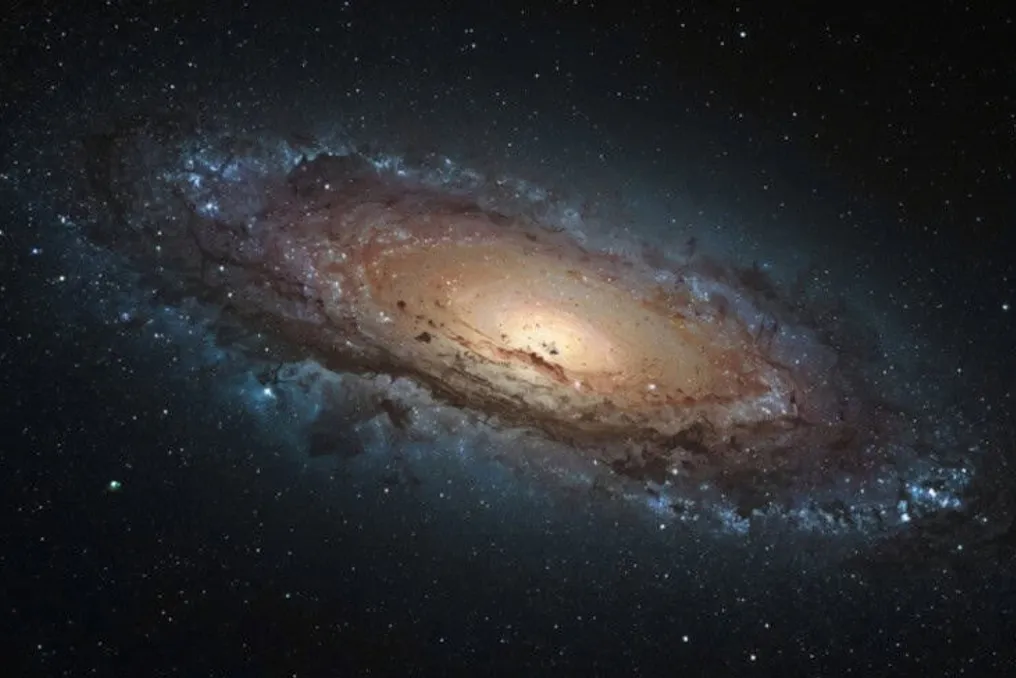
The Milky Way may have undergone a drastic transformation in its orientation due to a significant collision that occurred approximately ten to eleven billion years ago. This hypothesis was recently proposed by astronomers from the University of Durham during the Royal Astronomical Society's National Astronomy Meeting, held in Birmingham.
Analysis of Cosmological Simulations
The conclusion was reached through the analysis of cosmological simulations involving galaxies similar to ours, which were compared with data obtained by the Gaia mission, belonging to the European Space Agency. The main objective of this study is to elucidate why the stellar halo of the Milky Way exhibits a rotation rate considerably slower than predicted by researchers.
Implications of the Ancient Collision
If this interpretation is validated, it will add a new segment to the narrative of galaxy formation and may provide clues about the evolution of dark matter. Furthermore, it suggests that the location of the Solar System within the Milky Way has not maintained a constant orientation over time.
Link Between Slow Rotation and Change in Orientation
To investigate the cause of the slow rotation of the stellar halo, scientists monitored the evolution of twenty-five galaxies with characteristics similar to the Milky Way using supercomputers over billions of years. The goal was to determine which events could result in a configuration similar to what is currently observed.
The comparison showed that galaxies whose stellar halos rotate more slowly possessed two notable characteristics: they had suffered a head-on impact with another galaxy and subsequently experienced an orientation change greater than 90 degrees in their disks, an event termed by astronomers as a 'disc flip.'
Gaia-Sausage-Enceladus and the Milky Way
Kirill Batrakov, the researcher responsible for the study, pointed out that the history of the Milky Way itself points to the possibility of this process having occurred in our galaxy. He stated during the presentation at the Royal Astronomical Society's National Astronomy Meeting: 'We already know that the Milky Way underwent a massive head-on collision with a galaxy known as Gaia-Sausage-Enceladus. Therefore, we believe that the Milky Way's disk probably also changed orientation in the past.'
The researchers recall that Gaia-Sausage-Enceladus, nicknamed the 'Sausage Galaxy,' was a dwarf galaxy incorporated into the Milky Way between ten and eleven billion years ago. This encounter is considered the largest merger event in the early phase of our galaxy, leaving behind billions of stars in extremely elongated orbits.
Understanding Dark Matter and Stellar Trajectories
According to the authors, identifying this ancient disk inversion expands the possibilities for understanding the behavior of the dark matter halo, as the findings indicate a strong correlation between the rotation of this invisible structure and that of the stellar halo.
Batrakov emphasizes that a modification of this magnitude would have altered the path of most stars in the Milky Way. He stated: 'A disk flip means that most stars in the Milky Way have traveled very different paths than those currently observed, possibly even our Sun, which indicates that our seemingly stable position in the galaxy may not have been the case throughout the entire existence of the Solar System.'
The astronomer also emphasizes that reconstructing such remote episodes aids in comparing the evolution of the Milky Way with that of other galaxies. Batrakov concluded during the dissemination of the study: 'Since we live inside the Milky Way, we can study it with a level of detail impossible in any other galaxy. Discovering that its disk changed orientation adds a new chapter to its history and shows that it is possible to reconstruct this complex past from current observations.'