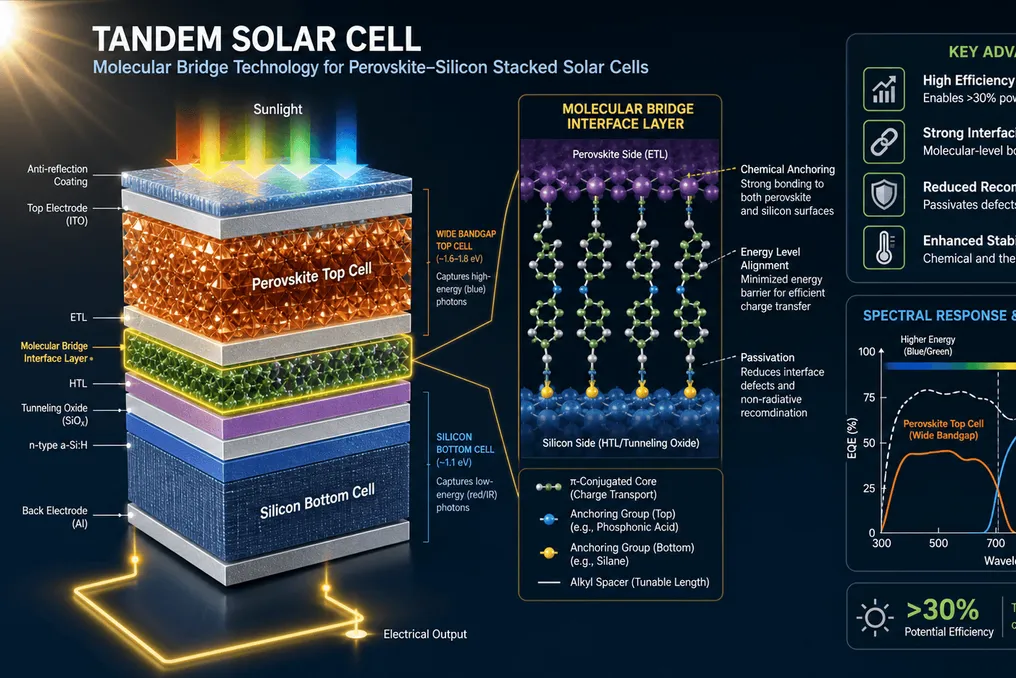
Scientists from China have developed a three-layer solar cell combining perovskite and silicon, which demonstrated a record voltage of 3.15 volts. The main breakthrough was the successful stabilization of the most vulnerable top perovskite layer using an organic salt.
Principle of Tandem Cell Operation
Tandem (two-layer) solar cells provide higher efficiency compared to standard silicon cells due to more effective utilization of sunlight. However, the design is not limited to two layers; it is possible to add a third, fourth, or even fifth photoactive layer. To achieve maximum overall efficiency, the bandgap of the upper layers must be wider, as photons must be distributed among the layers in decreasing order of energy.
Problems with Perovskite Analogues
Unlike three-layer cells based on gallium arsenide and III-V semiconductors, which are already used in space with efficiencies exceeding 40 percent, analogues based on perovskites and silicon face difficulties. The bottom layer is usually silicon with a bandgap of 1.12 electron volts, while the second and third layers are perovskite. The greatest challenge lies in obtaining and maintaining the stability of the third layer, which requires a bandgap of 1.8 electron volts or higher.
Mechanism of Instability
To widen the perovskite bandgap, some iodine ions in the crystal lattice are replaced by bromine. Excessive bromine content triggers phase segregation: ions begin to migrate, leading to the formation of heterogeneous regions with different compositions—where bromine predominates and where iodine predominates.
Solution to Stabilization Problem
Chinese material scientists led by Haijian Tan from Nanjing University managed to create an effective and stable three-layer perovskite cell. The design utilized a textured silicon heterostructure cell as the bottom layer. Above it is a perovskite with a bandgap of 1.52 electron volts, and the top layer is an ultra-wide bandgap perovskite Cs0.25FA0.6MA0.15Pb(I0.43Br0.57)3 with a bandgap of 1.93 electron volts, which was the main source of stability problems.
Role of Organic Additives
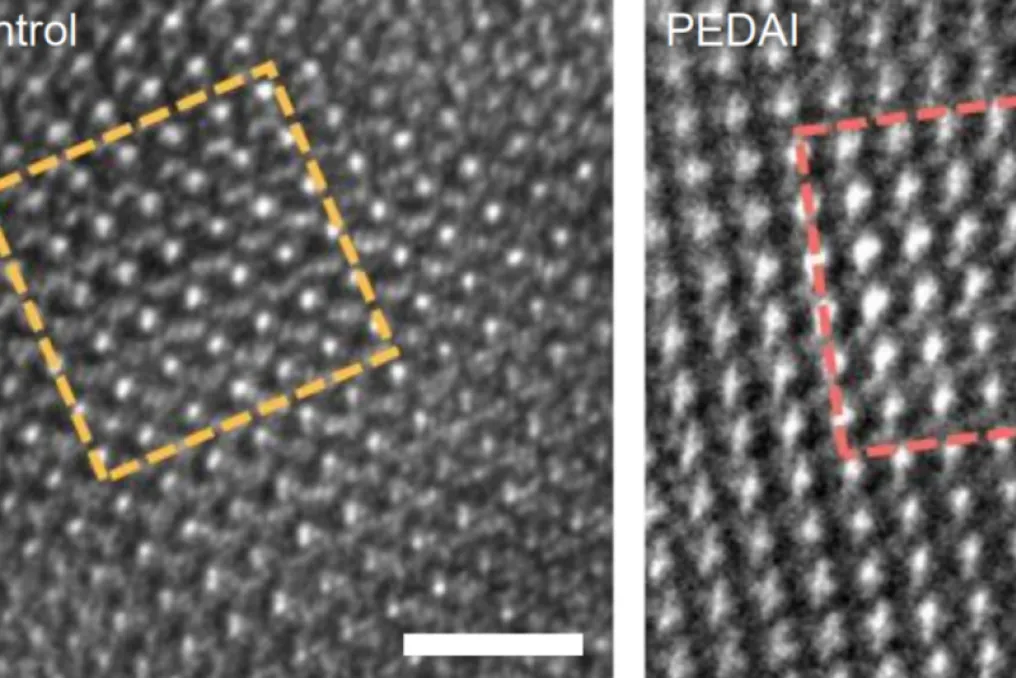
To prevent phase segregation in the perovskite, Tan and his team introduced the organic salt 1,4-phenylenediamine dihydroiodide (PEDAI). This additive forms strong bonds with the crystal structure, increasing the ion migration barrier and promoting greater layer uniformity. Additionally, PEDAI molecules occupy voids and bind with lead ions, reducing the number of defects within the perovskite. The surface of the layer was also treated with another organic salt—3MTPAI, which helped reduce the number of grain boundary defects and improved electron transport.
Results and Prospects
Ultimately, a device with an efficiency of 26.18 percent was obtained, confirmed by independent examination, and a record voltage of 3.15 volts. Although this efficiency is currently lower than that of two-layer tandems reaching 35.5 percent this month, the authors expect rapid growth in efficiency in the coming years. Regarding stability, the devices showed respectable results, retaining 96 percent of initial efficiency after 1500 hours of continuous operation. There is a hypothesis that the salt additives proposed by Tan could also be applied to improve the stability of standard two-layer tandems.