In July 1979, the planet experienced a moment of collective apprehension due to the imminent reentry of Skylab, the first American space station, which weighed 77 tons. For weeks, the media provided daily updates on the possible landing sites of the debris. Despite the panic, no injuries were sustained, but the event became a milestone in the history of space exploration, demonstrating the need for rigorous planning for the safe return of large orbital structures.
Origins and Missions of Skylab
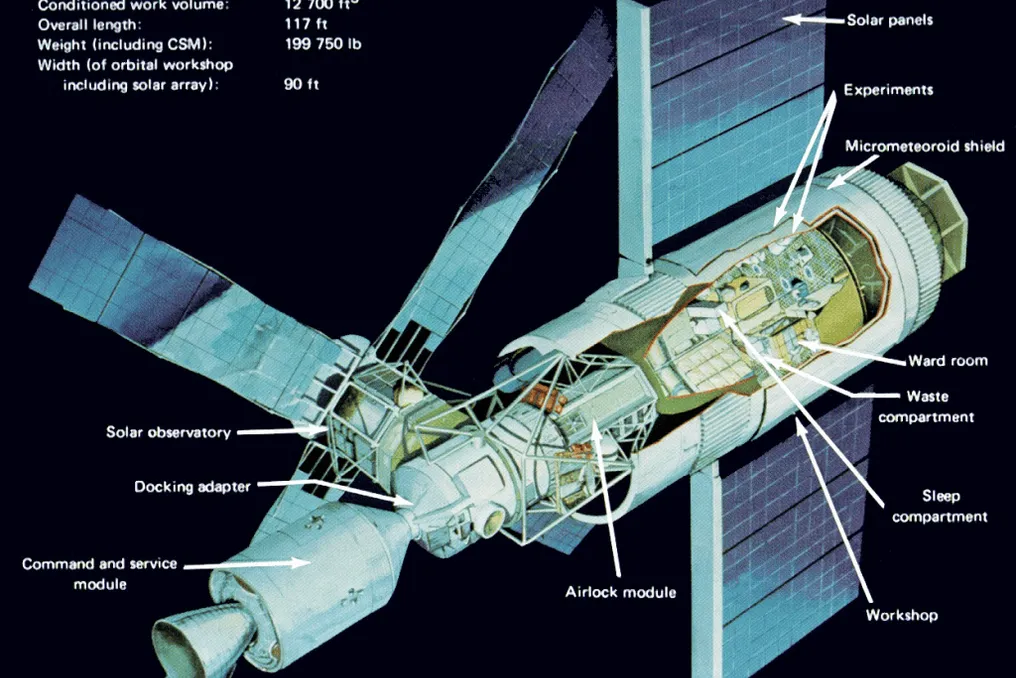
Skylab was developed shortly after the Apollo program. Instead of being built entirely, NASA adapted the third stage of the Saturn V rocket, transforming the large aluminum tube into an orbital laboratory. This launch occurred in May 1973. Initially, the station lost its thermal shield and a solar panel, and another panel became stuck. However, the first crew managed to perform repairs in orbit, allowing Skylab to receive two more manned missions between 1973 and 1974.
Scientific Contributions and Dimensions
These missions resulted in significant scientific advancements. Astronauts conducted studies on the Sun, Earth observations, experiments in space physics and medicine, in addition to setting new records for time spent in orbit. The central module of Skylab, derived from the third stage of the Saturn V, had a diameter of 6.60 meters, offering 270 m³ of internal space, the largest in its category, which was vast enough for activities such as experiments, exercise, personal hygiene, sleep, running in various directions, and flight suit tests, surpassing the size of current International Space Station modules.
The Problem of Atmospheric Drag
A subtle yet crucial factor was the presence of an extremely rarefied atmosphere, although present, at more than four hundred kilometers altitude. This environment exerted minimal but constant drag. Since the station did not have its own engines for orbital adjustments, with each trip around the Earth, it gradually lost speed and altitude. The hope was that the introduction of space shuttles would move Skylab to a higher orbit, but this maneuver did not materialize due to delays in the shuttle program and increased solar activity.
Intensification of the Fall
Periods of high solar activity cause the heating and expansion of the upper layers of the atmosphere, increasing molecular density at Skylab's altitude and intensifying drag, which accelerated its descent. With the certainty that the space shuttle would not be ready in time, reentry became inevitable, and without maneuvering capability, it would be uncontrolled.
Difficulties in Predicting Reentry
Global expectations were immense, but predicting the exact time and location of the fall is complex. Atmospheric density fluctuates constantly according to solar activity and other unpredictable factors. Small variations affect the rate of descent, and traveling at 28 thousand kilometers per hour, an error of a few minutes can shift the impact point by thousands of kilometers.
The Impact of Reentry
Upon penetrating the denser layers, the high speed compresses the air ahead, generating temperatures of thousands of degrees and destroying much of the structure. Simultaneously, aerodynamic resistance causes the spacecraft to disintegrate. Although most of the material vaporizes, denser and more resistant components may survive and reach the ground. It is estimated that about 30 tons of Skylab material survived reentry.
Public Reactions and Final Intervention
Although NASA calculated a 15% risk of debris hitting cities with over 100,000 inhabitants, the event generated media frenzy, with sales of themed products and popular speculation. However, the situation was serious. NASA's last projection indicated the fall between July 10 and 14. On the 11th, ground controllers intervened, altering Skylab's orientation to maximize drag and accelerate entry, aiming for the Indian Ocean. However, it persisted and reached southwestern Australia, near Esperance.
Consequences and Lessons Learned
Dozens of fragments fell over a vast area near Esperance. Fortunately, despite the risk and alarm, there were no casualties. The Museum of Esperance received space artifacts, and NASA was fined for dumping trash in the Australian city. Skylab, initially seen as an American engineering feat, gained notoriety for its end. Its story inspired films, tales, and music. The incident taught crucial lessons: today, satellites and spacecraft perform controlled reentries, usually directed to the Pacific Ocean, far from populated areas. Furthermore, modern vehicles possess propulsion systems for planned deorbit maneuvers and reuse, preventing reentries as dangerous as Skylab's, although the International Space Station also needs to be removed from orbit under strict control.