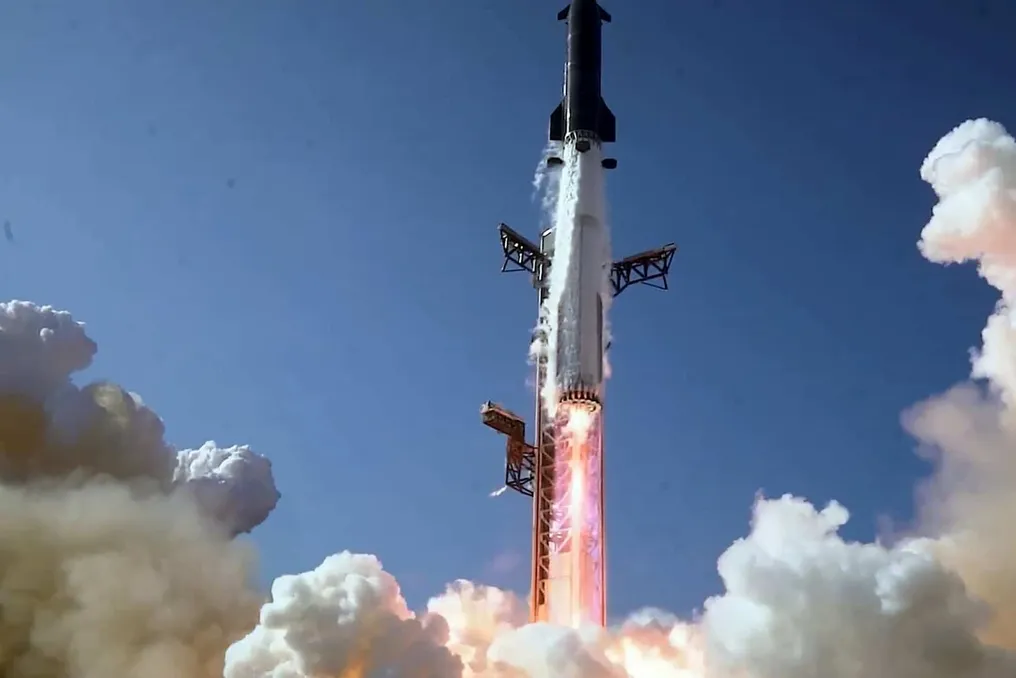
SpaceX is about to launch the Starship mega-rocket, with live coverage available. The scheduled time for the launch start is 7:45 PM Brasília time.
Changes and Objectives of the New Flight
Originally scheduled for Thursday of the previous week (the 16th), the flight was postponed due to a takeoff failure, and has been rescheduled for Monday (the 20th). This new test flight aims to replicate the objectives of the previous mission, which introduced the Starship and Super Heavy vehicles in the V3 version. Furthermore, this time, the mission will include the transportation, for the first time, of next-generation Starlink V3 satellites.
Super Heavy Booster Goals
The primary purpose of the Super Heavy booster is to successfully complete all initial phases of the flight. This includes launch, ascent, stage separation, boostback burn, and landing burn at an offshore landing zone located in the Gulf of Mexico. To ensure this, the company implemented several hardware and software updates to correct issues detected in the previous test.
Technical Corrections Implemented
During Flight 12, stage separation revealed minor discrepancies in the activation of the Starship engines, causing an approximate 90-degree misalignment during the Super Heavy's rotation maneuver. To prevent recurrence, the engine ignition sequence was modified to be more robust against time variations, allowing the rotation to occur in the desired direction with greater safety. This change also aims to improve the overall system performance.
Additionally, in Flight 12, after separation and the rotation maneuver, the Super Heavy initiated the boostback burn, but five of its 33 engines failed during the relight attempt, forcing the premature termination of the maneuver. For this new flight, the booster received hardware modifications focused on increasing the reliability of engine relight, along with updates to alert and abort systems to better reflect the conditions of a flight environment with multiple engines operating simultaneously.
Upper Stage Missions
As for the Starship upper stage, it has three main goals: placing 20 Starlink V3 satellites into suborbital orbit, performing the relight of a single Raptor engine in space, and executing another controlled atmospheric entry, followed by descent and splashdown in the Indian Ocean.
SpaceX has also made several changes to the Starship propulsion system to resolve the engine failure that occurred in the previous flight. About 40 seconds after stage separation in the past mission, the vehicle lost one of its three Raptor engines optimized for vacuum. Even with this failure, the vehicle demonstrated its ability to proceed with the mission with one inoperative engine and reached the planned suborbital trajectory. The company reported that various hardware and operational adaptations were made to address the causes related to this problem, and further improvements in reliability are expected for future versions of the Raptor engine.
Debut of Next-Generation Starlink
For the first time, Starship will carry Starlink V3 satellites, designed to substantially expand the network's capacity and increase the speed offered to users. In this initial test, the spacecraft should release 20 satellites. After separation, these will begin opening their solar panels and antennas, seeking to establish communication with the Starlink constellation through high-capacity lasers.
The satellites will remain in the same suborbital trajectory as Starship and are expected to be destroyed during atmospheric re-entry, approximately 20 minutes after being released.
Thermal Shield Inspection
Six of the satellites were equipped with a camera set capable of inspecting the Starship's thermal shield during the flight and transmitting these images to ground teams. The goal is to continue evaluating methods for analyzing the thermal shield's conditions for future missions where Starship will return to the launch site. As part of this experiment, several panels of the vehicle's thermal coating were painted white to simulate missing parts and serve as targets for the cameras.
New Experiments on Thermal Shield
In addition to satellite inspections, the mission will test a series of enhancements and experiments related to the Starship's thermal shield, continuing the development of a fully reusable vehicle with rapid readiness for new flights. Among the planned tests is the installation of multiple thermal tiles on the metallic surface of the vehicle's rear flaps, as well as the use of modified tiles and new fastening mechanisms in the area of the thermal shield covering the rear tail. The objective is to collect in-flight data on different fastening methods.
Starship will also employ tiles equipped with load sensors to measure the stresses supported by the thermal shield during ascent. In this mission, the vehicle will face dynamic pressure higher than in previous flights, which will intensify the stress on the tile fastenings, in exchange for superior payload capacity to orbit.
Starship Flight History
The flight history includes: Flight 1 in April 2023, where Starship exploded while still attached to Super Heavy, with engine failures activating the self-destruct system. Flight 2, in November 2023, allowed the separation of the vehicle from Super Heavy for the first time, but the booster subsequently exploded, resulting in the loss of Starship before the completion of the flight.
In March 2024, Flight 3 lasted about 50 minutes and represented a significant advance, despite the loss of the vehicle before the planned landing. Flight 4, conducted in June 2024, culminated in a controlled landing of Starship in the Indian Ocean, while Super Heavy landed in the Gulf of Mexico. In October 2024, SpaceX managed to capture Super Heavy on the launch tower for the first time, and Starship also executed a controlled re-entry.
Flight 6, in November 2024, saw the booster perform a controlled landing and the vehicle reignite an engine in space. In January 2025, Starship was lost after an explosion during testing. Flight 8, in March 2025, had its upper stage lose stability about eight minutes after launch and was destroyed. Flight 9, in May 2025, marked the first reuse of a Super Heavy, but failures prevented some planned experiments.
In August 2025, the mission achieved crucial objectives, such as tests with satellite simulators, engine relight in space, and controlled re-entry. Flight 11, in October 2025, successfully concluded the V2 phase of Starship, including the controlled landing of Super Heavy, the vehicle's re-entry, and new operational tests. Finally, Flight 12, in May 2026, was the first test of the Starship V3 version, presenting notable advances, such as the launch of satellite simulators and two modified Starlink satellites. However, the Super Heavy booster suffered a failure during the return attempt because the engines did not reignite properly after separation.