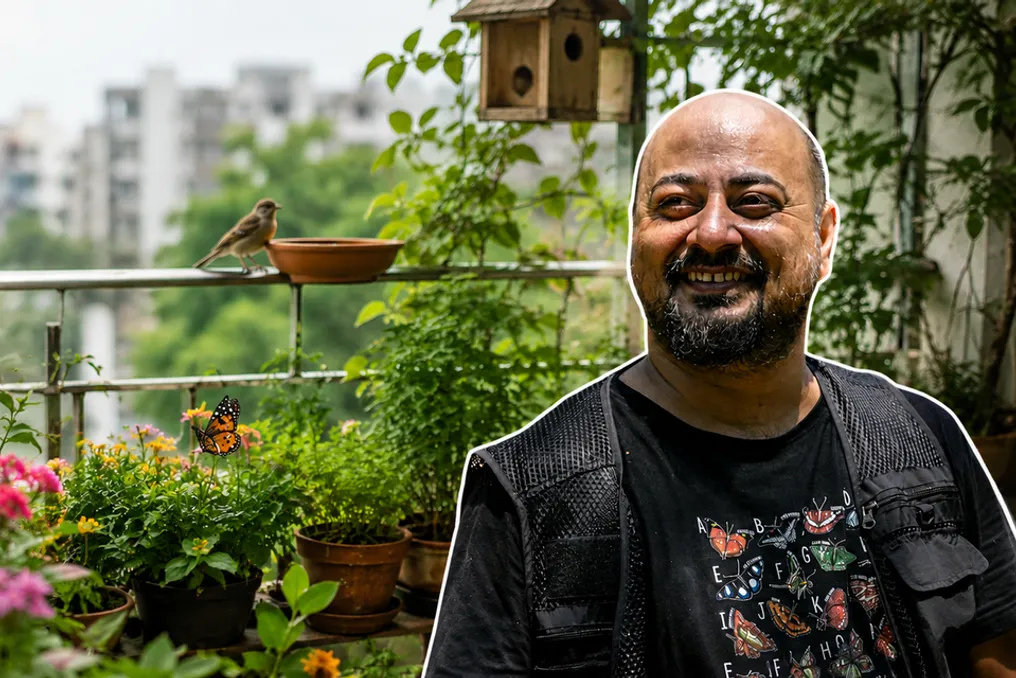
Sohail Madan, an ecologist who has spent over 15 years restoring nature in forests, neighborhoods, and schools, asserts that preserving nature is possible not only in reserves but also on every balcony, terrace, or backyard.
Memories of Lost Nature
Madan recalls his childhood when it was customary to stop at gas stations during car trips to clean the windshield of insects, emphasizing how much has been lost. He notes that modern children probably will never experience such a phenomenon. For 43-year-old Sohail, this memory serves as a reminder of a time when butterflies, moths, bees, and birds were an ordinary part of life.
The Scale of Conservation Issues
The expert, founder and director of the WildTales Foundation, has worked on restoring damaged landscapes and creating butterfly corridors across Delhi. His words come amid scientists' warnings about the silent disappearance of wildlife. According to the State of India's Birds 2023 report, nearly half of the assessed bird species show a long-term decline in numbers, and about 178 species are recognized as needing protection. Globally, there has been a sharp decline in insect populations, mainly caused by habitat loss and excessive use of chemicals.
The Path to Ecology
Born in Africa, where his parents worked as doctors, Sohail spent his early years among wildlife. Even after his family moved to Delhi, weekend walks and visits to nearby forests maintained this interest. However, like many young Indians, he chose a career path in engineering, studying at San Jose State University in California and working in Silicon Valley. Despite the apparent perfection of this career, he felt that life consisting of coding on a computer did not suit him, and he wished to work outdoors.
The Turning Point and Career
The decisive moment came during a visit to a self-sufficient farm in Santa Cruz. Instead of being impressed by technology, he was drawn to simple gardening. He remembers enjoying working around a chicken coop and being close to nature. Observing children exploring the farm, he realized he wanted a life connected to nature, not to building equipment. He soon left the field of engineering. In 2010, Sohail joined the Bombay Natural History Society (BNHS), India's oldest natural history organization, where he worked for 13 years, becoming assistant director. In April 2023, he founded the WildTales Foundation to continue this work.
The Importance of Native Plants
The site of Asola Bhatti, a Delhi wildlife sanctuary, transformed his understanding of conservation. Working there, he realized that restoring nature is not just about planting trees but also about restoring interconnections in nature. When these connections are broken, the entire system weakens. It was found that most nurseries offered ornamental imported species, while local plants that support insects and birds were rare. Therefore, Sohail and his colleagues created a nursery dedicated entirely to native plants, which annually produces about 10 lakh saplings for restoration projects in Delhi.
How Butterflies Disappear
A recurring lesson was that every plant supports life. Butterflies often lay eggs only on specific native plants, and if these plants disappear, the butterflies go with them. Sohail gives the example of the Common Mormon butterfly, whose caterpillars feed on turmeric leaves; if turmeric disappears, the butterfly will not switch to an ornamental plant. Thus, replacing native plants means destroying millennia-old connections.
Nature Versus the Perfect Garden
Sohail criticizes manicured lawns and ornamental gardens, which, although they look beautiful, rarely support life. Lawns require constant watering, mowing, and fertilization but serve only as 'green carpets.' He believes that gardens should resemble nature more closely: planting native trees, shrubs, and grasses, allowing fallen leaves to serve as compost, and abandoning the pursuit of perfect symmetry. Such gardens become alive through the return of butterflies, bees, and birds.
Creating Urban Corridors
Turning to the issue of cities, Sohail initiated the Delhi Butterfly Corridor Project. Since Delhi's forests are surrounded by roads and buildings, hindering pollinator movement, the team decided not to create one huge park. Instead, they encouraged schools, parks, hospitals, and private homes to plant small patches of native plants that together form 'stepping stones' for butterflies to move across the city. One success of the project was achieved at a government high school in RK Puram, where students turned the campus into an outdoor learning space, leading the teacher to receive the Best Teacher award in 2022.
Five Simple Ways to Help Wildlife
Madan emphasizes that helping wildlife does not require a large garden; a balcony or a few pots suffice. Firstly, chemical pesticides should be avoided, as eliminating all insects deprives birds and butterflies of food. Secondly, native plants such as turmeric, lemon, milkweed (Calotropis), and local flowering vines must be grown, as they provide food for insects. Thirdly, plants should be planted not only for butterflies but also for birds, such as native fruit-bearing plants like mulberry and guava. Fourthly, water should be left outside year-round, as it is needed by birds not only for drinking but also for bathing. Finally, the fifth tip is to allow nature to be a little messy, as fallen leaves and wild grasses serve as shelter for insects.
Wildlife is Already Nearby
Despite the belief that wildlife should only exist in forests, Sohail argues against this, pointing out that Delhi is home to over 400 bird species, and Mumbai has about 70 leopards. He concludes that wildlife is already around us, and the question is whether we make room for it. Every action, whether adding a native plant to a balcony or placing a bowl of water, helps create a safe stopover for animals surviving in growing cities.