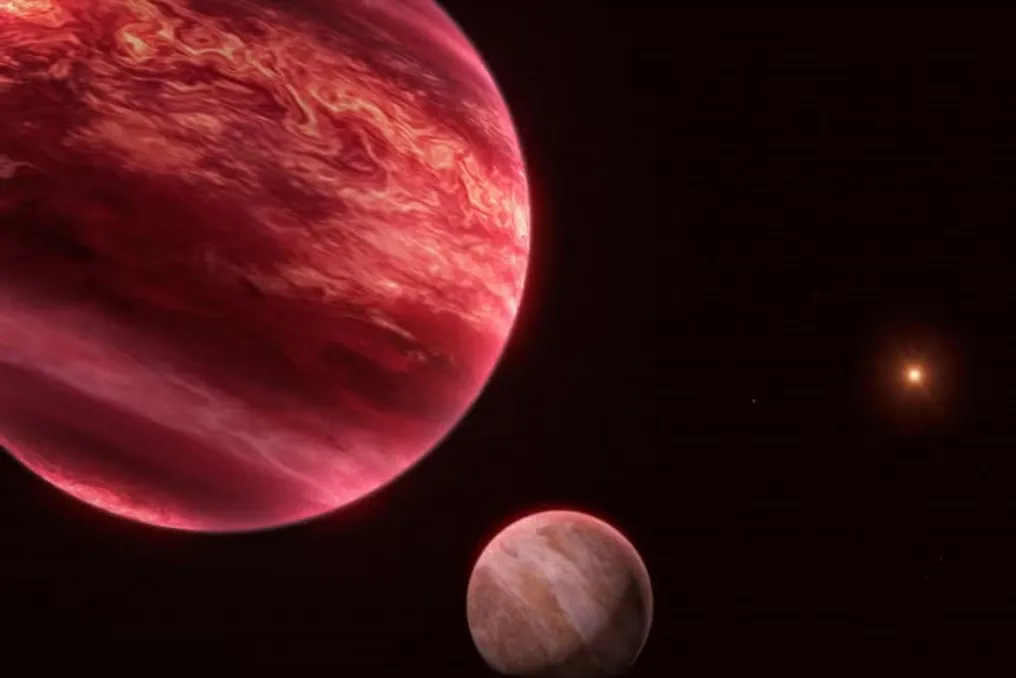
An international group of astronomers has recorded signs of a potential natural satellite outside the Solar System. This object is located in a system consisting of a star, a brown dwarf, and a body whose mass approaches that of Jupiter.
Methodology and Observations
The study showed that the celestial body orbits the brown dwarf CD-35 2722 B, which, in turn, moves around a star with approximately half the mass of the Sun. Observations were conducted from October 2023 to February 2026 using the Very Large Telescope (VLT) located in Chile.
The potential exomoon was not observed directly. Its existence was established by changes in the movement of the brown dwarf caused by the gravitational pull of this object. Researchers determined that the orbital period of this body is about 170 days.
Classification and Challenges of the Discovery
Confirmation of this discovery still requires additional measurements. Despite its similarity to moons, this object possesses significantly greater mass than known Solar System satellites and orbits a brown dwarf, not a planet. Therefore, researchers initially used the term exomoon to describe the body orbiting another object outside the Solar System, without defining its classification as a moon or a planet.
The main difficulty lies in the unusual structure of this system. In our Solar System, moons usually orbit planets, while planets orbit stars. The new configuration includes a moon-like body orbiting a brown dwarf—an object situated between the category of a giant planet and a star.
Comments from the Lead Scientist
Kevin Hoy, the lead author of the study and a graduate student at Universidad Diego Portales in Chile, stated in an interview with g1 that the object is difficult to define because scientists are 'truly expanding the boundaries of the words we have invented to describe the Solar System, trying to apply them to a system that is completely unlike ours.'
According to the researcher, the detection of the signal was an important moment for the team, especially because the predictions made based on preliminary data were confirmed by subsequent observations. Hoy specified that the new recordings demonstrated behavior consistent with the model created by the scientists.
Future Research Steps
The brown dwarf CD-35 2722 B has a mass approximately 37 times that of Jupiter. The associated object has dimensions allowing for comparison with a giant planet, although its position in the system allows it to be considered a moon. The team reached this conclusion by tracking small fluctuations in the displacement of the brown dwarf, which were attributed to the gravitational influence of the body in orbit, thus revealing a recurring pattern over time.
Currently, astronomers plan to collect additional data for a more accurate calculation of the possible satellite's mass and confirmation of its trajectory. One planned strategy is the direct measurement of the displacement caused by the object on the brown dwarf. This discovery may expand the search for similar bodies in distant systems. As astronomical instruments develop, the same methodology can help identify smaller exomoons that are more similar in characteristics to satellites found in the Solar System. Hoy believes that the research may also stimulate a review of the criteria for classifying celestial bodies, as such cases could provoke a broader discussion about the meaning of terms like exomoon and exoplanet.