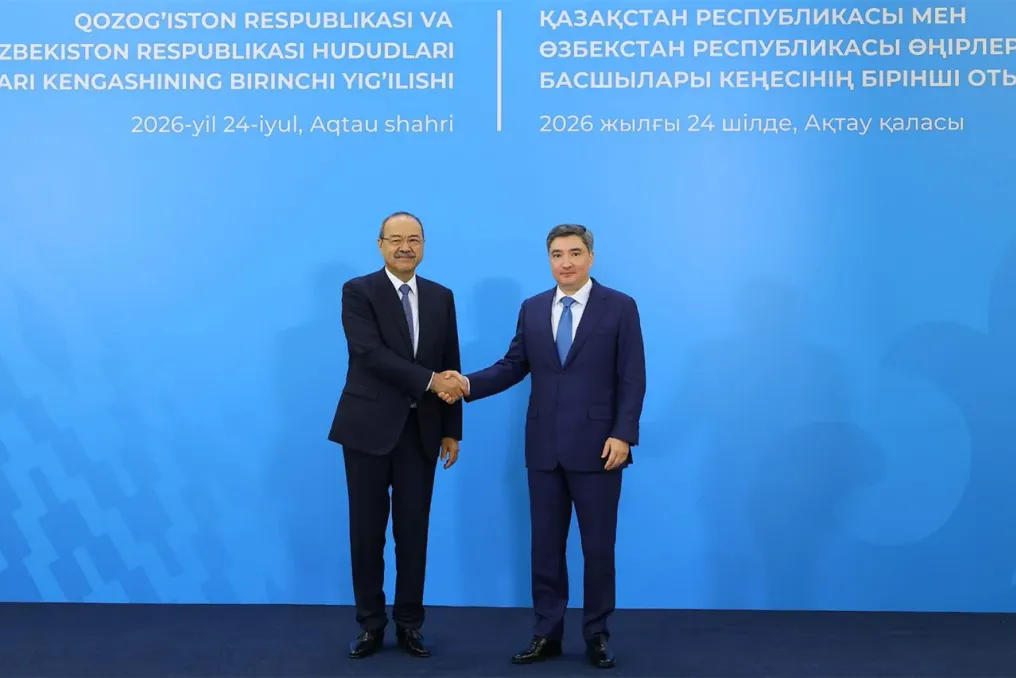
The first meeting of the Council of Regional Leaders of Uzbekistan and Kazakhstan took place in the city of Aktau. The event was attended by the Prime Minister of Uzbekistan, Abdullah Aripov, and the Prime Minister of Kazakhstan, Olzhas Bektenov.
The first meeting of the Council of Regional Leaders of Uzbekistan and Kazakhstan took place in the city of Aktau. The event was attended by the Prime Minister of Uzbekistan, Abdullah Aripov, and the Prime Minister of Kazakhstan, Olzhas Bektenov.
This new mechanism for interregional interaction was established by the decision of the President of Uzbekistan, Shavkat Mirziyoyev, and the President of Kazakhstan, Kassym-Jomart Tokayev, as reported by the press service of the Prime Minister of Kazakhstan. Bektenov noted that the creation of the Council is a natural continuation of the active political dialogue between the heads of the two states and opens up new opportunities for regional partnership.
He emphasized that strengthening direct ties between the regions will help expand trade and investment cooperation, thereby supporting the presidents' goal of increasing bilateral trade to 10 billion US dollars. Aripov called the choice of Aktau for the first meeting symbolic, noting that the city is an important transport and logistics hub. He also stated that Kazakhstan is a reliable strategic partner and ally of Uzbekistan, and the Council of Regional Leaders will give a new impetus to bilateral relations by expanding direct contact between the regions of both countries.
During the meeting, participants noted that the regions of Mangystau, Aktobe, Kyzylorda, and Turkestan of Kazakhstan border the regions of Karakalpakstan, Jizzakh, Navoi, Syrdarya, and Tashkent of Uzbekistan. The total state border stretches for approximately 2300 kilometers. Participants discussed plans to create an International Center for Industrial Cooperation in Central Asia, which should serve as a platform for implementing mutually beneficial joint projects.
Special attention was paid to transport and logistics infrastructure. The parties highlighted the importance of the Trans-Caspian International Transport Route, connected with the North-South route and the Trans-Afghan corridor. In 2025, cargo transshipment through Kazakh ports in Aktau and Kuryk reached 8 million tons. In the first half of 2026, container traffic through Kazakh ports increased by 5%, exceeding 50,000 TEUs.
Participants also noted the potential for tourism development, emphasizing the growing interest of citizens from both countries in the historical and cultural sites of Kazakhstan and Uzbekistan. The regional leaders addressed the plenary session, which was attended by over 300 business representatives. After the meeting concluded, the parties signed memorandums on cooperation between the regions of Kazakhstan and Uzbekistan, as well as commercial agreements worth over 80 billion tenge. The parties stated that the achieved agreements will strengthen cross-border and interregional interaction, contribute to joint projects, and support sustainable economic development in Central Asia.
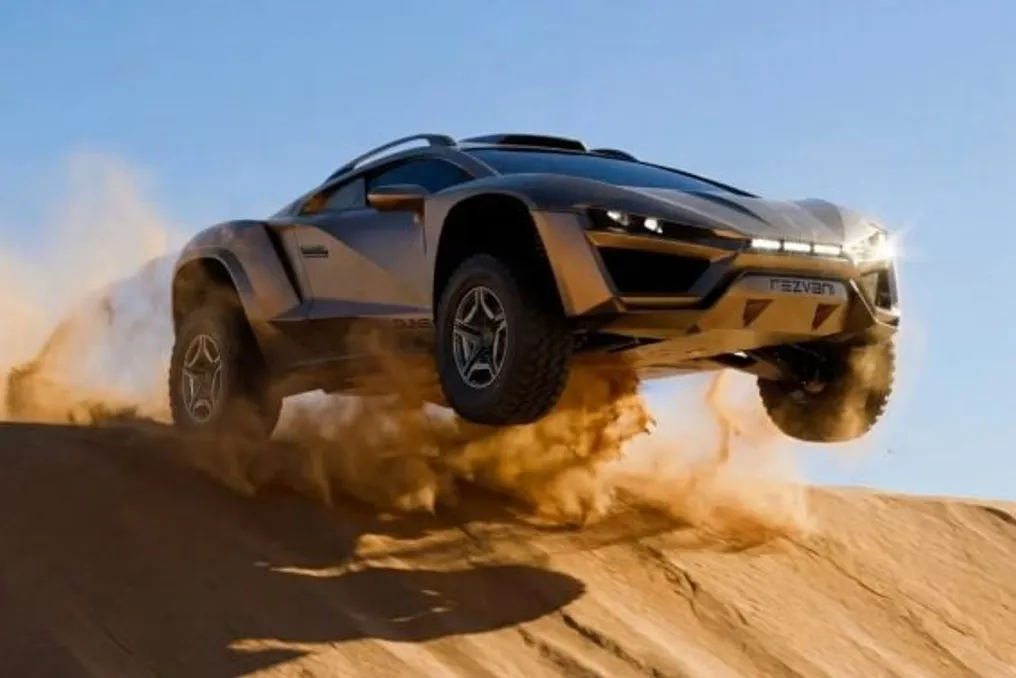
Rezvani, the American manufacturer known for creating armored-aesthetic vehicles, has unveiled the Dune. This all-wheel-drive supercar takes the concept of an 'off-road supercar' to an extreme level.
Based on the Lamborghini Huracán Sterrato, the Dune model has extremely restricted production, limited to only seven units globally. It delivers 811 hp, features a ground clearance of nearly 28 cm, and uses 31-inch tires specifically designed to handle mud.
The launch of the Dune occurs at a strategic time, as the original Huracán has been discontinued, and the Sterrato, its factory version aimed at rough terrain, is also no longer being produced. This absence created demand for a V10-powered supercar ready to leave the asphalt, a gap that the California company seeks to fill with this project.
Unlike the Sterrato, which was a balance between asphalt and light dirt, the Dune focuses entirely on off-road performance. Its body has been extensively rebuilt in carbon fiber and features widened fenders, increasing the total width to 2.23 meters. The vehicle also incorporates functional air intakes on the hood, auxiliary LED headlights installed on the roof and grille, tow hooks, and a snorkel to ensure clean air intake in dusty environments.
The increased height is provided by a custom long-travel suspension, raising the car by 11.4 cm compared to the standard Huracán, or approximately 15 cm when considering the larger tires mounted on 20-inch wheels. The undercarriage is protected by armored plates, and the approach and departure angles reach 25 and 35 degrees, respectively. Furthermore, a terrain management system allows the driver to select specific modes for different surfaces, such as sand, mud, rocks, snow, urban use, and Baja-style driving.
The Huracán's naturally aspirated 5.2L V10 engine has been modified with a positive displacement compressor, developed in collaboration with VF Engineering. This results in a power jump to 811 hp and 108.5 kgfm of torque, representing an increase of about 200 hp compared to the Sterrato's 610 hp. The four-wheel drive distribution is handled by a seven-speed dual-clutch gearbox.
Although the final price has not been disclosed, Rezvani is already accepting reservation orders with a refundable deposit of US$1,500, guaranteeing that each unit will be customized according to the buyer's preferences. As a reference point, the original Huracán Sterrato cost around US$280,000. Due to the deep modifications, there is no guarantee that traditional Lamborghini technical assistance will cover components such as the engine, suspension, or carbon fiber body.
Paramount Skydance has agreed to postpone the finalization of its purchase proposal for Warner Bros. Discovery, extending the potential deadline until June 2027. This delay comes amidst ongoing legal proceedings in the United States, which could result in an increase in the total cost of the transaction.
Last week, a group of US state attorneys general, led by California Attorney General Rob Bonta, filed a lawsuit alleging that the merger could harm competition. In response, the judge overseeing the case issued a temporary restraining order on Monday (20), causing an initial delay in the completion of the union.
Previously, Paramount had repeatedly stated its intention to close the deal by the end of September. Even with the postponement, the company classified this development as a 'significant victory' in a statement released this Friday (24).
In an official note, the company stated that it views the progress of the process favorably, as it allows the case to be evaluated directly based on evidence. Paramount asserted: 'The outcome is exactly what we have sought from the beginning: a direct path to an evidence-based trial. This is the fastest and clearest way to prove that this transaction is good for competition, good for consumers, and good for creators, a conclusion that dozens of competition authorities around the world have already reached.'
Additionally, the company refuted the arguments presented by the plaintiffs, declaring: 'The plaintiffs' market definitions have no relation to the reality of the current market and do not withstand closer scrutiny. We look forward to proving our case at trial.' Following the release of this information, Paramount Skydance shares fell by 3% during afternoon trading on that Friday.
Under the terms established between the companies, Paramount must pay a progressive fee, known as a 'ticking fee,' to Warner Bros. Discovery shareholders if the deal closing extends beyond the September 30th deadline. This payment will add US$ 0.25 (R$ 1.27) per share for each subsequent quarter until the acquisition is completed. This financial mechanism could represent approximately US$ 650 million (R$ 3.3 billion) in quarterly amounts.
Paramount and Warner Bros. Discovery announced the merger agreement in February, after the company led by David Ellison surpassed an offer made by Netflix. The deal, valued at US$ 110 billion (R$ 560.7 billion), would unite two major Hollywood studios, two popular streaming services, and several television networks.
The operation already received the green light from the U.S. Department of Justice's antitrust division in June. More recently, European Union (EU) antitrust regulators also approved the transaction earlier this week. Despite these approvals, attorneys general from various American states argue that the merger could reduce competition in the sector and cause job losses in the film industry.
When filing the lawsuit last week, California Attorney General Rob Bonta warned that the deal could be detrimental to both consumers and industry businesses. He stated: 'The illegal merger of these two entertainment giants would lead to higher prices, lower quality, and less content for cinema and television, harming movie theaters, basic cable distributors, and ultimately, the public in every sofa and cinema seat in the US.'
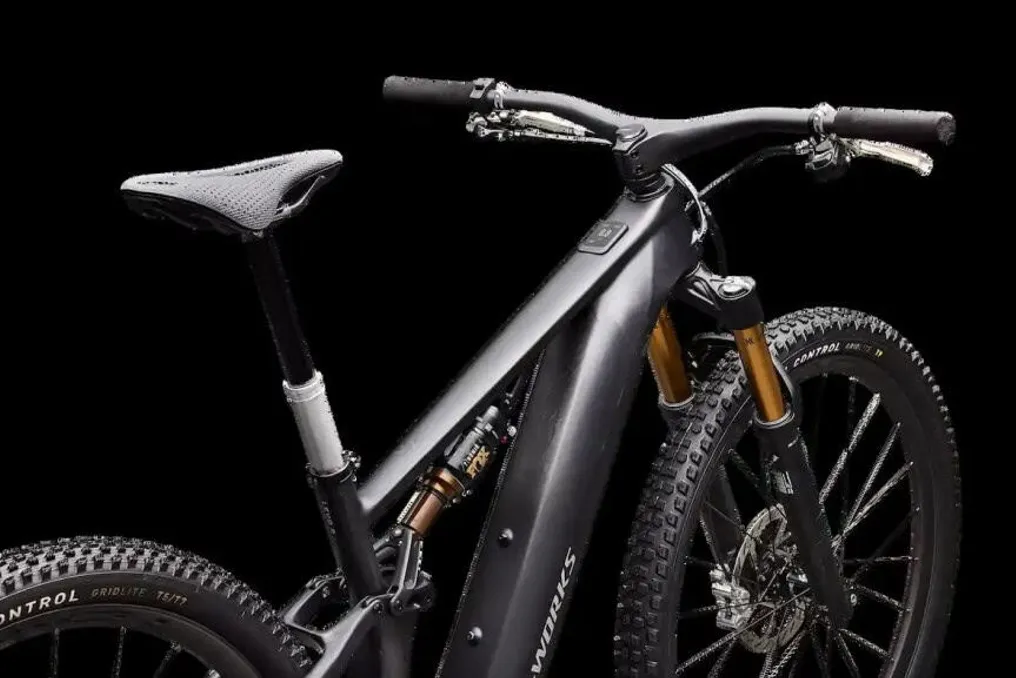
Specialized has introduced the S-Works Turbo Levo R Ultralight LTD, a new premium electric mountain bike, reinforcing its focus on the niche of lightweight e-MTBs. This specific model weighs only 18.8 kg while retaining the manufacturer's latest full-power drive system.
According to Specialized, this bicycle is approximately 2.3 kg lighter compared to other recently launched Levo R models, positioning it as one of the lightest full-power e-MTBs currently available on the market.
Despite the weight reduction, the manufacturer assures that performance has not been sacrificed. The S-Works Turbo Levo R Ultralight LTD is equipped with the new Turbo 3.1 S-Works motor, capable of generating 111 Nm of torque and reaching a maximum power of 850 W. The system is powered by a 600 Wh battery. For riders needing greater range, the company offers an alternative 840 Wh battery or a 280 Wh range extender. Specialized reports that the higher capacity configuration can provide up to 4.4 hours of riding.
The bike was built using a new FACT 11m carbon frame, specifically designed for cross-country trails. It features 140 mm of front suspension travel and 130 mm in the rear. Furthermore, it incorporates adjustable geometry and the GENIE suspension technology, developed internally by the manufacturer itself. According to the company, this system enhances traction and performance when traversing small obstacles without compromising support on steeper descents.
The equipment included on the bike covers an integrated SWAT storage compartment in the downtube, a 2.2-inch MasterMind display compatible with Apple's Find My network, SRAM XX SL Eagle Transmission wireless drivetrain, Roval Control SL carbon wheels, and Trickstuff Direttissima four-piston brakes. Specialized emphasizes that this set of top-tier components increases the model's cost, although the S-Works badge already indicates its direction towards the elite segment.
The manufacturer mentioned having launched several notable electric models recently, considering the S-Works Turbo Levo R Ultralight LTD as one of the best in the line. Another item presented was a 12-amp, 700-watt smart charger. Specialized details that this accessory can charge the optional 840 Wh battery from 0% to 80% in less than an hour. The system also offers different charging modes, including a function that limits the charge to 80% to aid in battery longevity.
In terms of cost, all the embedded technology reflects the high-end segment. Specialized sold the S-Works Turbo Levo R Ultralight LTD for US$ 12,999.99, equivalent to R$ 66.2 thousand. The company developed the model targeting cyclists who want to combine full-power electric assistance with lighter and more agile handling, challenging the idea that performance and maneuverability are mutually exclusive, provided the consumer invests in first-rate components and the prestige of the S-Works brand.