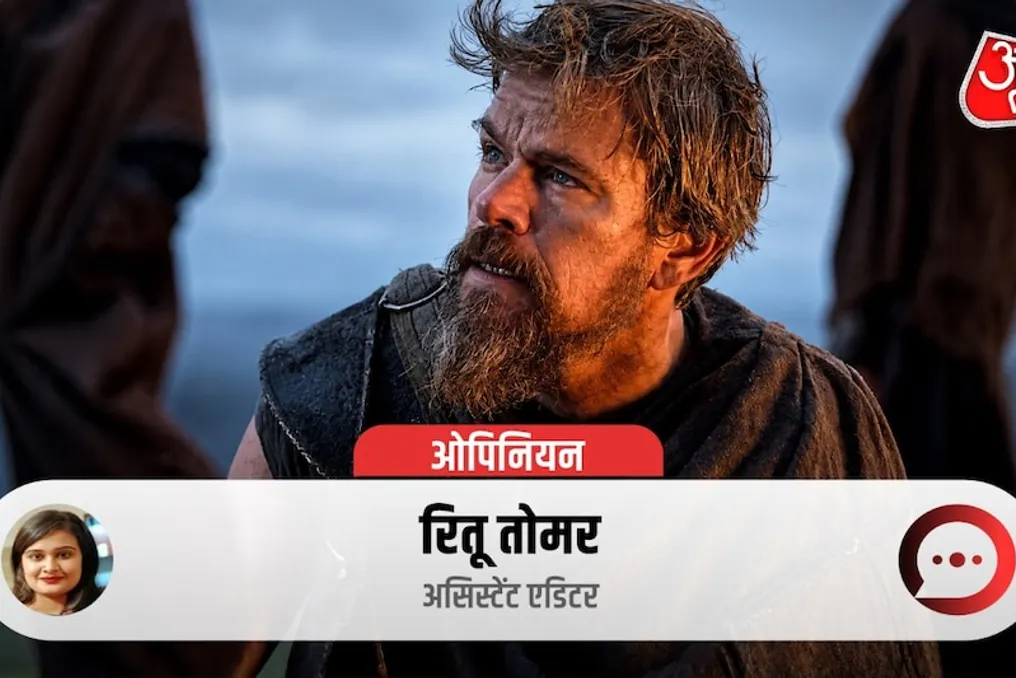
After the war ended and Troy was burned, the warriors returned to their homes. Ten years passed, but Odysseus still had not reached his dwelling on Ithaca, before which stretched the endless sea. His wife Penelope and son Telemachus waited for his return for years. He sails on a ship, striving only to get home.
More Than Just a War Victory
Although Odysseus is a victor of Troy, in Christopher Nolan's film 'Odyssey,' he moves forward carrying the burden of his own decisions and the pain they caused. He is filled with guilt. This is a story about a man trying to return to his inner peace after conquering war.
To view Nolan's 'Odyssey' merely as a grand mythological film would be unfair. Odysseus is a man burdened by the weight of his past. Looking at him only as a hero is incorrect. 'Odyssey' is more a story of a person learning to move on by accepting his mistakes than an epic of heroic triumph.
Questions About the Price of Victory
The plan to use the Trojan Horse, which changed the course of the war, was devised by Odysseus himself. However, Nolan's film questions this act: can a victory achieved in war satisfy a person's conscience? The entire plot of 'Odyssey' seems to search for an answer to this question. Odysseus wanders not so much across the sea as through his own past. Every difficulty he faces is not just an external problem but a reflection of his internal conflict. Every island, every storm, and every monster becomes the face of his hidden fear, greed, or guilt.
A characteristic of Nolan's films is that while they may appear majestic externally, internally they are deeply human and complex. In 'Odyssey,' alongside the vast canvas of the sea, war, and the mythical world, there is the inner struggle of a man living under the weight of his own burden. Odysseus's journey is not just a path home; it is a story of self-discovery, accepting one's limits, and moving forward with a broken heart.
Trials and Symbolism
In this film, no character is merely a backdrop; each symbolizes some battle, so every stop of Odysseus is a test of his character. After the war in Troy, as Odysseus wanders the sea, his ship is destroyed, and he ends up on the island of Ogygia, where Calypso saves him, who begins to love him and wishes for him to stay with her forever. However, Odysseus wants to go home. Here, Calypso and her island can be seen as a symbol of temptation.
Wandering the sea, Odysseus and his companions encounter many monsters and gods who prevent them from returning to Ithaca. Among them is the cyclops Polyphemus, son of the sea god Poseidon. Odysseus escapes with his comrades after gutting him. A sorceress named Circe turns Odysseus's companions into pigs. Odysseus meets his past in the underworld, which actually represents his past sins that he left behind. The monsters Odysseus fights are not in the sea; they live inside man. Sometimes they become pride, sometimes greed, sometimes attachment, sometimes false glory and temptation.
Moral Conflict and Athena
The aspect of repentance deepens Odysseus's character. His wisdom is his strength, but it also becomes his moral weakness. The laws of Zeus are mentioned repeatedly in the film, which everyone observes, but when Odysseus's soldiers destroy the entire city of Troy, they kill the temple priestess. Nolan depicted this scene very effectively on screen. The girl's head is not shown, but the decapitation of the statue of Athena is symbolically shown. Athena, considered the goddess of wisdom in Ancient Greece, is the moment when Odysseus realizes that he has violated the laws of the gods and suffered defeat despite winning the war. Odysseus long justified the war in Troy, but this incident shook him, and he was overcome with guilt.
Nolan portrayed Athena as Odysseus's guide throughout the film. The image of Athena in the film actually corresponds to the image of the girl whose head the soldiers of Odysseus killed. Nolan linked Athena to Odysseus's burden of guilt, which constantly appears before him, making him more human because the hero's victory gains greater meaning when his weakness is known. Odysseus moves forward, acknowledging his mistakes, and perhaps therein lies his true heroism.
Rethinking Heroism
Ultimately, 'Odyssey' is remembered for overturning the traditional definition of heroism. It tells us that a true hero is not one who wins every battle, but one who remains human despite defeats, mistakes, and feelings of guilt. Odysseus's greatest victory was not in war, but in the ability to learn from past mistakes. This is why he seems more real than an ideal. The main impact of Nolan's 'Odyssey' is that it shows an old story in a new light, lowering the hero from a divine pedestal to the level of a human whose conflict we all understand.