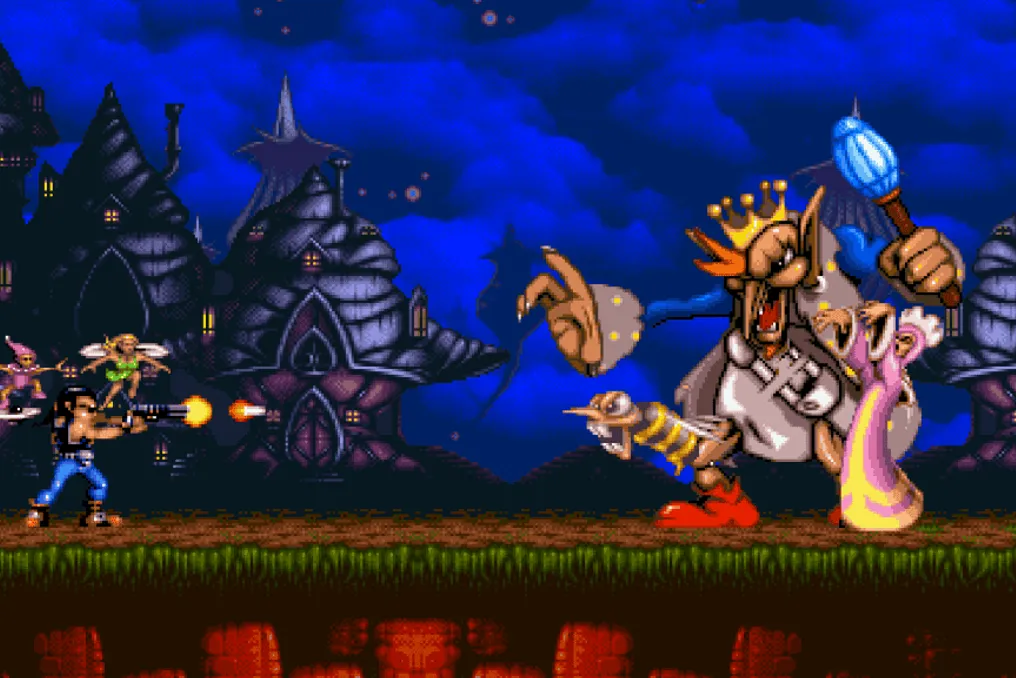
Biomechanical Toy is a game primarily known through YouTube videos or studies of old arcade machines. It was released in 1995 by Gaelco, developed by Zeus Software. This run-and-gun platformer resembles Metal Slug and Contra, and even promotional materials call it the 'forgotten cousin of Metal Slug' because it was released a year before SNK's classic, possessing similar expressive pixel art but never becoming a global phenomenon.
Similar stories
Popular
Pros and Cons
Among the game's strengths is the mechanic of rescuing allies (small dragons, geniuses) that help clear the screen. The level design is also noted for its thoughtful structure with clear phase divisions and exploration rewards (secret areas, hidden items). Customizable cheats are provided to increase accessibility, along with four difficulty levels and the option to set additional lives (up to three).
The graphical options are diverse (pixel perfect, CRT, Suave, Varredura), and the inclusion of rewind functions, save states, and a historical vault featuring a jackpot box and concept art makes the game a good value for money.
Gameplay Drawbacks
However, the game can prove difficult even on the easy level, which might disappoint players who prefer a more relaxed pace. Visual clutter, caused by the large number of elements on screen simultaneously, hinders threat recognition. Furthermore, the strict timer for each phase increases pressure on ammunition management, which can tire out fans of a freer rhythm.
Current Release and Features
Previously, information about an arcade cabinet presence in Brazilian gaming halls was absent, and the game was mainly known through emulation. This situation changed in July 2026 when QUByte Interactive, in partnership with Bleem!, released the game simultaneously on PC (Steam and Epic Games Store), Xbox One, Xbox Series X/S, PlayStation 4, PlayStation 5, and Nintendo Switch, officially launching on July 16, 2026. The reviewer tested the Nintendo Switch version, but the following details apply to all platforms. The release price is $9.99 USD (R$29.99 in Brazil).
QUByte positions itself as the largest independent publisher in Latin America specializing in retro gaming, utilizing its proprietary emulation technology, the 'QUByte Emulation Engine'. The protagonist, Inguz, is a direct homage to action cinema; his appearance (ponytail, dark vest, jeans, and sunglasses) is clearly inspired by Steven Seagal from films such as 'Mr. Nice Guy' and 'Hard to Fall'. The original game was programmed by Ricardo Puerto, and the art was done by Raul Lopez—the same pair who created Risky Woods (1992), which also received a remaster from QUByte.
Gameplay Mechanics
The main premise is that the villain Scrabby escapes and steals the Magic Pendulum, an artifact that gives life to the entire toy kingdom. RELIK, an animated cuckoo clock, the official guardian of the artifact, calls upon Inguz to restore peace. The plot serves merely as a backdrop, not requiring deep immersion, but rather functioning as a catalyst to get the player into action.
The gameplay is the main product. During intense moments, there are many elements on screen, which can cause visual overload. Adding to the intensity is the mechanic of freeing imprisoned toys—small dragons and magical genies—from cages, which fight alongside the player for a period, helping to 'clear the screen' during chaotic moments.
Level design also rewards exploration: mushroom-shaped springs lead to vertical secret zones, and shooting at boxes containing toy faces, flying hats, or yellow emojis releases hidden items for score and life collection. A distinctive feature of the game is the reloading system: ammunition is not infinite, and the player must collect bullets on the map. This fundamentally changes the approach, as wasting a shot is quickly punished, especially with a large number of enemies on screen.
The platformer structure supports this. In some areas, one can avoid direct confrontation by climbing onto a platform and dodging the enemy onslaught. This is viewed as a resource management strategy, not cowardice. It is important to note that limiting primary weapon ammunition in the run-and-gun genre is rare, unlike in Contra where weapons are infinite, or Metal Slug where only heavy weaponry is limited. Biomechanical Toy follows a rarer path, constantly treating primary weapon ammunition as a finite resource, which strongly emphasizes resource management for the player.
To help conserve ammo, and what doesn't always require firing, jumping on enemies also results in their destruction. Therefore, before spending ammunition, one must determine which enemies accept this form of elimination. This relates to another important lesson: patience and evasion strategy are valued over pure reflexes. Understanding the pattern of each enemy—what it does when attacking, how it moves—is practically essential for progressing without unnecessary resource expenditure.
Difficulty and Time Management
The game offers four difficulty levels: easy, normal, hard, and very hard. It should be emphasized that even on the easiest level, the game does not make things easy. Additional settings allow choosing the number of extra lives (up to 3), enabling the player to tailor the challenge from 'simple recall without suffering' to 'feeling the true spirit of the 90s arcade'.
Another source of pressure is the strict countdown timer on each phase and the character's health bar, consisting of 80 points. Damage from enemies and obstacles reduces this bar, while food restores points. Life is lost when the bar reaches zero, falls off the screen, or the phase time expires. Icons along the route act as checkpoints; without them, every mistake sends the player back to the beginning of the entire phase. This adds an extra layer of pressure on top of ammunition management, once again highlighting that patience and enemy analysis are more important than sheer speed.
Six Phases and Bosses
The game is divided into six stylized worlds, each with its own visual identity and unique enemies, culminating in a phase boss. Crazy West is a western setting featuring mechanical cowboys and aggressive biomechanical cacti; the boss is the Sorceress Queen, a floating entity that teleports and summons reinforcements.
Chess Valley is a chess world where giant pieces come alive to crush the player; the boss is the Flying King on a high-tech flying throne, firing bombs. Train to Hell is a wild chase on an uncontrollable train; the boss is the Virus, a mutated computer glitch in mechanical form.
Wood of Clocks is a foggy, mystical forest with living clock trees; the boss is the Alien, a giant floating skull head that spews enemies from its mouth. Dragon's Tower is a vertical ascent of a medieval castle, culminating in a bonus mini-game 'Flying Pigs Matanza'; the boss is the Mechanical Dragon, which unleashes wide fire cones.
Wild Land is the final hostile scrap heap, full of traps, leading to the final confrontation with Scrabby. Accessibility is improved by built-in cheats that allow activating infinite ammo, lives, tokens, and changing weapon types, which is ideal for nostalgic replayability.
Soundtrack and Graphics
The soundtrack complements the action moments well but is not memorable, which may not be required for this type of game. It maintains adrenaline without distracting from what is happening on screen. One of the release's strong points is the visual flexibility: the screen mode adapts to the widescreen display of the Switch. The graphics are optimized, offering various display modes: 'pixel perfect' for sharp pixels and CRT, Suave, and Varredura filters to maintain the authentic arcade look.
Moreover, the port includes modern saving tools: instant rewind and save states. The menu also features a 'historical vault'—a jackpot box with original tracks and exclusive concept art, useful for history enthusiasts.
Multiplayer and Conclusion
Unfortunately, the game is entirely focused on single-player mode, which limits the desire to return after completion. In the case of cooperative run-and-gun, co-op play would be chaotic due to the struggle for ammunition and unpredictable enemies. Although the author played on Switch, the issue is structural to the game. Nevertheless, thanks to the price-to-quality ratio and genuine difficulty, the game is worth checking out. It is recommended for fans of Metal Slug and old run-and-gun games, as it is precisely that 'forgotten cousin' they will recognize and appreciate. However, those looking for something easier will not find this title suitable.
The Agent had lived for a long time in a state he considered a dream lasting over a decade and a half. His daily routine included manually brewing coffee, enjoying it, observing the synchronized movement of autonomous capsules in the city, resting in his office, studying the technical specifications of old machines, and ordering synthesized food. He drove the patrol car, encountered violators, but always found satisfaction in the activity, despite suspicions about what was happening.
The decision to change the usual course of events
Despite knowing all the routes and constantly pursuing violators, the Agent could not shake the desire to question the entire operation. However, that day he decided to act differently, choosing to join the 'desert rats' because he saw no threat from their behavior to the residents of White City.
Meeting with superiors and dismissal
After infiltrating the community of old machine enthusiasts, he felt something was about to change in his life. Instead, however, an unexpected turn awaited him. After leaving the Commissioner's office, he was immediately summoned to the Chief's office. The Chief informed him that management had decided to automate patrolling 100% starting at three o'clock in the morning the next day, excluding human involvement. Despite the Agent's protests, the Chief offered him the position of supervisor in the Third Level Residential Area Analysis Department to protect him from the desert dust, acknowledging his many years of work.
Transition to a secret mission
The Agent accepted the offer, handed over the patrol car diagnostic key, and thanked the Chief. However, realizing that his sixteen-year dream had been canceled by a bureaucratic decree, he discovered in the holographic schedule that the Perimeter Harmonization Protocol was scheduled for 3:00 AM. The first subject of suppression was Colin and his little Locust. The Agent left the key at the logistics counter as Agent 404, and then, using a blocking sticker, set his bracelet biometrics to rest mode, effectively becoming a 'ghost'. He descended into the basement of White City to Zero Level.
Preparation for the operation
Valeria Vance was waiting for him there next to a red Fiat Coupé. She warned him that time was running out. The Agent informed her that he had transferred the token to the system and was now 'asleep'. Valeria reminded him that the protocol started at three o'clock in the morning, and the first target was Colin. She advised him to hurry, as the 500-kilogram tubular chassis would not withstand the first side impact from a Class 9 vehicle. She also pointed out that the only exit from the northern sector was Hydraulic Drainage Tunnel No. 4, which led to the gravel valley, and warned him about the small space between the mirrors and the concrete wall, as well as the high turbo boost pressure.
Representatives of the Ladakh Apex Body (LAB) expressed approval of climate activist Sonam Wangchuk's decision to end his 26-day fast, which concluded on Thursday evening at Medanta Hospital in Gurugram.
LAB Representatives' Reaction
Co-chairman of LAB, Chering Dorjai Lakruk, stated that they had previously urged Wangchuk to stop the fast, as their main goal was to see him alive. He noted deep concern over the activist's deteriorating health and expressed relief regarding his decision. Lakruk reported that he and four other LAB representatives were at Medanta when Union Ministers J.P. Natta and Jitendra Singh arrived, and Wangchuk ended his fast in their presence.
Contact Attempts and Participation in Negotiations
LAB Convenor Gelek Punchok mentioned that a delegation led by Lakruk traveled to New Delhi to meet with Wangchuk, but they had to wait several days before receiving permission for the meeting. It should be noted that Wangchuk himself is a member of LAB. Earlier this month, LAB had appealed to Wangchuk to end his fast and return to Ladakh, emphasizing that his presence was necessary as negotiations with the Central government reached a critical phase.
Previously, on May 22 of this year, Wangchuk participated in the Ladakhi delegation negotiating with the Ministry of Home Affairs (MHA) subcommittee regarding regional demands. However, on July 3, Wangchuk could not participate in discussions between Ladakhi leaders and the MHA because he was fasting at Janthark Mantar in New Delhi.
For gamers who take video games seriously, choosing the right monitor is crucial to optimizing the experience, whether through visual smoothness, reaction speed, or color fidelity. Three good options for gamer monitors currently available on Amazon have been gathered, designed to cater to both the casual player and the one seeking a real competitive advantage.
Gamer Monitor Options
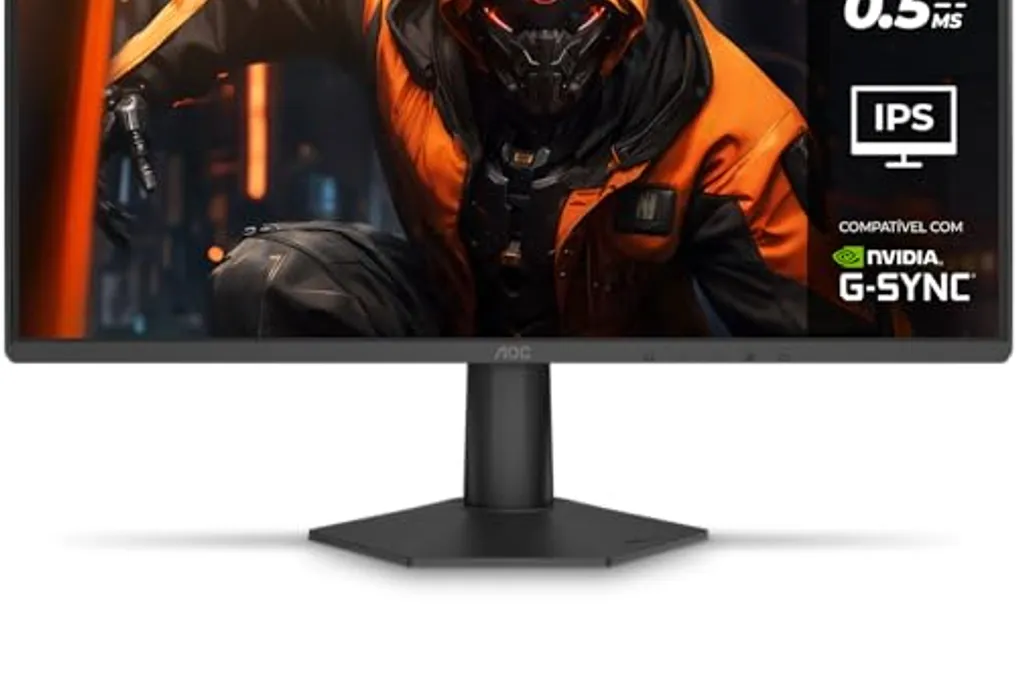
The AOC AGON G50 model is presented as a robust option for those who desire smooth images and good response capability. This monitor features a 24-inch IPS panel, a 144Hz refresh rate, and a response time of only 0.5ms, ensuring that movements in intense matches are fluid and blur-free. Furthermore, it supports G-SYNC to eliminate screen tearing, and HDR10 enhances the color palette and contrast of scenes.
The Haiz monitor, with a 25-inch IPS screen and Full HD resolution, provides accurate colors and wide viewing angles. With 144Hz and a 0.5ms response time, it rivals more established products in the market. The Adaptive Sync functionality manages synchronization with the GPU, and VESA compatibility allows installation on articulated arms, offering greater flexibility to the setup.
Finally, the LG UltraGear 24G411A-B stands out by offering simultaneous compatibility with NVIDIA G-SYNC and AMD FreeSync on its 24-inch panel, making it versatile for any graphics card. It operates at 144Hz, has a 1ms response time via MBR, and supports HDR10, guaranteeing sharp images without visual distortions even during the most frantic moments of the game.
Offer Information
It is important to note that promotions like these usually have limited stock and are subject to change at any time. If any of these monitors pique your interest, it is recommended to take advantage of the offer immediately before prices increase or items run out. To check the full conditions, you should click on the button for each product on Amazon.