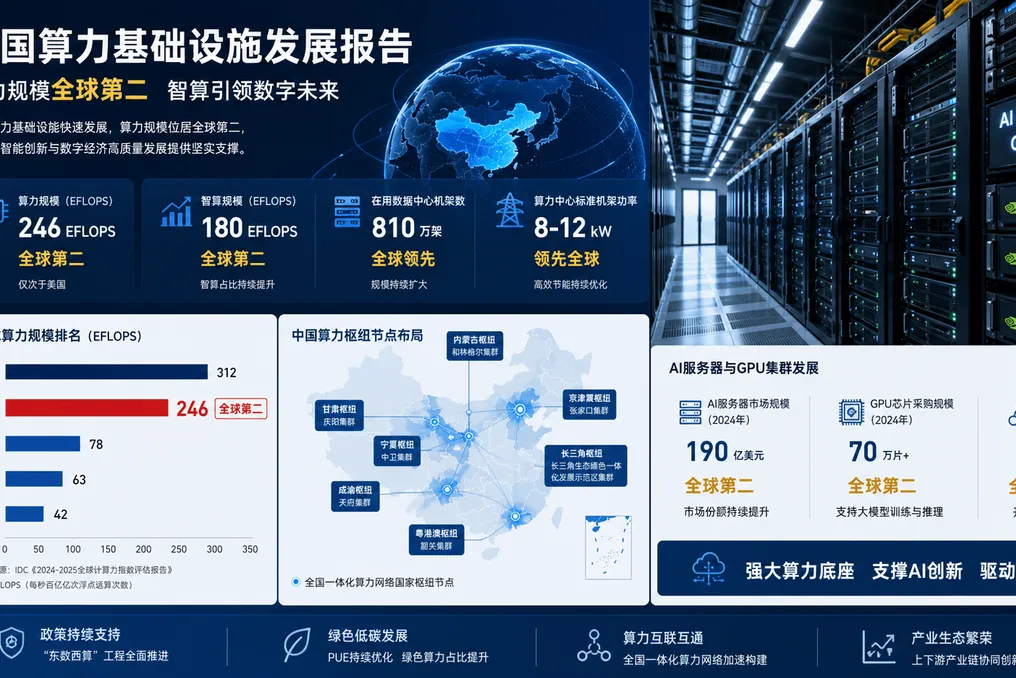
China's computing power reached 962 EFLOPS, securing second place globally. Furthermore, sales of artificial intelligence servers exceeded sales of general servers for the first time. Five key areas define the future development of the industry: high-performance computing, energy efficiency, domestic substitution, global expansion, and computing services.
Market Overview in 2025
According to the '2025 China Server Industry Development Report,' presented at the Smart Computing Foundation event on July 23-24, China's total computing power in 2025 was 962 EFLOPS, accounting for 21% of the global volume. The structure of computing has undergone radical changes: the growth of AI computing significantly outpaces the growth rates of both general and supercomputing systems, becoming the main source of growth.
Financial Indicators and Sales Structure
In 2025, China exported 4.727 million server units, generating revenue of 466.26 billion yuan. This represents a growth of 14.7% and 55.3% compared to the same period last year. The average price per unit reached approximately 111,900 yuan, reflecting a structural shift towards AI servers equipped with high-performance chips and HBM.
AI servers surpassed general servers in sales for the first time in 2025. The AI server market in China reached 761,000 sold units with revenue of 253.03 billion yuan, demonstrating an annual growth of 69.1% and 83.4% respectively. The Compound Annual Growth Rate (CAGR) from 2021 to 2025 was 34.7% by volume and 63.3% by revenue, which is significantly higher than the growth of the general server segment.
Demand Concentration and Growth Directions
Market demand is highly concentrated: five leading sectors—internet companies, telecommunications operators, government, data center service providers, and financial institutions—collectively accounted for 90.5% of the market. Only internet companies generated 170.04 billion yuan, supported by the race for large models and infrastructure development.
The high-performance computing direction shows the most confident growth, as the revenue growth rate of AI servers significantly exceeds the growth of both general servers and the company's overall revenue. Energy efficiency is viewed as a long-term trend driven by policy, since traditional air-cooled servers cannot support large, high-density load clusters, making the adoption of liquid cooling inevitable.
The domestic substitution direction through Xinchuang ensures stable growth, supported by policy, as state, financial, energy, and military sectors accelerate the replacement with domestic servers to ensure information security and supply chain autonomy. Global expansion opens up long-term growth opportunities, as developing markets abroad continue to actively build out computing infrastructure. Computing services represent a path to increased profitability: the traditional sale of low-margin hardware is transforming into compute leasing, cluster management, and provision of customized solutions, which improves revenue stability and gross profit.
Key Industry Challenges
Key challenges facing the industry include trade barriers in supply chains, competition from foreign manufacturers, industry cycle risks, saturation of universal servers, and rapid technological updates. The report recommends strategically positioning in all five directions while simultaneously strengthening supply chain resilience.