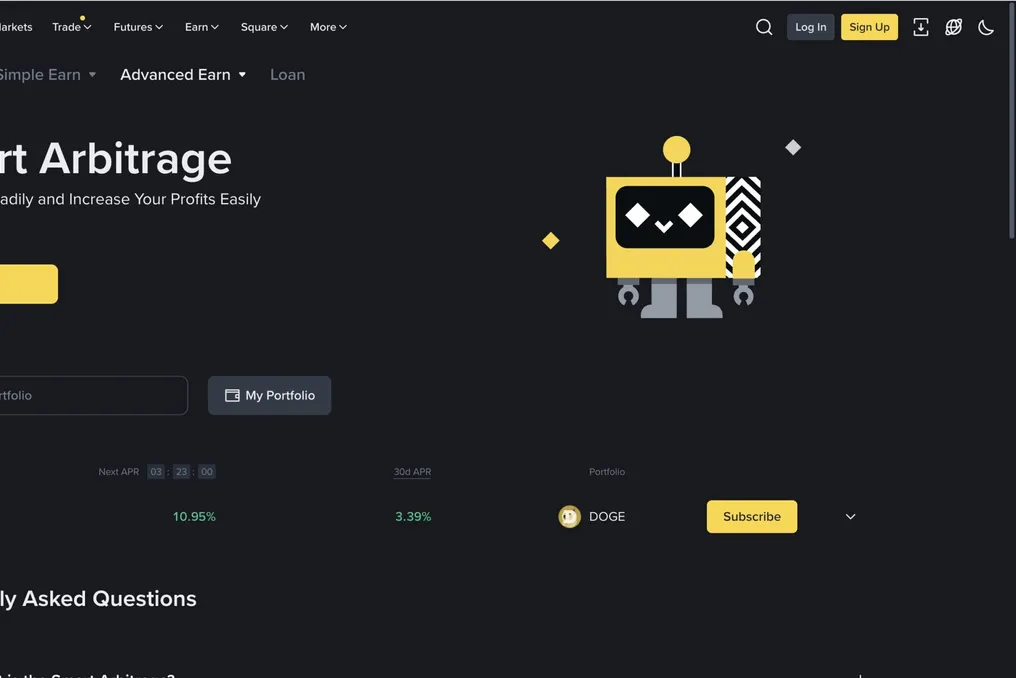
Crypto arbitrage is the practice of buying a cryptocurrency on one exchange at a lower price and simultaneously selling it on another exchange at a higher price, thereby extracting the price difference as profit. This principle is analogous to what stock and forex traders have used for decades, but it has been adapted for the global, 24/7 crypto market.
How Arbitrage Works
In traditional financial markets, arbitrage opportunities close within milliseconds. However, the fragmentation of crypto markets, which includes hundreds of global exchanges with varying liquidity, user bases, and regional demand, sustains the viability of crypto arbitrage.
Trading Strategy Mechanics
The basic mechanism is simple: if Bitcoin is priced at $95,000 on Exchange A and $95,400 on Exchange B, a trader buys on the first and sells on the second simultaneously, earning the difference of $400 minus fees. With total fees amounting to $100, the net profit would be $300. Scaling this operation with large capital and repeating it multiple times leads to cumulative income growth.
The main difficulty lies in speed. By the time an order is confirmed on Exchange A, the price on Exchange B may have already changed. Therefore, most serious cross-platform operations are executed by automated bots that track real-time price flows, rather than manually.
Reasons for Price Inefficiencies
In a perfectly efficient market, all assets trade at the same price everywhere. Crypto markets, however, are fragmented, and there are several reasons why price discrepancies persist:
- Fragmented Liquidity: Orders are distributed across hundreds of exchanges. A large purchase on one platform changes its price but does not immediately affect others.
- Regional Demand: Local economic conditions, currency exchange rates, and regulations create persistent price gaps between countries.
- Slow Price Aggregation: During rapid market movements, price data requires time to propagate, allowing gaps to open before they close.
- Uneven Trading Volume: Exchanges with low volume update prices more slowly, creating temporary discrepancies with high-volume platforms.
Notable Example: The Kimchi Premium
The Kimchi Premium most vividly illustrates crypto arbitrage—a persistent price gap between South Korean crypto exchanges and global markets. The peak of this premium in January 2018 reached 54.48%, when Bitcoin on Korean platforms was nearly 55% more expensive than on American exchanges. During 2017–2018, the gap often amounted to 15%, providing huge profit opportunities. Traders moving capital between South Korean won-denominated markets and dollar-denominated global markets reaped significant benefits.
The driving force behind this phenomenon was South Korea's strict currency controls, which contained domestic demand and inflated prices. Traders utilized the borderless nature of blockchain to move cryptocurrency between markets and capture this gap. However, by August 2025, the situation changed: South Korea's Virtual Asset User Protection Act of 2024 (VAPUA) introduced strict KYC and AML rules, reducing local exchange liquidity by 22%. The Kimchi Premium became a clear example of how regulation permanently transforms crypto arbitrage opportunities.
Types of Crypto Arbitrage Strategies
There are several types of crypto arbitrage. The most common is inter-exchange (spatial) arbitrage: buying an asset on one exchange and selling it on another at a higher price, which was the basis for Kimchi Premium trades. The main obstacle here is withdrawal time: moving Bitcoin between exchanges takes minutes, during which the difference may disappear.
Triangular arbitrage allows all operations to take place on a single exchange, eliminating withdrawal risk. The trader exploits inconsistencies between three trading pairs simultaneously: for instance, using dollars to buy ETH, then ETH to buy BTC, and finally selling BTC back for dollars. If the exchange rates between these three pairs differ slightly, the full cycle yields profit without moving assets between platforms.
Both these strategies require high speed, making automated crypto arbitrage bots the standard tool for serious participants, tracking hundreds of pairs simultaneously.
Decentralized and Flash Loan Arbitrage
Decentralized arbitrage exploits price discrepancies between decentralized exchanges like Uniswap and SushiSwap, or between DEXs and centralized platforms. During the DeFi boom in 2021, one ETH-based arbitrage bot earned over $50,000 in a single week by automatically finding and executing trades based on price differences across various DEXs.
Flash loans elevate DeFi arbitrage to a new level. A flash loan is an uncollateralized loan taken out and repaid within a single blockchain transaction block. If repayment fails, the entire transaction is automatically reversed. This allows traders to conduct crypto arbitrage with massive capital without owning it beforehand.
P2P and Funding Rate Arbitrage
In P2P arbitrage, individuals buy cryptocurrency at one price on sites facilitating peer-to-peer exchange in countries with unstable currencies or high demand for crypto assets. They then sell this cryptocurrency on global platforms at an agreed-upon price. This often occurs where people are willing to pay more for crypto assets, viewing them as a reliable store of value.
There is also funding rate arbitrage. It involves operations on sites like Binance or Bybit that offer perpetual contracts. These platforms charge a fee to ensure the contract price aligns with the spot cryptocurrency price. When this fee is very high, traders perform two actions simultaneously: buying the spot cryptocurrency and selling these special contracts, earning the fee as income. They do not need to worry about the rise or fall of the cryptocurrency price. This type of trading is simple even for those who cannot code.
Step-by-Step Guide to Crypto Arbitrage
Practical execution of crypto arbitrage involves the following steps:
- Step 1 — Strategy Selection: Inter-exchange arbitrage is suitable for beginners. More experienced traders can use triangular or funding rate arbitrage. Flash loan arbitrage requires smart contract development skills.
- Step 2 — Account Setup: You must register on multiple exchanges, fully complete KYC, and pre-fund accounts on both sides. Choose the best exchange for crypto arbitrage with deep liquidity and fast settlement.
- Step 3 — Monitoring Price Spreads: Use tools like Coinglass or CoinMarketCap exchange comparisons, as well as specialized crypto arbitrage scanners, to track price differences in real time.
- Step 4 — Calculating Real Profitability: Before execution, you must account for trading fees (0.1–0.5% on each side), withdrawal fees, slippage, and the risk that the spread will close before the trade is completed.
- Step 5 — Fast Execution: Manual execution is only suitable for large, slowly changing gaps. Most crypto exchange arbitrage requires a bot or simultaneous placement of pending orders on both exchanges.
- Step 6 — Tracking and Refinement: Record every trade. The most profitable price gap strategies require iterations, adjustments to fee structures, execution speed, and accounting for new gaps as old ones close.
Advantages and Risks of Arbitrage
Arbitrage can indeed be profitable, but the margins are smaller, and competition is fiercer than many guides suggest. Advantages include market neutrality, stable opportunities, and an accessible entry point. Risks involve execution risk, fee erosion, capital lockup, regulatory risks, and smart contract risks.
Tips and Automated Tools
For serious crypto arbitrage, manual management is only feasible for the largest and slowest gaps. Experienced traders use the following tools:
- Arbitrage Bots: Platforms such as Pionex, Bitsgap, and Cryptohopper offer ready-made bots with exchange API integration for automatically finding profitable crypto arbitrage gaps.
- DEX Aggregators: 1inch and ParaSwap route trades through multiple DEXs, which is useful for identifying and executing DeFi arbitrage trades without writing custom smart contracts.
- Spread Monitoring Panels: Coinglass tracks funding rates on perpetual exchanges, while the CoinMarketCap exchange comparison page shows the price of the same token across different platforms in real time.
- Pre-funding Capital: The most common reason for missed opportunities is withdrawal time between exchanges. It is necessary to pre-fund accounts on all relevant platforms.
- Checking Liquidity Depth: A price gap on a low-volume exchange may be impossible to execute in large volumes. Always check if the opportunity can absorb your order without moving the market.
Conclusion: Is Arbitrage Worth Trying?
The prospects of crypto arbitrage in 2025 depend on your resources and skills. If you have programming skills, DeFi knowledge, and flash loan arbitrage experience, it offers real profit potential, but you will be competing with professional teams of quantitative analysts and specialized infrastructure. For the retail trader, the most realistic starting point is funding rate cryptocurrency arbitrage: the margin is lower, but the entry is more accessible and manageable.
Inter-exchange Bitcoin arbitrage is more complex than it seems. Fees, withdrawal delays, and bot competition squeeze the margin to such an extent that small accounts struggle to achieve tangible profits after accounting for expenses. It is recommended to start by selecting the best exchange for crypto arbitrage to build the necessary infrastructure.