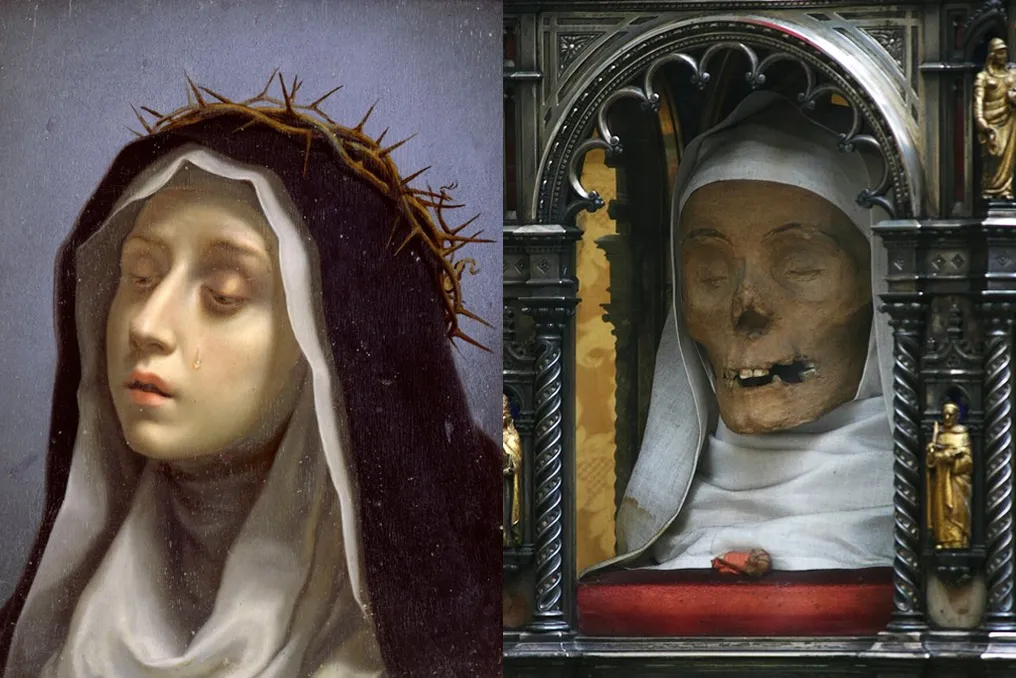
Catholic tradition maintains the belief in the transformation of preserved mortal remains into relics. The Vatican refers to incorrupt saints as those whose bodies or parts show exceptional preservation after death, which many faithful view as an indication of holiness.
View of the Roman Catholic Church
However, it is important to emphasize that the Roman Catholic Church itself does not establish bodily preservation as a miraculous or supernatural requirement. It recognizes the influence of physical, biological, and environmental elements in this phenomenon. Furthermore, preservation is not a prerequisite for canonization.
Researcher Leonardo Rossi states that, for the Roman Catholic Church, the absence of decomposition, the malleability of flesh post-mortem, and the emission of fragrances do not constitute proof of divine election or supernatural events, and therefore do not justify special honors on altars.
History and Notable Cases
The first records of this phenomenon date back to the 4th century AD, accumulating hundreds of documented cases. Before the Catholic reforms of the 17th and 18th centuries, the mere existence of incorrupt bodies was sufficient to foster small cults and devotions.
In an article published in 2025, Rossi cataloged one hundred bodies currently preserved and displayed in churches, sanctuaries, or religious institutions. Among the best-known examples are Saint Bernadette of Lourdes, Anthony of Padua, Saint Rita of Cascia, Saint Catherine Labouré, Saint Vincent de Paul, Saint Catherine of Siena, Saint Thérèse of Jesus, and others.
Saint Bernadette of Lourdes
Bernadette Soubirous, a French nun born in 1844 and died in 1879, witnessed several apparitions of a woman dressed in white, who later identified herself as Our Lady of Conception. Thirty years after her death, in 1909, her body was exhumed for the purpose of recognizing the canonization process and was found in almost perfect condition, without unpleasant odor. Subsequent exhumations, conducted in 1918 and 1925, also confirmed the integrity of the body. Some relics were removed, and a wax mask was created for the saint. Her body is displayed at the Convent of Saint-Gildard, located in Nevers, France.
Anthony of Padua
Considered possibly the most popular saint in Brazil, Anthony of Padua has highly venerated relics, although he is not classified as an incorrupt saint. His tongue was found remarkably preserved when his tomb was opened in 1263, approximately thirty years after his death. This finding was interpreted as a sign, given that Anthony was an eloquent preacher and his tongue had disseminated Christian teachings during his life. Centuries later, in 1981, Pope John Paul II ordered the exhumation, at which time the vocal cords were also found intact. Currently, these relics reside in the Basilica of Saint Anthony of Padua, in Italy. The tongue remains in the same golden reliquary used in the 13th century and can be seen by devotees.
Saint Rita of Cascia
Patroness of impossible causes, Saint Rita of Cascia is perhaps the most popular incorrupt saint among Brazilians. After becoming a widow and losing her children to illness, Rita entered a convent in her hometown, Cascia, in Italy. In 1457, after her death, an unusual event was noticed: the church where she was buried began to emit a pleasant fragrance that lasted for centuries. One hundred and fifty years after her death, her body was exhumed and found intact. She was canonized in 1900, and decades later, in 1946, the Basilica of Saint Rita was erected in her honor, where her body is displayed today.
Saint Catherine Labouré and Saint Vincent de Paul
Catherine Labouré (1806-1876) chose to become a nun after a dream in which she was guided by a man to a room full of sick people, being instructed to care for them. She recognized this man in a portrait as Saint Vincent de Paul. Immediately, she decided to join his order. In 1830, she received visions of the Virgin Mary, who described the design for the Miraculous Medal, an object of Catholic devotion to this day. In 1933, more than fifty years after her death, her body was exhumed and found incorrupt. She was canonized in 1947, and her body is displayed in the Chapel of the Miraculous Medal in Paris.
The famous French saint who inspired Catherine Labouré, Saint Vincent de Paul, dedicated his life to the needy, founding the Congregation of the Mission and the Daughters of Charity. He died in 1660 and was exhumed in 1712, when his body was found intact. However, a second exhumation, carried out in 1737 (the year of his canonization), revealed that an underground flood had caused its natural deterioration. Only his heart remained intact, and it is currently displayed in a reliquary in the chapel of the motherhouse of the Daughters of Charity, in Paris.
Relics of Saint Catherine of Siena
The philosopher and theologian Catherine of Siena (1347-1380) was a prominent figure in 14th-century Catholic circles. She was one of the main forces behind the return of the Papacy from Avignon (France) to Rome. Since 1939, she has been the patron saint of Italy, alongside Saint Francis of Assisi. The body of Saint Catherine of Siena is partially incorrupt, but it has a historical peculiarity: her relics are dispersed across various European cities. The saint died in Rome in 1380, and her body was separated a year later, by papal order, to be sent to her hometown.
Her relics are located as follows: the main body is buried in the Basilica of Santa Maria sopra Minerva, in Rome. Her mummified head and thumb are on display in the Basilica of San Domenico, in Siena, and her right thumb rests in a smaller nearby reliquary. Her left foot is kept in Venice, in the church of Santi Giovanni e Paolo. A rib, previously belonging to the Cathedral of Siena, was donated to the sanctuary of Saint Catherine in Astenet, Belgium, in 1985. A scapula fragment is located in the sanctuary of Saint Catherine in Siena.
Saint Thérèse of Jesus
Teresa of Ávila, the Spaniard known as Saint Thérèse of Jesus (1515-1582), is one of the most notable examples of partial preservation of mortal remains among Catholic saints. Founder of the reform of the Carmelite Order and one of the greatest mystics in Christian history, she was canonized in 1622. Openings made in her tomb in the years 1750, 1914, and 2024 always revealed her incorrupt and well-preserved body.
The relics of Teresa of Ávila are distributed in several locations in Spain and Europe: most of the mortal remains remain in the Basilica of the Annunciation of Our Lady of Mount Carmel, in a tomb-reliquary in Alba de Tormes, Spain. Her heart is also in this same basilica. Her left arm is in the Convent of the Discalced Carmelites of Ronda. Her left hand is preserved in the Carmelite Museum of Lisbon. One index finger is preserved in the Convent of Our Lady of Mount Carmel. Additionally, small bone fragments are scattered in Carmelite churches and convents globally, including in Italy, France, and various Latin American countries, although there is no complete public inventory of these relics.