A team of scientists has developed an enzyme that demonstrated the ability to remove compounds related to cellular wear in tests conducted on human samples. This advancement was detailed in a study published in the journal Nature Communications.
A team of scientists has developed an enzyme that demonstrated the ability to remove compounds related to cellular wear in tests conducted on human samples. This advancement was detailed in a study published in the journal Nature Communications.
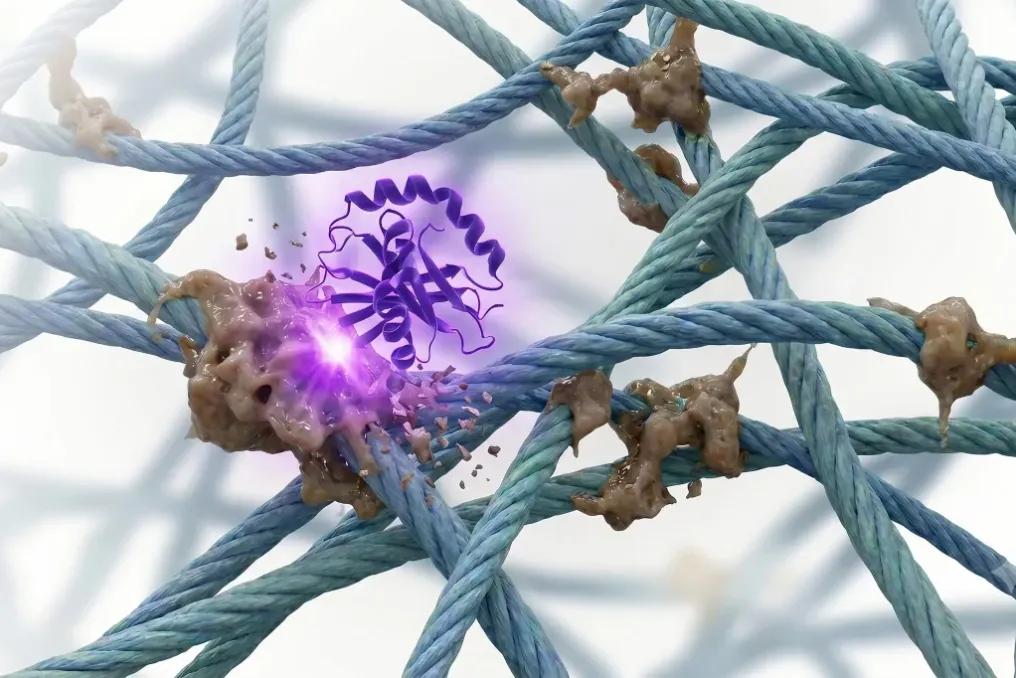
The enzyme, named CMLase, was specifically created to reduce advanced glycation end-products, known as AGEs. These are substances that accumulate in the body over the years. The process of bodily aging involves several chemical modifications, with the accumulation of AGEs being one of them. AGEs arise when sugars interact with proteins and fats present in the body, a phenomenon comparable to the browning of a cake during baking.
These accumulated compounds make structures like collagen more rigid and are linked to inflammations that can cause heart, eye, kidney, and diabetes problems. While previous research focused on preventing the formation of AGEs, the new approach proposes removing these compounds after they have settled in the tissues.
Aaron Cravens, founder and CEO of Revel Pharmaceuticals and lead author of the study, commented that aging is a complex process, and this work represents a small step forward in that direction. To find a solution, researchers sought inspiration from natural microorganisms known for their decomposition capabilities, hoping to identify mechanisms to break down very resistant molecules.
Using artificial intelligence, the team analyzed the DNA of over fifty thousand microbes to calculate which enzymes could act against AGEs. After several refinement phases, CMLase was developed. Key results included the elimination of AGEs in real human tissues, improvement in the levels of these compounds in aged structures, and a reduction in marks associated with cellular wear, suggesting potential future application in age-related diseases.
One particularly notable test showed that a 70-year-old skin sample had AGE levels similar to those found in 30-year-old skin. Despite these promising findings, the enzyme is not yet a commercially available treatment. The next phase of the project requires evaluating its performance in medical contexts, such as diabetic eye diseases.
John Baynes, a retired biochemist from the University of South Carolina, compared the accumulation of AGEs to rust in tissues, explaining that it deposits on proteins. Michael C. Jewett, a bioengineer from Stanford University, emphasized that while it is not an immediate clinical solution, this proof of concept paves the way for new longevity therapies. If future studies confirm safety and efficacy, CMLase could be investigated for various age-related problems, proposing a distinct idea: undoing some bodily wear, rather than just slowing it down.
Experts consider the growing reliance of people on artificial intelligence (AI) for help, often preceding a visit to a therapist, to be dangerous. The question of where lonely, scared, or confused children turn is increasingly finding an answer in a machine.
Not only children but also adults are beginning to use AI to seek advice, comfort, and emotional support, sometimes before speaking with a friend, counselor, or mental health professional. Danny van Loggerenberg, founder of the National Center for Children Protection, reported that among the children his organization works with in schools across the country, 82% admit to primarily, and sometimes exclusively, turning to AI for support and advice.
He noted that many children in South Africa, especially those over 12, communicate with AI companions who become friends because the AI also learns about them. Van Loggerenberg warns that these relationships can become so comfortable that some children begin to form romantic attachments to AI, which he says is dangerous.
He provides examples where children ask AI companions how to gain acceptance, how to fit into a group, how to speak correctly, and what to say. More alarming is that some ask ChatGPT to help write suicide notes, stating: 'I plan to kill myself, please help me write a letter... here is what I want in the letter.'
Children most often use chatbots such as Copilot, Gemini, and Claude. Van Loggerenberg explains that some children turn to AI due to a lack of boundaries at home, unlike parents who can say 'no'; AI does not. He emphasizes that anything can be convinced with AI, and different answers result depending on the conditions set in the conversation.
One young woman uses AI as a useful tool for structuring thoughts, processing complex situations, and drafting messages during moments of intense emotion. She also sees a therapist, believing that these two approaches serve completely different functions. She argues that therapy offers something AI cannot fully replicate: genuine human connection with someone who knows her history, understands her patterns over time, and is professionally trained to help her cope.
Another young woman uses ChatGPT for everything: summaries, grammar checks, and encouragement. She also shares with the AI things she doesn't want to tell people for fear of judgment. She admits to talking to all AI but deletes these dialogues after receiving an answer.
Cassie Chambers, Operations Director of the South African Depression and Anxiety Group (SADAG), notes that the organization is increasingly receiving calls from people who first consulted ChatGPT or another chatbot before seeking help. Some callers told SADAG that AI directed them to the organization or prompted them to seek professional assistance. Chambers believes that AI acts as a 'gateway,' helping to take the first step, but insists that AI is merely a tool, not a therapist.
In Chambers' view, people are drawn to AI because it is confidential, immediately accessible, available 24/7, and seems less intimidating than communicating with another person. Nevertheless, she stresses that diagnosis, risk assessment, treatment planning, and crisis intervention require qualified professionals.
The South African Society of Psychiatrists (SASOP) has warned that the growing use of AI chatbots for mental health support has caused international legal and regulatory issues. In the US, Canada, and Europe, cases related to interactions with AI, especially involving vulnerable young people, have been linked to suicide, murder, mass shootings, and psychological trauma, leading to at least seven lawsuits against the creator of ChatGPT, OpenAI.
A SASOP member, Professor Christopher Sabo, stated that AI chatbots can provide inaccurate information, false reassurance, and reinforce harmful thoughts, and their human-like responses can generate dangerous emotional dependency. He cautioned that AI cannot replace the value of personal interaction with an experienced therapist and may react inappropriately in a crisis situation, potentially increasing the risk of self-harm. Sabo reminded that psychiatrists assess patients comprehensively, considering context, body language, facial expressions, behavior, and history.
Dr. Colin Surendra Thakur, an IT expert at Unisa, compares the current situation to internet addiction. He notes that AI has transformed the internet from a reactive tool into a contextual conversational tool that can be used for good or as a weapon. Thakur points to the rise of new forms of compulsive behavior, such as pathological online shopping and virtual gambling, as well as companion apps criticized for marketing emotionally intimate relationships.
At the beginning of this week, the publication Independent asked ChatGPT about the reasons people turn to it with mental health questions. Among the questions people ask were: 'What is the least painful way to die?', 'What happens if I take X and Y together?' and 'Can you write a farewell letter?'. ChatGPT admitted that it cannot definitively ascertain a person's intent and must encourage immediate help-seeking in a crisis situation.
Google has implemented significant improvements in Chrome for Android, resulting in a 48% reduction in what is known as 'scroll jank,' making the scrolling experience smoother for users.
This type of instability is a common behavior, but one that is now less frequent, where the scrolling flow appears to momentarily stop. In certain situations, the browser may exhibit a 'jump,' abruptly advancing to a more distant point on the page, making it difficult to locate specific information.
Google clarifies that this jump occurs due to a time limit Chrome has to display each frame before screen refresh. If this limit is exceeded, the previous frame remains visible for an additional refresh cycle. When the new frame is finally ready, the page jumps directly to the most updated scroll position.
Although users perceive this dynamic as a visual 'stutter,' the problem is considered more subtle than a complete freeze. Therefore, Google focused its efforts on reducing this 'scroll jank.'
The solution was not limited to just speeding up Chrome, but rather ensuring that the frame delivery flow was as consistent as possible, given that various factors can cause this instability. Developers modified how Chrome manages touch inputs related to scrolling.
Instead of overloading the browser's main task—which might be busy executing scripts—the scrolling processing was transferred to a more specialized and consequently less prone to delays component. Additionally, Chrome began optimizing the frame display time.
If a small delay of a few milliseconds occurs in a touch, the browser chooses to wait a bit before rendering the next image. If the remaining time is insufficient, the system estimates the position the finger should reach at the subsequent moment, preventing the screen from repeatedly displaying an old frame and generating the 'stutter' effect.
As a result of these optimizations, Google reports that 'scroll jank' has been reduced by 48% in Chrome for Android between 2023 and 2026. Although the article's author expected a higher percentage, they consider this advancement relevant, considering the vast diversity of devices and configurations on which Chrome for Android operates. Google indicated that optimization work on Chrome for Android will continue.
Anthropic announced the launch of Claude Opus 5 on the 24th, its latest artificial intelligence. The startup reported that this new model offers performance comparable to its most sophisticated model, Fable 5, but at approximately half the cost.
The development of Opus 5 specifically aimed to meet the needs of routine office tasks and computer programming, serving as a more accessible option for users who do not require all the advanced features of the platform.
In conversation with Reuters, Dianne Penn, Anthropic's product leader, highlighted that the launch of Opus 5 demonstrates the rapid evolution of the company's AI models. She also mentioned that this new version offers greater efficiency compared to Opus 4.8, which was released in May.
Penn stated: 'We are building and consistently delivering cutting-edge intelligence, making it as accessible as possible with each model generation.'
Anthropic reported that internal tests indicated that Opus 5 has a lower capacity to exploit cybersecurity vulnerabilities compared to Fable 5. For this reason, the new model incorporates less stringent security safeguards than those applied to its most powerful model.
Furthermore, the startup communicated that Opus 5 proved less prone to being manipulated for improper purposes compared to other current company models. It is worth noting that Fable 5, launched in June, had its availability temporarily suspended due to concerns raised in the United States about the potential diversion of its capabilities to foreign military applications.
According to Penn, the decision on whether to use one model or another should be based on the nature of the task. She advised users to choose Opus 5 when prioritizing the best cost-to-performance ratio, while Fable 5 is better suited for 'highly autonomous, multi-day projects.'
During the interview, Penn also addressed Kimi K3, an open-source AI model created by the Chinese company Moonshot. There have been accusations from the United States that Anthropic benefited from Anthropic's technology. In response, the executive stated that it is still necessary to observe how open-weight models behave in complex real-world scenarios, similar to those requested by users from Claude.
Open-weight models allow users to download, run, and customize virtual AI systems, which differs from proprietary models that remain under the exclusive control of the developing corporations.