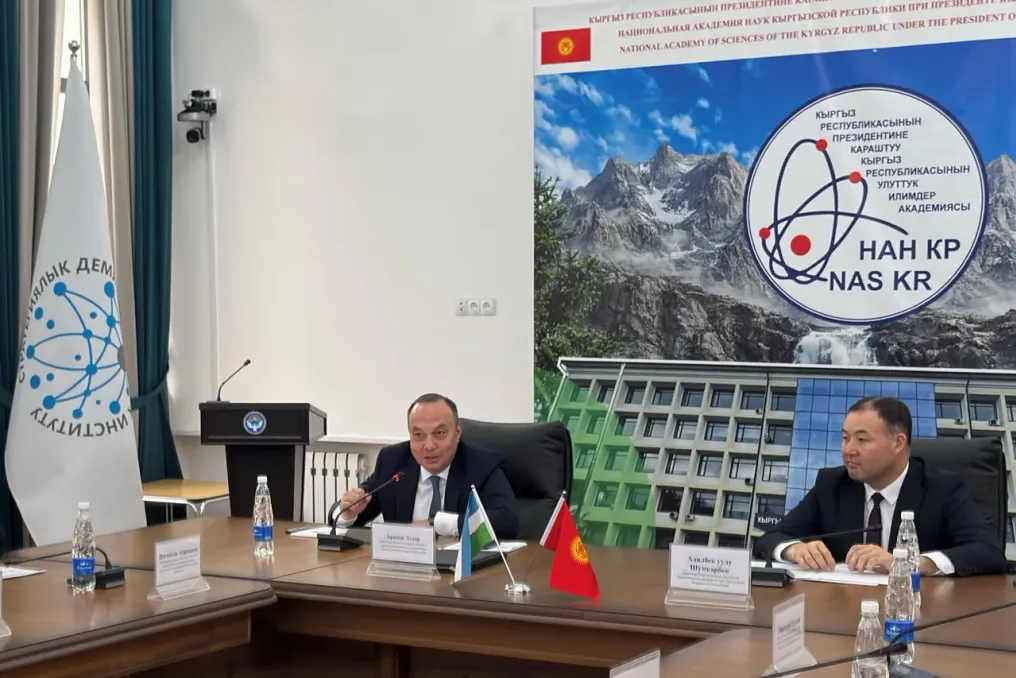
At the second meeting of the Expert Council of Uzbekistan and Kyrgyzstan, held in the capital of Kyrgyzstan and titled 'Uzbekistan and Kyrgyzstan: Strategic Partnership and Prospects for Its Further Development,' a significant improvement in bilateral relations was noted.
Discussion of Progress in Relations
The delegation from Uzbekistan participated in the event, which included leaders and specialists from leading analytical centers, relevant state agencies, and representatives of the business community. Eldor Aripov, Director of the Institute of Strategic and Interregional Studies (ISRS), addressed the participants, emphasizing the qualitative changes in ties between the two states.
According to Aripov, thanks to the strong political will of the leaders of both countries, all key and complex issues on the bilateral agenda have been successfully resolved. He called this a historic achievement, stating that for the first time in many decades, Uzbekistan and Kyrgyzstan can focus their efforts not on overcoming the past, but on jointly shaping the future.
Economic Cooperation and Infrastructure
Economic interaction was also highlighted. Aripov noted that bilateral trade, which barely exceeded $100 million ten years ago, has now approached $1.2 billion, showing a growth of almost 40% in the last year alone. The parties aim to move from simply increasing trade volumes to deeper industrial cooperation and the creation of joint production capacities.
Regarding major infrastructure projects, Aripov emphasized the importance of the China-Kyrgyzstan-Uzbekistan railway line and the Kambarat-1 Hydroelectric Power Plant project. He stressed that these projects go beyond the bilateral agenda, as they are effectively shaping the new economic geography of Eurasia.
Water Resources and Public Contacts
On the issue of transboundary water resources, Aripov reported that recent experience demonstrates a gradual decrease in the relevance of traditional division of interests between upstream and downstream countries. Instead, mutual consideration of interests and shared responsibility for common natural resources is observed.
Concluding his speech, Aripov noted the unprecedented growth in contacts between the citizens of the two countries. Over the last decade, the number of Kyrgyz citizens who visited Uzbekistan has increased more than sevenfold, reaching 3.3 million people last year, which was the highest figure among all incoming international tourist flows to the country.