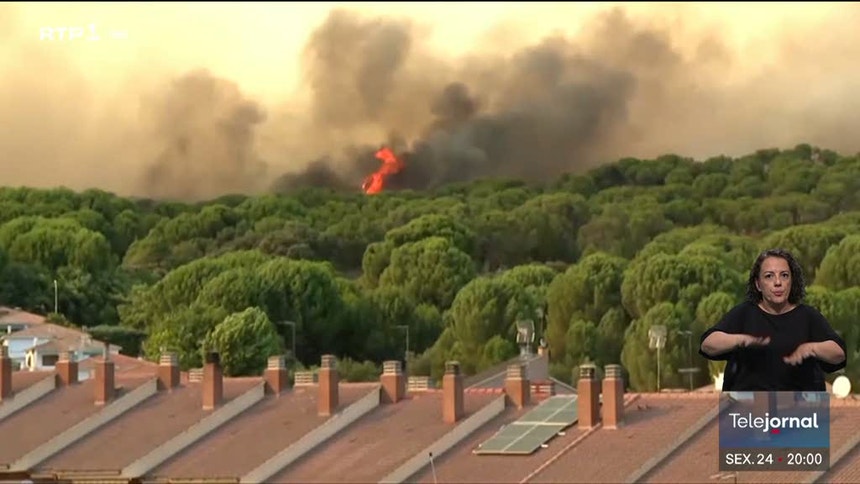
According to authorities, the fires that have been affecting the regions of Madrid and Ávila in Spain since Thursday continue to spread, and the situation is assessed as extremely serious. Approximately 60 thousand people have been evacuated or placed under control.
Fire situation in Madrid
The Minister of Environment, Agriculture and Internal Affairs for the Madrid region, Carlos Novillo, stated during the day that the fire in Madrid is at 'the worst level' and 'impossible to extinguish.' Consequently, a state of emergency was declared for Madrid and Ávila on Thursday, and the European Civil Protection Mechanism was activated to request four aerial firefighting assets from European Union (EU) partners.
Novillo reported after the Central Command meeting (Cecopi) on Friday that the wildfire in the southwest of the region has reached its 'peak' and is now 'beyond extinguishing capabilities.' He emphasized that the current priority is 'protecting cities, assisting evacuated residents, and utilizing all available resources,' as the fire cannot be extinguished directly in this zone.
Government reaction and scale of damage
The severity of the fire's consequences prompted Spanish Prime Minister Pedro Sánchez to confirm his presence at the coordination center for the major wildfire this Saturday at 08:00 GMT. Sánchez will be accompanied by the Minister of the Interior, Fernando Grande-Marlaska, in the municipality of Senisientos, where an emergency meeting will take place. According to Carlos Novillo, 45,000 people in the autonomous community of Madrid have already been affected: 26,000 were preemptively evacuated, and about 20,000 are under house arrest.
In the neighboring region of Ávila, part of Castile and León, another 1,500 people have currently been relocated. Novillo noted that the smoke plume is moving further north than expected and expressed hope that the fire does not reach the tree canopy, which would accelerate its spread and complicate control. The firefighting operation is hopeful for the night, when the wind usually subsides after daytime speeds exceeding 60 kilometers per hour.
Additional details and warnings
The regional minister also noted that the fire 'continues to grow,' but 'at the moment' has not resulted in any injuries. He thanked those who arrived with reinforcements from other autonomous communities, including the Valencian Community, and called the fire 'unprecedented' in both Madrid and Spain due to its impact on the population and the number of evacuees. According to the latest report, the flames have destroyed 43 homes and damaged more than 280 others. Authorities predict that the fire in Madrid will be joined by the fire spreading in the province of Ávila, and the flames may threaten the Escorial, the world's largest Renaissance building.
The Spanish government delegate in the Madrid region, Francisco Martín, told journalists that authorities do not rule out further evacuations in the coming hours due to the development of the flames. Data was later updated, and two more municipalities under house arrest were evacuated. The President of the Autonomous Government of Madrid, Isabel Díaz Ayuso, called it 'the worst fire in history' for the region, labeling it a 'catastrophe' for a densely populated area.
Spain's Minister of the Interior, Fernando Grande-Marlaska, added that besides the fires in Madrid and Ávila, nine other hotspots are burning across the rest of Spain, which led to the activation of the European Civil Protection Mechanism. A man suspected of being the source of the fire in Ávila was arrested while he was operating agricultural machinery in a prohibited area. This year, over 130,000 hectares burned in Spain, compared to over 393,000 hectares in 2025, which is the largest area ever covered by fire in the country's history.