The Ministry of Justice of Uzbekistan has introduced amendments to the procedure for operating a special legal regime designed for testing crypto technologies under regulatory supervision. These changes concern the rules for issuing stablecoins.
The Ministry of Justice of Uzbekistan has introduced amendments to the procedure for operating a special legal regime designed for testing crypto technologies under regulatory supervision. These changes concern the rules for issuing stablecoins.
Previously, participants in the experimental regime were only allowed to issue stablecoins provided they had backing in the form of national or foreign currency. Now, issuers have access to using government securities owned by the issuer itself as collateral for digital assets.
According to the updated regulations, funds must be placed in a dedicated account at the Central Bank. Simultaneously, government securities are blocked through the Central Depository on behalf of the regulator, following established depository procedures. It is important to note that the issuer retains the right to receive income and interest from these securities.
An mandatory condition has been introduced to ensure the security of holders of digital assets: the total value of funds held in the Central Bank's account, along with the nominal value of the blocked government securities, must equal or exceed the total nominal value of all stablecoins in circulation. Furthermore, forming this collateral using borrowed funds, loans, or pledged property is prohibited.
It should be recalled that an organized criminal group engaged in illegal trading of crypto assets was previously liquidated in Tashkent. According to investigative bodies, the volume of turnover of this criminal scheme reached $1.5 million.
The fintech company PhonePe, the largest Unified Payments Interface (UPI) application in India by transaction volume, reported an increase in net loss to ₹2,791.59 crore in the fiscal year 2025-26 (FY26). This figure is higher than the ₹1,727.41 crore recorded in FY25, even with an 11.5% year-on-year revenue growth.
The Bengaluru-based company generated revenue of ₹7,920.48 crore in FY26, compared to ₹7,105.01 crore in FY25. However, PhonePe's total expenses rose to ₹10,588.51 crore in FY26, which is 16% more than the ₹9,116.54 crore in FY25.
In March, the company temporarily suspended its Initial Public Offering plans due to market instability and the conflict in the Middle East. One significant factor affecting revenue was the cessation of income from rent and related categories following guidelines issued by the Reserve Bank of India (RBI).
This category previously accounted for 17.89% of PhonePe's revenue in FY25 and 22.72% in FY24. In the first half of FY26, it contributed 13.44% of the company's total revenue. Furthermore, the ban on real money gaming (RMG) last year reduced the contribution to revenue that previously came from payment services and advertising. In FY25, this segment constituted about 3.5%, and in FY24, 4.65%; in the first half of FY26, its share was only 1.84%.
In recent months, the fintech company has also faced a series of senior management departures. Vishal Gupta, head of PhonePe's insurance division, left this month to launch his own startup after more than ten years with the company. In June, Akash Dongre, co-founder and product director of PhonePe's Indus Appstore, departed. May saw the exit of Ujwal Jain, CEO of PhonePe Share.Market brokerage platform.
In contrast, industry competitor Paytm earned ₹8,437 crore in operating revenue in FY26, while the company posted a net profit of ₹553 crore.
In the rapidly evolving world of digital finance, the ability to find optimal exchanges for crypto arbitrage determines whether a venture will be profitable or lead to costly errors due to slippage. Crypto arbitrage does not depend on predicting price direction; instead, it focuses on exploiting inefficiencies found between different trading pairs, exchanges, or derivatives markets.
However, in 2026, the decisive factor is not so much the ability to find a price gap as it is the speed of trade execution, API stability, and liquidity depth. This guide reviews 10 of the best exchanges for crypto arbitrage in 2026, detailing their advantages and disadvantages, and demonstrating methods to maximize profits while managing risks.
Before an in-depth analysis, an overview of the best exchanges for crypto arbitrage is presented, based on the most important criteria. Among them stands GhostSwap, a non-custodial, KYC-free exchange that allows instant exchange of over 1600 cryptocurrencies, with funds moving directly from the user's wallet to the target address.
GhostSwap fully supports privacy-focused coins such as Monero (XMR), Zcash (ZEC), and Dash, which many centralized exchanges have excluded due to regulatory pressure. The platform has a history of completing over 750 million crypto trades and serves more than 1.5 million users. It has been noted by leading crypto publications, including CryptoNews, 99Bitcoins, CoinGape, and CoinDesk. Furthermore, GhostSwap offers a Telegram bot for mobile trading and allows purchasing cryptocurrency using credit or debit cards without identity verification.
Launched in 2018, Bybit has established itself as a powerful derivatives hub and the fastest execution engine in the industry. For traders engaged in funding rate arbitrage, Bybit is the benchmark. Thanks to its Unified Trading Account (UTA), users can leverage cross-margin efficiency to increase capital. The exchange boasts deep liquidity, rarely suffers from slippage even with large orders, and provides unlimited access via WebSocket API.
Toobit positions itself not just as an exchange, but as an institutional-level aggregator. This crypto arbitrage software connects to various exchanges to execute sales, significantly accelerating the volatility process. Launched in 2022, Toobit uses 'Bee-Safe' technology and is ideal for deploying specialized software that can capture micro-differences inaccessible to humans.
Binance maintains its status as the gold standard due to massive liquidity and a variety of trading pairs. Ultra-low fees contribute to significant profit generation. The extensive number of trading pairs creates an exponential number of triangular routes, and the industry-leading liquidity ensures that the third stage of the trade is not affected by slippage. The exchange requires mandatory KYC verification but offers protection through the SAFU fund.
CoinCatch, created in 2022, specializes in high-performance derivatives platforms. It is designed for traders aiming to exploit price discrepancies between spot prices and perpetual contracts (funding rate arbitrage). The platform's interface provides specialized data on funding rates and projected premiums, making it attractive to those who value privacy and leverage.
OKX leads in Web3 integration, offering seamless connectivity with a multi-chain wallet, making it the best platform for spatial arbitrage between centralized (CEX) and decentralized (DEX) exchanges. Fees here are very low (0.02% for maker/0.05% for taker), and this rate can be reduced by holding the native token OKB. Its proprietary Web3 wallet integration ensures fast asset transfer across different blockchains to exploit cross-chain inefficiencies.
As global regulations tighten, privacy is becoming a key value in the world of digital assets. For traders who highly value data security and anonymity, finding optimal crypto exchanges without identity verification (KYC) in 2026 is of paramount importance. The demand for such platforms has sharply increased among those seeking to avoid intrusion into their private lives and trade without restrictions.
The ability to acquire cryptocurrency without going through KYC goes beyond mere convenience; it is a matter of financial sovereignty. However, it should be noted that no-KYC crypto exchange options can carry certain risks, as fraudulent schemes exist, and not every platform promising anonymity is safe.
This guide analyzes leading platforms where users can buy cryptocurrency without KYC, aiming to ensure high liquidity, reliability, and trading freedom, including the ability to buy Bitcoin without KYC. Many venues were tested to compile this comprehensive list.
When choosing a platform for anonymous cryptocurrency purchase, one must find a balance between privacy and functionality. The table presented compares the main characteristics of leading competitors, helping to decide where best to buy Bitcoin without KYC, whether it is an exchange with low fees or a decentralized solution.
GhostSwap is positioned as a premium no-KYC exchange created for traders requiring complete confidentiality. Being a fully non-custodial platform, it eliminates the need for registration, account creation, or any identification. Users can instantly swap over 1600 cryptocurrencies by transferring funds directly from their wallet to the target address, which is ideal for anonymous trading or buying Bitcoin without KYC.
A distinguishing feature of GhostSwap is its support for privacy-focused coins such as Monero (XMR), Zcash (ZEC), and Dash. These coins are often delisted from centralized exchanges under regulatory pressure. GhostSwap handles operations like swapping BTC for XMR or ETH for ZEC without triggering KYC flags.
The platform has gained trust in the space of anonymous crypto exchanges, completing over $750 million in swaps and serving more than 1.5 million users. It has been noted by leading crypto publications, including CryptoNews, 99Bitcoins, CoinGape, and was a partner of CoinDesk. In addition to web swaps, GhostSwap offers a Telegram bot (@ghostswap_crypto_bot) for mobile trading and supports fiat gateways that allow buying crypto with cards without verification.
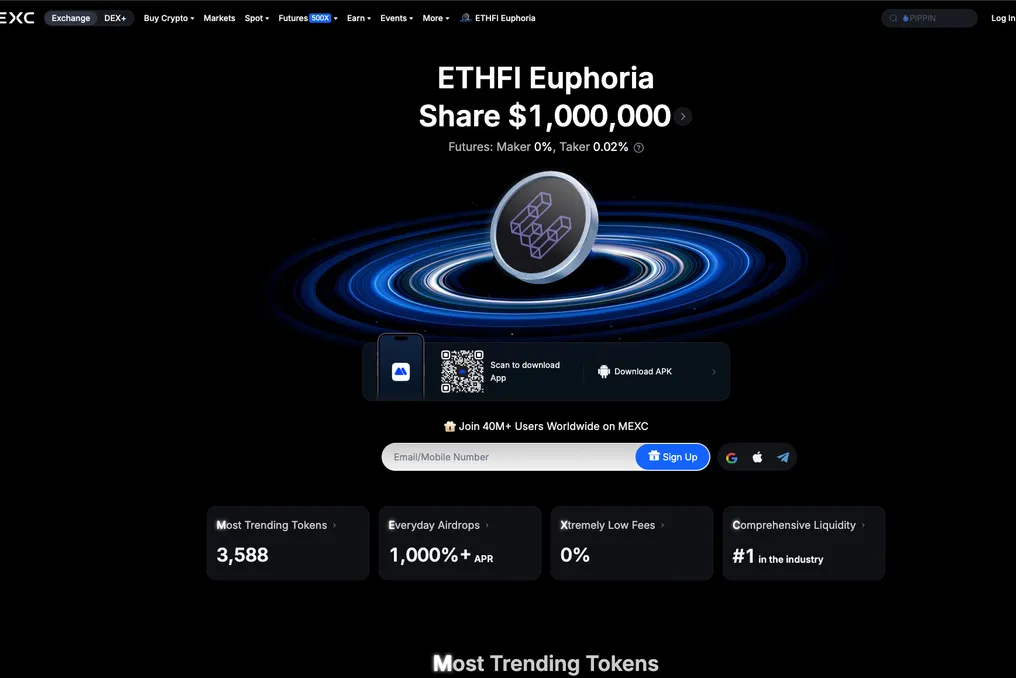
MEXC is considered one of the best no-KYC crypto exchanges for traders focused on minimizing costs. The exchange regularly ranks among platforms with the lowest fees due to aggressive zero-fee promotions for makers. It provides deep liquidity and a wide selection of altcoins for those who want to trade without KYC with high leverage, offering a centralized experience without paperwork.
BingX has established itself as a powerful social trading platform, being one of the best no-KYC crypto exchanges for users who wish to copy successful trader strategies. The platform acts as a bridge between a no-KYC crypto exchange and a social network for investors, ensuring seamless integration for portfolio automation.
CoinEx operates on a 'privacy first' principle and is one of the best no-KYC crypto exchanges for a global audience, offering a simple and clean interface. Unlike some competitors, CoinEx openly states its policies regarding the absence of KYC, making it an excellent choice for buying crypto without KYC and accessing a wide range of DeFi tokens.
Changelly functions not as a traditional exchange but as an instant exchange platform. It is among the best no-KYC crypto exchanges due to its speed, allowing a user to send one cryptocurrency and receive another without leaving funds on the exchange. The service aggregates rates from other leading crypto exchanges to offer the best deal.
It is impossible to discuss the best no-KYC crypto exchanges while ignoring decentralized exchanges (DEXs). Uniswap is a leader in decentralized trading on the Ethereum blockchain. It is the ideal no-KYC crypto exchange because there is no company requiring identification; you just need to connect your wallet and start trading. Uniswap is the standard for achieving a truly permissionless environment for buying crypto without KYC.
For traders looking for the best crypto exchanges for decentralized margin trading, dYdX presents a solution. This platform combines the speed of a centralized exchange with the privacy of a DEX, allowing derivatives trading and leveraged trading entirely on the blockchain, while buying Bitcoin without KYC.
Phemex is a hybrid platform ranking highly among non-KYC crypto exchanges. Although it encourages verification, the limits for unverified users are generous enough for most traders. Phemex offers both spot and futures trading, making it a good choice for buying crypto without KYC with a premium interface.
LBank often serves as the first centralized exchange to list new meme coins. It is one of the best no-KYC crypto exchanges for traders hunting for promising altcoins and allows buying Bitcoin without KYC, especially shining when trading exotic altcoins.