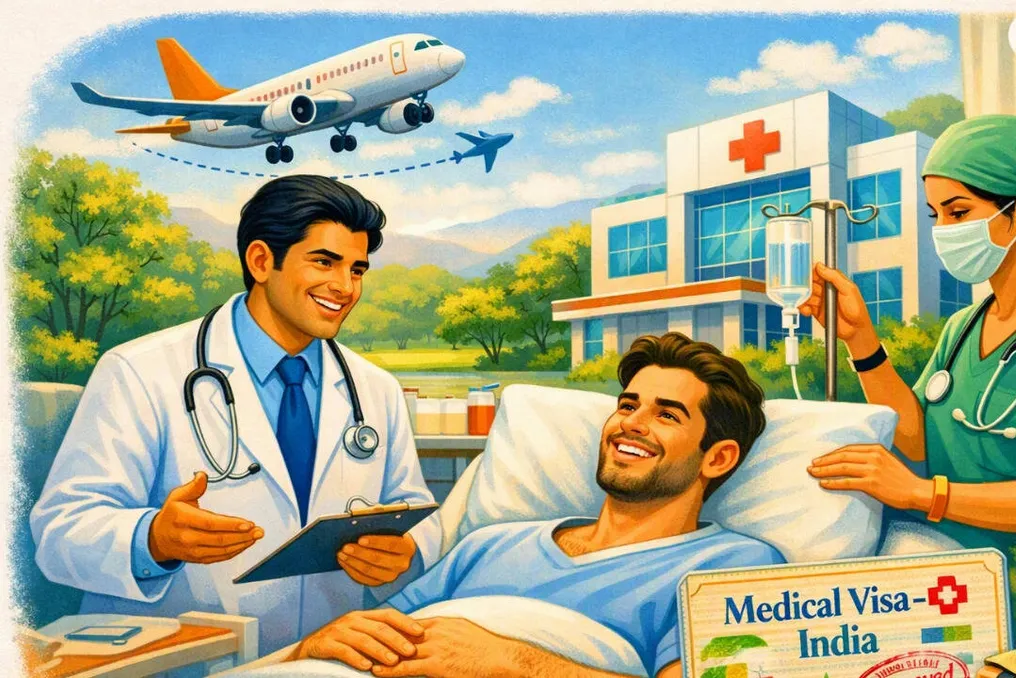
Every year, hundreds of thousands of patients travel to India not for sights or beaches, but to receive medical care. What initially stemmed from the need of patients from neighboring countries for inexpensive treatment has transformed into a broader ecosystem of medical tourism.
Growth of the Medical Tourism Market
Industry estimates, cited in the Economic Survey 2025–26 and by the government, project that India's medical tourism market will grow from approximately $8.7 billion in 2025 to $16.2 billion by 2030. During the same period, the global medical tourism market is forecast to grow from $115.6 billion in 2022 to $286.1 billion by 2030. Furthermore, India's wider healthcare market is expected to grow by 10–12 percent annually, reaching nearly 12 trillion rupees by the 2030 fiscal year, while private hospital chains plan to increase capacity from about 70,000 to over 108,000 beds.
According to the Medical Tourism Index 2020–21, India ranks 10th out of 46 global destinations for medical tourism.
What is Medical Tourism?
Medical tourism is defined as patients traveling outside their own country to receive planned treatment. While the low cost of procedures remains a significant factor, patients also consider waiting times, access to specialists, quality of care, language support, and post-treatment follow-up when choosing a destination.
Demand in India covers a wide range of services: from cardiac surgery and joint replacement to cancer treatment, fertility, organ transplantation, dentistry, cosmetic surgery, and neurological interventions. Improvements in digital consultations and simplified access to treatment information have also made it easier for patients to compare hospitals and plan their treatment before traveling.
Government Initiatives and Infrastructure
Under the Federal Budget for 2026–27, it has been proposed to develop five Regional Medical Centers in collaboration with government bodies and the private sector. These centers will integrate medical, educational, and research institutions, as well as AYUSH centers and specialized centers to promote medical tourism.
To facilitate such trips, India provides e-Medical and e-Medical Attendant visas, which are extended to citizens of 172 countries, as well as new e-AYUSH visa categories for those seeking traditional Indian systems of medicine. The government is also modernizing the Heal in India (Medical Value Travel) portal into a unified platform for finding hospitals, planning treatment, booking, payment, and postoperative care, and has offered airport concierge services to assist international patients upon arrival.
According to the government, as of 2026, India has 69,364 hospitals, including 43,486 private and 25,778 public institutions, along with about 1.2 million registered doctors and over 1,299 NABH-accredited hospitals. Many hospitals also hold Joint Commission International (JCI) accreditation, with most located in Delhi, Mumbai, Bangalore, Chennai, and Hyderabad.
Reasons for Patients Choosing India
For patients traveling, accessibility is often just part of the overall picture. In 2025, 507,244 foreign patients arrived in India for treatment, accounting for about 5.5 percent of the total number of foreign tourists that year, compared to approximately 112,000 in 2009. Bangladesh was the largest source of arrivals with 325,127 guests, followed by Iraq (30,989), Uzbekistan (13,699), Somalia (11,506), Turkmenistan (10,231), Oman (9,738), and Kenya (9,357).
Patients cite various arguments in favor of choosing India. American traveler Charlie Evans, who underwent treatment for seasonal flu and ear pain at a hospital in Rishikesh, noted his initial hesitation about seeking medical help in a foreign country. However, he reported being met by English-speaking staff, having virtually zero waiting time, and receiving treatment using equipment comparable to what he saw in the United States.
Evans stated that his consultation, medication, and treatment cost approximately $10–$20, compared to an estimated $150 for a similar visit in the US. He said, 'I received better treatment in Rishikesh—faster and cheaper than ever at home.' Beyond the lower cost, Evans emphasized the professionalism of the medical staff. He added that the doctor who treated him could easily practice in the US, and that healthcare in India seemed less profit-driven and more focused on patient care.
This experience reflects a broader trend where patients increasingly weigh convenience and quality against cost. American content creator Kristen Fisher, residing in India, also highly praised the country's healthcare system in her social media videos and interviews with Times Now. Although she believes the US offers a better overall hospital experience, she prefers India's healthcare system because it is 'simple, accessible, and fast' and offers 'quality treatment.' Fisher noted, 'I like that in Indian healthcare you pay before treatment. And after you leave the hospital, you never have to pay or worry about anything else.' She contrasted this with the US, where patients can receive bills 'months after' treatment.
She also commended the transparency of healthcare costs in India, stating, 'The cost is clearly defined before treatment. This allows people to look for a good deal according to their budget.' In a series of social media posts, Fisher also highlighted the accessibility of medical services in India, noting that patients can often see a doctor the same day without an appointment, unlike in the US where consultations can take weeks. She described Indian doctors as 'much less rushed and more attentive to your needs' and recounted treating a thumb injury at a Delhi hospital in just 45 minutes for 50 rupees.
Price and Experience Comparison
The cost advantage is evident even for routine procedures. Sedg, living in Utrecht, Netherlands, says she plans her dental visits around trips to India. She notes, 'A 30-minute teeth cleaning costs about €185 near my home. In Lucknow, I pay about 3000 rupees for the same treatment.' Aditya Oza, CEO of CureMeAbroad, which connects international patients with accredited hospitals, believes India is beginning to attract patients who previously chose destinations like Turkey and Thailand. He gave an example where two people who had previously traveled to Turkey for treatment chose India for their last procedure. 'Patients who have already been through it once and know what to look for are increasingly choosing India specifically. There is accreditation, specialist experience, and the cost gap is often the biggest among all destinations,' he said. 'What has changed is that patients now have a way to check all this beforehand instead of guessing.'
The Future: Focus on Patient Experience
Hospital leaders believe that India's competitiveness will increasingly depend on the overall patient experience, not just on costs. Dr. Sonia Lal Gupta, co-managing director of Metro Group of Hospitals, stated that accreditation, transparent clinical outcomes, and accountability remain important distinguishing features. She added, 'What we have not yet fully built is the trust and experience associated with this care, and that is where the real opportunity lies.' She emphasized that support must extend beyond the hospital stay, covering everything from the initial inquiry and medical visa assistance to treatment, recovery, and follow-up consultations after patients return home.
Meanwhile, Dr. Charan Shivraj Patil, founder and chairman of SPARSH Group of Hospitals, reported that providers are investing in specialized services for international patients to make treatment smoother from the initial inquiry to recovery. This includes pre-arrival teleconsultations, medical visa assistance, transparent treatment plans with cost estimates, airport transfers, accommodation support, language translation, culturally appropriate food, and post-treatment follow-up. He concluded, 'As the expectations of international patients continue to evolve, the focus remains on delivering world-class clinical outcomes complemented by personalized, culturally sensitive, and compassionate care.'
Content maker Ruben Charles from the UK, based in Guwahati, was impressed by the convenience and professionalism of his medical experience in India after using a home medical service for blood tests. He noted that the healthcare worker assisting him was knowledgeable, spoke fluent English, and took time to explain the procedure in detail. Charles stated, 'The service was excellent. It was very, very fast. It came right to my home.' He believes that the combination of quality, affordability, and convenience makes India an attractive destination for medical tourism, especially for international patients who can afford private medical care.
On the other hand, Jai Prakash, founder of the medical tourism consultancy Health Voyage Global, noted that patients often turn to India after failing to receive a correct diagnosis. He stated, 'Many patients feel they can get the right diagnosis and treatment in India for a fraction of the cost they would pay elsewhere.' He added that Indian doctors work with advanced medical equipment and global treatment protocols, allowing them to offer high-quality care with shorter treatment durations and lower overall expenses.
Not all patients travel to India solely because of lower costs or better hospitals. For some, crossing borders also provides privacy. A resident of Delhi shared how his neighbor traveled to India from Nepal for infertility treatment because she faced social stigma and family pressure at home regarding fertility issues. Seeking help away from her community allowed her to undergo the procedure without intense scrutiny or judgment.
Areas for Improvement
Despite the growing number of patients, hospitals note uneven access to healthcare across the country. Dr. Bharat S Modi, chairman of Welcare Hospital in Vadodara, noted that India attracts a steady stream of patients from neighboring countries such as Bangladesh, Nepal, Sri Lanka, and Afghanistan, as well as from Africa and parts of Central Asia. However, he believes the country has not yet realized its full potential in attracting patients from Europe, the US, and other developed markets.
Modi pointed out that international patients are drawn by India's competitive prices and medical experience, but much of the treatment remains concentrated in metropolitan areas, although second-tier centers can offer comparable quality at lower prices. Furthermore, he stressed that the medical visa application process remains a hurdle for foreign patients. He noted, 'Our experience has also shown that the government portal for issuing medical visas is unfriendly to the user,' adding that this 'disappoints a potential patient wishing to come to India for treatment.' He cited Marco Bellaro, an Italian living in Indonesia, who came to Vadodara for hip replacement surgery after finding a hospital online. Although Bellaro was initially concerned about hygiene standards and hospital infrastructure, Modi said these issues were resolved during consultations. The surgery was successful, but the medical visa process proved burdensome, confirming that simplifying visa procedures and strengthening global branding could help India attract more foreign patients.
Dr. Alok Hullar, CEO of RJ Corp Healthcare, also emphasized the need to simplify medical visa procedures, increase the number of internationally accredited hospitals, improve coordination between airports and hospitals, and expand multilingual support as key priorities.