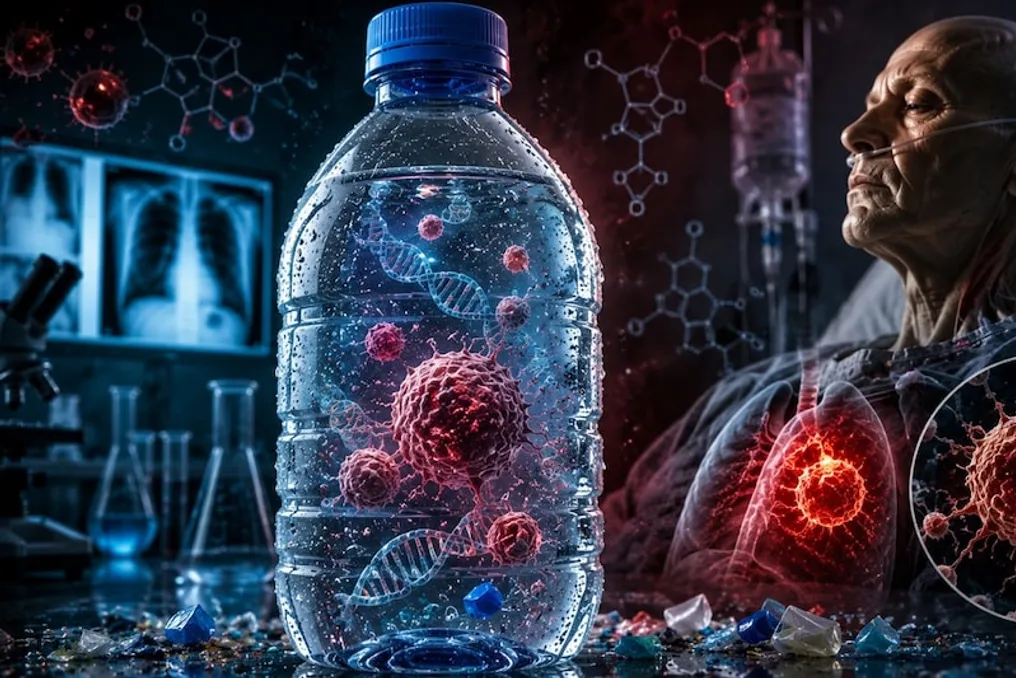
Claims are often circulated on social media that consuming water from plastic bottles can lead to cancer, causing concern among many people. This raises the question of whether ordinary plastic bottles pose a health threat and if this is dangerous.
Claims are often circulated on social media that consuming water from plastic bottles can lead to cancer, causing concern among many people. This raises the question of whether ordinary plastic bottles pose a health threat and if this is dangerous.
There is an opinion that if a plastic bottle is exposed to heat for a long time, the probability of releasing the chemical substance BPA increases. Furthermore, microplastics have become a subject of concern in recent years because they have been found in many human organs and in blood. Since these tiny plastic particles can enter water, there is a risk of them entering the body, given that BPA is considered a carcinogen.
To find out the experts' views, the publication spoke with Dr. Rohit Kapoor from the Oncology Department of Max Medical Center in Ghaziabad. Dr. Rohit notes that most studies conducted so far have been based on laboratory and animal models. Although some effects of these chemicals and microplastics have been observed in these studies, a direct proof of the link between drinking water from a plastic bottle and the development of cancer in humans has not yet been established, so further scientific research is necessary.
Nevertheless, Dr. Rohit advises trying to avoid drinking from plastic bottles. If the use of plastic is unavoidable, several precautions should be taken. It is necessary not to leave plastic bottles in direct sunlight or in hot cars. Bottles that are cracked, discolored, or old should not be reused. Ideally, glass or stainless steel bottles should be chosen for drinking.
Dr. Rohit emphasizes that research on microplastics and related chemicals is ongoing, but remaining vigilant remains extremely important. Therefore, if one must drink water from a plastic bottle out of necessity, it should not be used more than once or twice.
Microplastics are beginning to harm the heart. According to a new study conducted in Italy, particles of micro- and nanoplastics were found in the blood of patients who had suffered a heart attack. It was established that people suffering from heart attacks have higher concentrations of these particles than healthy individuals, which may indicate a link between microplastics and the occurrence of heart attacks.
Researchers from the University of Campania Luigi Vanvitelli in Italy took blood samples from 61 patients. Analysis of these samples revealed the presence of micro- or nanoplastics in 84% of patients with severe heart attacks. Furthermore, these particles were found in 40% of people who previously suffered from heart diseases. In 97% of cases where plastic was found in the patients' blood, polyethylene was identified—the same material used in the production of polyethylene bags, plastic bottles, and packaging materials.
As stated in the article published in the European Heart Journal, microplastics cause inflammation and oxidative stress in the body. Both processes contribute to increasing the risk of a heart attack. Although this study does not prove a direct causal link between microplastics and heart attacks, it confirms an increased risk of heart attack due to microplastic exposure.
Preventive cardiologist and nutritionist from America, Michelle Rautenstein, noted that the goal of this study was to examine the relationship between microplastics and heart disease. The detection of microplastics in patient blood samples demonstrates that these particles can damage the heart. However, the expert emphasized that it is premature to claim that microplastics are the sole cause of a heart attack and called for increased vigilance.
Microplastics are found in packaged food, airborne dust, and synthetic clothing fibers. They enter the body through the respiratory tract. Previous studies have already shown the presence of microplastics in human blood and lungs. Experts believe that completely eliminating contact with them is impossible, but the level of exposure can be reduced by minimizing the use of plastic in all its forms.
According to health officials, the fifth person has died from legionellosis in connection with the ongoing outbreak of the disease in the Upper East Side area of the city.
The New York City Department of Health reported that at least 82 cases of the disease have been identified, and eight people were hospitalized as of Tuesday. Fifty-six patients have been discharged from hospitals since the start of the outbreak.
Legionnaires' disease is a severe form of pneumonia caused by a bacterium that actively develops in warm, stagnant water. Health specialists have focused their efforts on inspecting cooling towers, which are part of the air conditioning systems of large buildings. Property owners were ordered to drain and disinfect those cooling towers that tested positive.
As of Tuesday, health authorities stated that 34 cooling towers in 33 buildings containing the live bacteria have been cleaned and disinfected. Nine cooling towers tested negative, and results from the remaining 140 cooling towers are expected within the next week.
According to data from the US Centers for Disease Control and Prevention, legionellosis is treatable, but about 10 percent of patients die due to complications. This outbreak occurred less than a year after another case in the Harlem area of New York, which affected over 100 people and claimed seven lives.