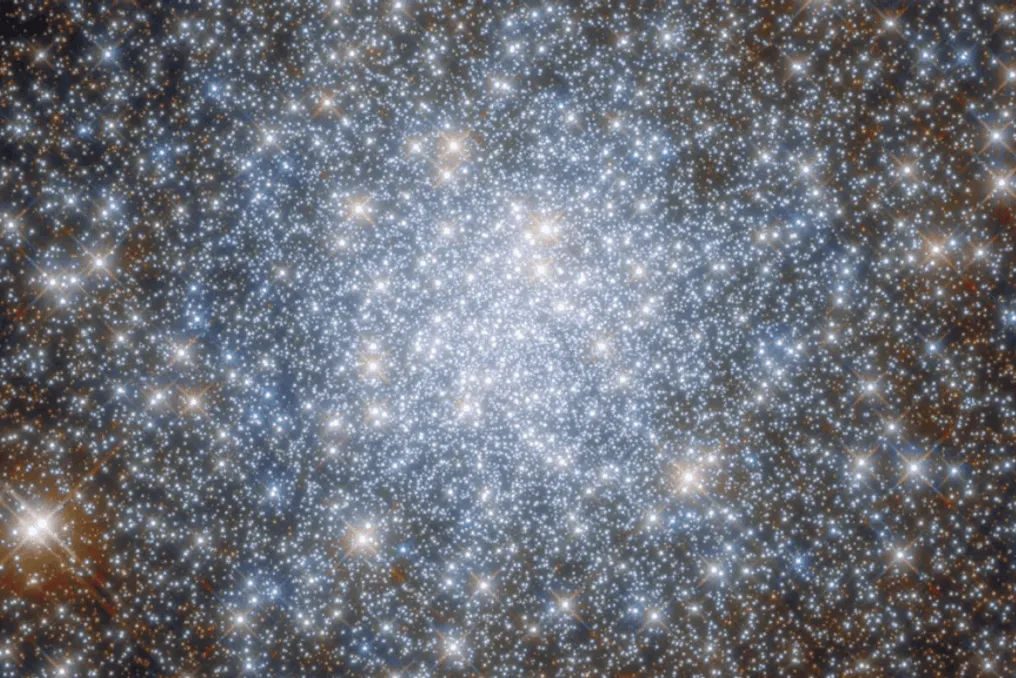
A new investigation offers a possible explanation for the enigma of the Little Red Dots, intriguing phenomena detected by the James Webb Space Telescope (JWST). Researchers propose that these objects did not simply disappear in the primordial universe, but rather evolved to become globular clusters, which are vast groupings of densely packed stars, like those found in the Milky Way.
Parallel with Terrestrial Evolution
The theory establishes an analogy with the evolution of terrestrial dinosaurs: just as many dinosaurs were not extinct but gave rise to current birds, the Little Red Dots could have survived, transforming into structures that persist in the contemporary universe.
Origin of the Mystery with James Webb
The Little Red Dots began to attract astronomers' attention in 2022, when James Webb started detecting them in large numbers at a phase corresponding to approximately 600 million years after the Big Bang. The mystery lies in the fact that these bodies appear to disappear before the universe reaches about two billion years old.
Several theories have been raised about their nature, including the possibility of being 'black hole stars,' meaning black holes surrounded by extensive clouds of gas and dust. However, the current research points to another path: these objects could be globular clusters in a formation stage, possessing a supermassive star at their core.
This hypothetical type of star would have a mass between one and ten thousand times that of the Sun and a very short life, but it would be capable of generating an appearance similar to that of the Little Red Dots observed by the telescope. John Chisholm, lead researcher from the University of Texas in Austin (USA), stated that these objects may not just be a strange new population from JWST unrelated to the current universe, but rather that they may endure beyond the primitive universe, evolving into something more known.
Chisholm added that the Little Red Dots could be galaxies, involve black holes, or represent something even more unexpected, and that their work demonstrates that the formation of globular clusters with supermassive stars must be considered in this debate.
Characteristics of Globular Clusters
Globular clusters are typically located in large galaxies and manage to concentrate millions of ancient stars in extremely compact areas. The Milky Way, for example, contains at least 150 of these clusters. Although well-studied, their origin remains a topic of scientific discussion.
Danielle Berg, also from the University of Texas in Austin, mentioned that astronomers usually observe these clusters after billions of years of evolution. She explained that at this point, their massive stars have already gone extinct, their gas has dispersed, and dynamic processes have modified their masses and structures, making it difficult to reconstruct the initial conditions of their formation.
Unusual Chemical Composition
Scientists believe that the stars within globular clusters formed approximately at the same time, during the early stages of the universe, when the cosmos was mainly composed of hydrogen, helium, and small amounts of heavier elements, called metals by astronomers.
However, many of these stars exhibit a peculiar chemical composition. They show a high abundance of helium and elements such as nitrogen, sodium, and aluminum, while showing lower levels than expected of carbon, oxygen, and magnesium. Mike Boylan-Kolchin, a member of the team, indicated that this chemical signature points to extreme nuclear fusion conditions.
He specified that this particular pattern signals nuclear fusion at temperatures much higher than those found in the cores of common stars, even massive ones. A supermassive star is exactly the type of environment capable of generating this chemical combination.
Life Cycle of Giant Stars
According to the researchers' proposed model, these supermassive stars would emerge in environments of extremely high density during the formation of the first globular clusters, where stellar collisions and mergers would occur frequently. Despite their colossal size, they would have a lifespan of only about one million years, an infinitesimal period compared to the 4.6 billion years of the Sun's life.
Even with this short existence, these stars would be capable of producing the chemical elements necessary to justify the composition observed in globular clusters. After dying in supernova explosions, these elements would be released into space, being used in the creation of new generations of stars.
Chisholm concluded that this would also explain the disappearance of the Little Red Dots. In their model, the supermassive star that makes the object look like a Little Red Dot lives for a short time; after its death, the object may cease to resemble a Little Red Dot, even if the cluster itself persists for billions of years.
Evidence of Distribution and Time
In addition to chemical analysis, the team identified other signs linking the Little Red Dots to globular clusters. The distribution of these objects in the early universe mirrors the distribution currently seen in globular clusters. Evolution models also suggest that the estimated masses of the Little Red Dots could naturally progress to reach the masses of existing globular clusters today.
An additional relevant factor is the timing of their appearance: the Little Red Dots appear about 600 million years after the Big Bang, coinciding with estimates for the beginning of globular cluster formation. Despite the evidence, the researchers warn that the hypothesis still lacks definitive confirmation. Boylan-Kolchin stated that although there is no conclusive proof that the Little Red Dots are globular clusters, this idea would explain several surprising and distinct observations. The study is in a preliminary version on the scientific repository arXiv, implying that its results have not yet undergone peer review.