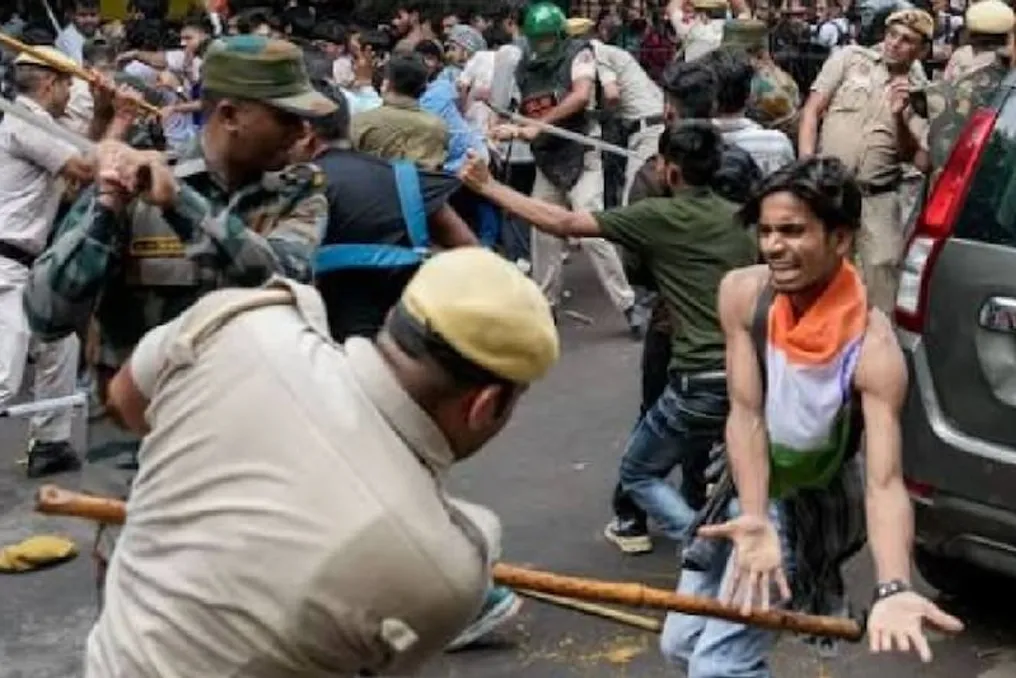
The greatest danger is not the use of force by the police, betrayal, or greed, but rather a state of dead silence where dreams fade. The protests are taking place at Jantar Mantar, a place where the country's anger is directed at its rulers.
The greatest danger is not the use of force by the police, betrayal, or greed, but rather a state of dead silence where dreams fade. The protests are taking place at Jantar Mantar, a place where the country's anger is directed at its rulers.
This time, the atmosphere at Jantar Mantar is characterized by a special mix of sorrow and anger. People and students are gathering to demand changes that will prevent anyone from stealing children's dreams under the pretext of exams. They demand the enactment of a law that would secure the future of every child.
The problem of injustice, dishonesty, and corruption, which has existed for hundreds of years, is reappearing. This 'cancerous tumor' of exam fraudsters requires a final intervention. Citizens want to determine the fate of politicians who profit from the government's life by sowing political seeds.
Besides issues such as inflation, poverty, and hunger, corruption is the most serious and dangerous disease for the country. It is asserted that overcoming this problem will allow the image of the 'golden bird'—a prosperous India—to be revived.
However, to win this fight, it is not enough just to light the torches of revolution, chant slogans, or go on hunger strikes. Self-change by citizens is necessary, as they themselves contribute to encouraging dishonesty and corruption. The NEET exam leak scandal is not just a leak, but an entire system of dishonesty and corruption.
The protests, which began at Jantar Mantar in the heart of Delhi, instill hope that the country can become honest and free from corruption, improving the future of the youth. Supporters of justice do not want to discuss their duties, waiting for fair conduct of exams like NEET. Some may argue that the students at Jantar Mantar were despotic or manipulated by politicians, but they should personally feel this anger and sorrow.
This crowd consists not of a segment of the electorate, but of people whose year of study and repeated disappointment in their parents' dreams have led them to this movement. Jantar Mantar, which literally means 'counting of time and planets,' has historically been a symbol of scientific progress and has today become a recognizable site for demonstrations.
Thirty-three years ago, in 1993, the Delhi University Students Union first held a major demonstration at Jantar Mantar. Since then, this place has become a venue where democracy lives. The current events began in May of this year when 22 million children were preparing for the NEET exam, which was stolen by fraudsters and canceled due to a leak.
Parents who invested all their savings in the dream of their children becoming doctors cannot be forgotten. When they had to sell property to provide for their children, they received only deception. If the country cannot protect even one exam from thieves and corrupt officials, then India's future will be overshadowed by anger and despair.
Many students who thought their goal was close after successfully passing the exam broke down upon learning about the fraud. More than 20 children across the country have taken their own lives. This causes deep shock, because while an exam can be understood, the suicide of children cannot.
The tragedy of NEET students has deeper roots. India is among the largest countries in the world with the most extensive education system, comprising 14.71 million schools where about 247 million children study. India is the second country after China in terms of graduates. Approximately 50 million people graduate every year, but only 28 million find employment, leading to an annual increase of 22 million unemployed people.
In such a situation, where a whole year of hard work is nullified due to exam theft, it is impossible to imagine what is happening to these children and their families. The question arises: how can a country that proclaims its greatness fail to protect even a small exam from fraudsters?
After the leak in May, students expressed dissatisfaction through small platforms. Then an unusual event occurred: the word 'Tarakan' was uttered by the Chief Justice of India. This comment, made in the Supreme Court of Delhi, was ridiculed in Boston, USA, and spawned the 'Tarakan People's Party' movement on social media. Initially, it was a joke, memes, but gradually it became an ally to the children affected by NEET.
Authorities assumed that no one would organize a re-examination. However, despite loud statements, for the first time, military aircraft from hostile countries were forced to deliver exam papers to testing centers within the country's borders. Only after this did the exams take place and results appear, raising questions about the reasons for the protests at Jantar Mantar.
What started as a joke reached Jantar Mantar. The demands were simple: improve educational conditions and force the Education Minister, recognized as a great teacher in education, to resign after the exam failure. The movement quickly went beyond social media.
The situation changed with the appearance of social activist Sonam Wangchuk from Ladakh, who announced a hunger strike at Jantar Mantar. After several days without results, people came and went. But as the hunger strike lengthened, people began to recall the events of 2011—the Anna Hazare movement, where a new generation saw echoes of Gandhi.
Sonam Wangchuk's condition worsened, and his lawyer approached the Delhi High Court requesting his life be saved and the hunger strike stopped. The court ruled that life is important and that Sonam Wangchuk's health must be cared for. This gave the police only one lever of pressure.
Before the start of the autumn parliamentary session, Sonam Wangchuk was informed of a student march to parliament. However, activity in Delhi suddenly intensified: on July 17, the Commissioner of Police of Delhi was changed, and his first meeting was dedicated to Jantar Mantar. Preparations for action took place in the evening and night. On July 18, after 20 days of fasting, the Delhi police forcibly took Sonam Wangchuk to Safdarjung Hospital, pretending to be doctors.
The planned march on July 20 became impossible because the police not only removed Sonam Wangchuk but also issued an order to clear Jantar Mantar. However, perhaps the police forgot the significance of Jantar Mantar, created for measuring time and planets. On March 20, thousands of children gathered there again to improve their time and planets.
The police were ready to stop the children, and the children were ready to convey their voice to the rulers. Shooting began; children's tears mixed with tear gas. Some were hit, some were lifted. Some headed to police stations, some to hospitals, and others returned home with a promise to come back to fill their dreams with colors, once again at Jantar Mantar. This movement cannot be ignored.
In conclusion, the worst thing is the dead silence, the absence of struggle, the acceptance of everything. The worst thing is the fading of our dreams.
Discontent is growing across the country regarding the leak of NEET examination materials. Protests by the Coakeruz Janata Party (CJP) took place at Janta-Mantar Square in Delhi, attracting a large number of students not only from the capital but also from other Indian states. Furthermore, students are holding protest actions in the streets of Patna and Mumbai.
Many famous personalities from the world of cinema and sports have reacted to this situation. Following Salman Khan, former Indian cricketer Sachin Tendulkar publicly spoke on the issue. He supported the anger of the students, understanding their pain, while also sharing a life lesson from his journey.
Publishing a message on social media, Sachin Tendulkar addressed the youth, noting that admitting failure is normal, but cheating or fraud is absolutely unacceptable. He emphasized that a society that focuses solely on results begins to look for shortcuts instead of valuing merit. He called upon society and the administration to remember their moral responsibility.
Tendulkar continued, stating that the disappointment of students is quite natural when they feel their hard work has not been rewarded. He noted that parents, teachers, schools, and administrators must jointly ensure that they never have to feel this way again, creating an environment where only honesty and competence prevail. He added that the youth are the future of the country, and it is important to understand their dreams, but it is equally important to remain patient during difficult times and maintain trust in the country's institutions and government.
Shubman Gill, captain of the Indian ODI and Test team, also expressed support for the peaceful actions of the youth in India through his Instagram account. Gill stated that the younger generation has every right to learn, dream, and shape the country's future. He emphasized that education is the true strength of nation-building, and the interests of every student should be taken into account in this matter, along with mutual respect and empathy.
Meanwhile, the political atmosphere is heating up due to debates over exam leaks and education. Rahul Gandhi, the opposition leader in the Lok Sabha and a Congress MP, reiterated the students' demands and called for the removal of Minister Dharmendra Pradhan. Additionally, the Coakeruz Janata Party (CJP) announced a nationwide protest for July 24.
