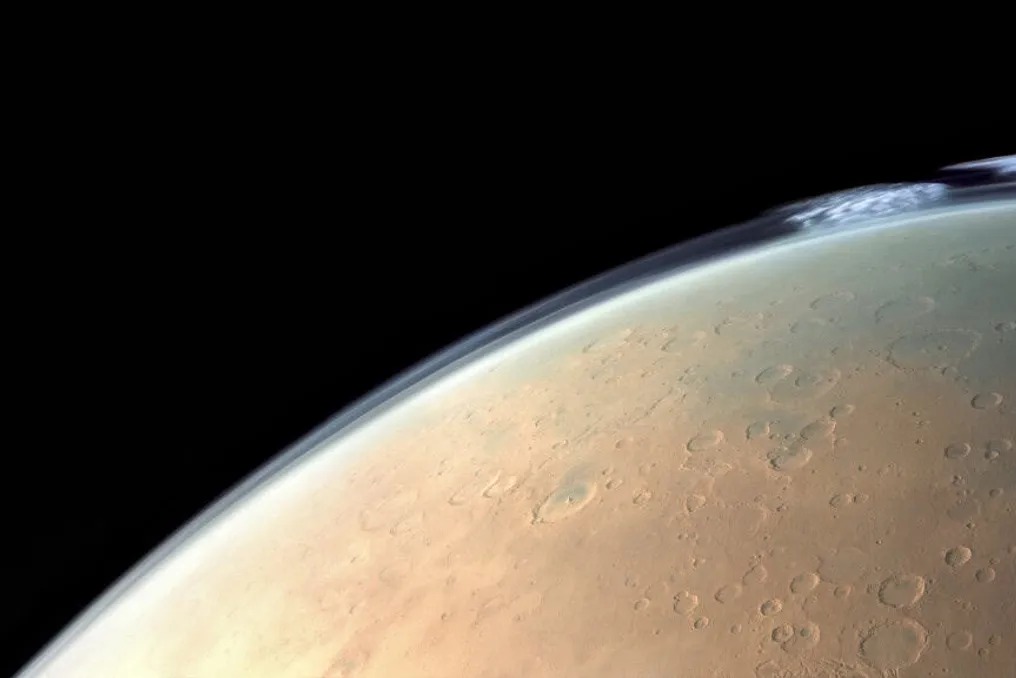
The NASA probe Psyche successfully completed its flyby of Mars on May 15. This maneuver utilized the planet's gravitational pull to accelerate the spacecraft and make minor trajectory adjustments toward the metallic asteroid Psyche, whose final destination is scheduled for 2029.
Testing Scientific Instruments
In addition to serving as a gravitational maneuver, the flight served as a crucial test for the various scientific instruments onboard the spacecraft. These instruments collected a vast amount of data and recorded images of the Red Planet. The US space agency reported that data collected in the weeks following the flyby indicated that all instruments operated as planned, generating measurements consistent with prior knowledge of Mars and adding new details to the planet's understanding.
By using Mars as a temporary substitute for the Psyche asteroid during the encounter, the team was able to validate the devices that will be essential for scientific studies when the probe reaches its target. Lindy Elkins-Tanton, the principal investigator of the Psyche mission at the University of California, Berkeley (USA), commented that the camera, magnetometer, and gamma-ray and neutron spectrometer teams worked hard to maximize this planetary encounter, and that all instruments showed excellent results.
She noted that major discoveries about Mars were not the initial expectation, given the extensive research already conducted on the planet. However, she added that the data obtained from Psyche's unique perspective helped complement Martian science.
Neutron Spectrometer Performance
One of the central tests involved the gamma-ray and neutron spectrometer, an instrument designed to determine the chemical composition of the surface of the Psyche asteroid. This equipment works by measuring neutrons and gamma rays emitted by a celestial body after its surface is struck by high-energy cosmic rays, allowing for the identification of chemical elements present in the soil.
Although the probe passed at an altitude of about 4,609 kilometers above Mars—a distance considered too great for detecting gamma rays from the planet—scientists expected to record neutrons escaping the Martian atmosphere and surface. As reported by NASA, this happened as predicted. David Lawrence, the scientific lead for the mission's spectrometer at the Johns Hopkins University Applied Physics Laboratory, stated that near the point of closest approach, the neutron spectrometer detected an increase in the count rate very close to what was expected, which was very satisfying to observe.
Lawrence also confirmed that, as anticipated, there was no detection of gamma rays originating from Mars, but the instrument was fully tested and demonstrated excellent functionality.
Magnetic Field Recording
Another component put to the test was the mission's magnetometer, which has been active since Psyche's launch in 2023. Its purpose is to measure the magnetic field of the Psyche asteroid and assist in verifying the theory that it represents the remaining metallic core of a planetesimal, a fundamental block in the formation of rocky planets.
Previously, the magnetometer continuously recorded the magnetic field of the solar wind during the spacecraft's journey, including coronal mass ejection events emitted by the Sun. However, the flyby of Mars marked the first time the equipment measured the magnetic signature of a celestial body.
Ben Weiss, an associate investigator on the mission and responsible for magnetometry studies at the Massachusetts Institute of Technology (MIT), explained that as it passed near Mars, the magnetometer registered a strong increase in the magnetic field associated with the bow shock region, where the solar wind collides with the planet's magnetic field. He added that this test validated the equipment's performance under dynamic conditions and revealed interesting aspects of planetary magnetism physics.
Detailed Images of the Red Planet
Psyche's multispectral camera was also employed during the encounter with Mars. This system consists of two identical cameras designed to photograph the asteroid's surface at different light wavelengths. Since early May, even before the maximum approach, the equipment began capturing images of the Red Planet.
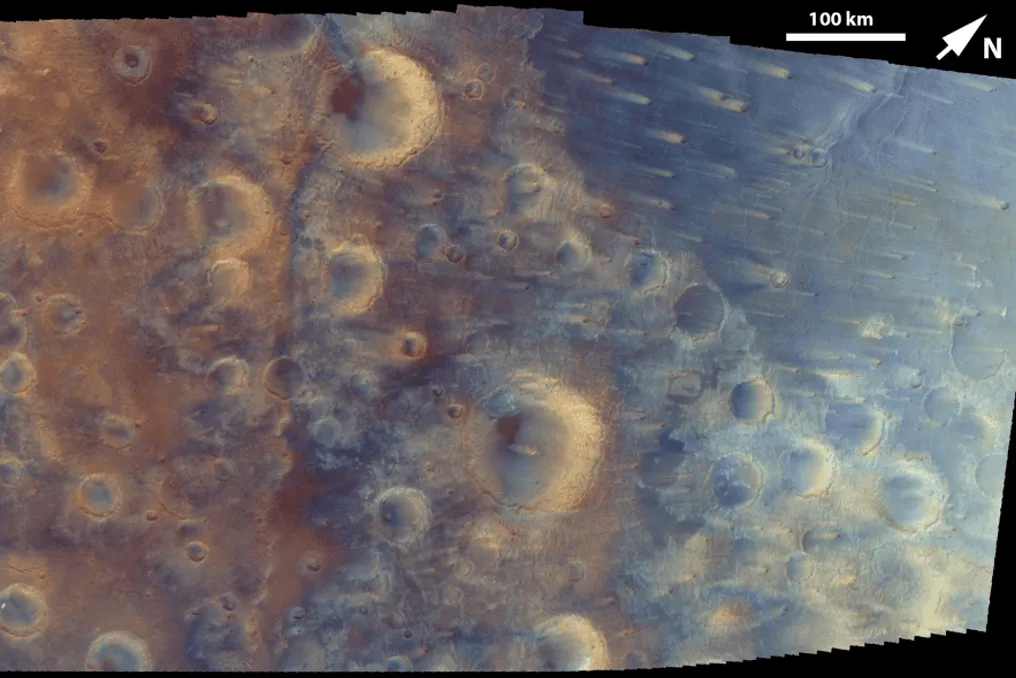
Due to the high angle of approach relative to the Sun, Mars initially appeared as a thin crescent moon illuminated, with sunlight scattering in its atmosphere. During the moment of closest proximity, the cameras captured detailed photos of the Martian surface, including wind-eroded craters, the south pole, and the large Huygens crater, notable for having two rings.
These images were compiled into a time-lapse video released by NASA, gathering records taken over approximately one month during the flyby sequence. Jim Bell, who is responsible for the instrument at Arizona State University (USA), stated that the camera performed exceptionally well, providing rarely seen images of the Red Planet.
Bell mentioned that, in addition to the visual quality of the photographs, the team was able to fully test the equipment's calibration and its sensitivity to scattered light. The researcher also highlighted that the cameras were able to identify the Martian moons Phobos and Deimos, even from a great distance. This procedure will serve as training for future searches for small natural satellites that may orbit the Psyche asteroid.
For calibration purposes, the team is comparing the images obtained by Psyche with records from other missions to Mars, such as the Mars Reconnaissance Orbiter and 2001 Mars Odyssey, the Curiosity and Perseverance rovers, as well as the European Space Agency's (ESA) Mars Express and ExoMars Trace Gas Orbiter, and the UAE's Hope mission.
Next Steps for the Mission
After completing the gravitational assist, the probe proceeds directly toward the Psyche asteroid, located in the main asteroid belt between Mars and Jupiter. Bob Mase, project manager at NASA's Jet Propulsion Laboratory (JPL), informed that the flyby was the result of years of planning. He emphasized that this gravitational assist required years of preparation and that the navigation team executed the maneuver with precision, placing Psyche on the correct trajectory for the asteroid encounter in the summer of 2029.
Mase added that the spacecraft is in excellent condition and that the mission remains on schedule to resume continuous operation of the solar-powered electric propulsion system in the second half of this year.