According to an analysis of the domestic foreign currency market conducted by the Central Bank, in the first half of 2026, the supply of foreign currency in Uzbekistan grew faster than the demand.
According to an analysis of the domestic foreign currency market conducted by the Central Bank, in the first half of 2026, the supply of foreign currency in Uzbekistan grew faster than the demand.
Total demand for foreign currency reached approximately 32 billion US dollars, which is 20% higher than in the period from January to June 2025. Meanwhile, the supply, excluding Central Bank operations, increased by 31% to 27.8 billion US dollars.
Demand from legal entities rose by 19% to 25.2 billion US dollars, while demand from private individuals increased by 26% to reach 6.8 billion US dollars. The supply of foreign currency from companies and banks amounted to 13.5 billion US dollars, showing a year-on-year growth of 29%. Private individuals contributed 12.3 billion US dollars, and the Ministry of Investment, Industry and Trade and the Reconstruction and Development Fund contributed about 2 billion US dollars.
Currency receipts from exporters grew by 30%, reaching 10.1 billion US dollars. Of this amount, 5.6 billion US dollars, or 55%, was sold on the domestic market, which is 1.2 billion US dollars, or 26.4%, more than the previous year. In the structure of import financing, the share of funds acquired on the foreign exchange market increased from 63.1% to 67.2%, while the share of companies' own foreign currency resources decreased from 23.7% to 22.6%. The share of foreign currency loans decreased from 13.2% to 10.2%.
An additional source of currency supply was the positive net balance of 5.5 billion US dollars in household foreign exchange operations with banks, as well as the inflow of international remittances. The country received 9.3 billion US dollars in remittances, while outflows amounted to 1.3 billion US dollars. Against this data, the sum remained relatively stable, trading in the range of 11,935 to 12,320 per US dollar. By the end of June, the exchange rate was 12,009 soms per US dollar, which has practically not changed since the beginning of the year. However, the average daily bilateral exchange rate volatility increased from 22.7 to 30.2 soms, which the Central Bank attributed to a more market-driven formation of the exchange rate.
The regulator reported that it sterilized additional liquidity arising from gold operations through foreign exchange transactions in accordance with the principle of neutrality and other monetary policy tools. In its June report (Article IV), the International Monetary Fund reclassified Uzbekistan's exchange rate regime from 'managed float' to 'floating'. According to the review, 33 countries, including South Korea, New Zealand, Malaysia, Turkey, Thailand, Armenia, and Kazakhstan, have the same classification. The IMF added that exchange rate flexibility is an important condition for effective inflation targeting and mitigating external shocks.
By the end of the current year and next, the Central Bank intends to develop a risk-based strategy for foreign exchange market operations, expand the market maker institution, improve trading infrastructure, including settlement, clearing, and market monitoring systems, and strengthen the legal framework for hedging currency risks, including through derivative financial instruments.
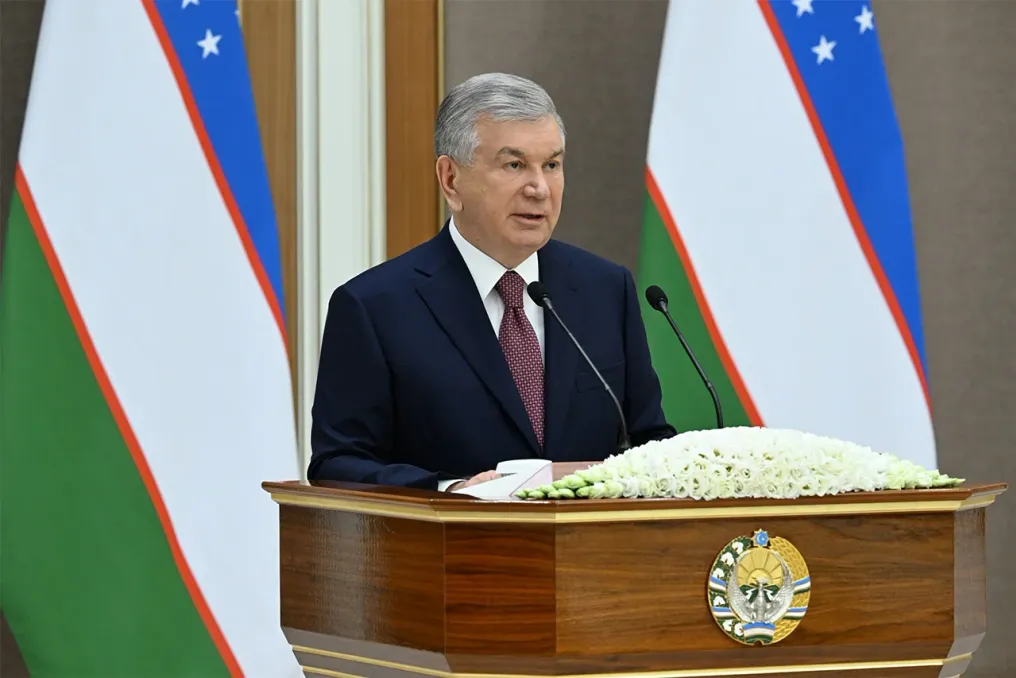
The President of Uzbekistan, Shavkat Mirziyoyev, chaired a video conference dedicated to the results of the country's socio-economic development in the first half of the year and the determination of priority tasks for the remainder of the year.
Mirziyoyev instructed officials participating in the meeting not to limit themselves merely to reports on completed work. He emphasized the need for a clear explanation of what new internal reserves have been discovered, what mechanisms have been created for their effective use, and what specific results are planned to be achieved by the end of the year.
Furthermore, the president stressed that in the context of a changing global environment, every employee must work with additional development scenarios and be prepared for various possible outcomes.
Since the beginning of the year, Uzbekistan's economy has shown growth at the level of 8.5%. Industrial production increased by 8%, the service sector by 16.9%, construction by 13.8%, and agriculture by 4.7%. The volume of investments reached 28 billion US dollars, and exports amounted to 14.4 billion US dollars. International rating agencies Fitch and Moody's raised Uzbekistan's sovereign credit rating by one step.
Nevertheless, the president noted that for the further improvement of the population's living standards, which numbers 40 million people, the country requires sustainable economic growth of 9–10%.
A critical analysis of the fulfillment of six-month plans was conducted at the meeting by heads of regional and industry structures. It was observed that in some regions, the existing potential was not fully utilized to increase the gross regional product, develop the construction industry, and attract investment.
Due to the ongoing instability of the world economy, additional financial funds are being allocated to regions, districts, and cities to implement projects in entrepreneurship and social infrastructure development. The President strongly stated that if the activities of any minister or hokim do not lead to a tangible improvement in people's quality of life and do not facilitate business conditions, the achieved figures remain only 'paper statistics.'
He also firmly stated that under current circumstances, no minister, hokim, or sector head has the right to operate without consequences if they fail to meet monthly, quarterly, or annual plans.
Special attention was paid to the implementation of a new model for organizing the work of the 'mahalla seven' system. It was noted that all main approaches were explained in detail last week, and specific tasks were assigned to responsible persons. As part of this work, the 'Active 40 Days' program was announced, which launches a fundamentally new system of labor organization in two thousand of the most problematic mahallas.
In these mahallas, tripartite agreements between hokims, mahalla chairmen, and territorial employment service units were revised. Hokims were delegated personal responsibility for the timely resolution of issues related to electricity, gas, and water supply, as well as road infrastructure in two thousand of the most problematic mahallas. Employment service leaders will work directly in the field, providing targeted assistance to residents, organizing professional training, and helping with employment and income increase.
Leaders of the mahalla system were also tasked with improving all 8992 mahallas in the country, including landscaping streets and residential areas, planting trees and seedlings, and maintaining irrigation canals in proper condition.
The President expressed extreme dissatisfaction with the work of banks at the mahalla level, sharply criticizing the heads of territorial departments of the Central Bank and directors of state banking branches. It was noted that the current year will be a testing period and a year of practical evaluation for heads of regional and district banks, as well as organizations of the mahalla system. Only those leaders who demonstrate real results will remain in their posts during the next three months; those who cannot ensure positive changes will be dismissed.
The Prosecutor's Office and the Accounts Chamber were instructed to monitor the organization of work in each mahalla and the real changes occurring on the ground. The meeting also included an assessment of work on improving mahallas, sanitary order, living culture, and cooperation with private households, while emphasizing the importance of expanding the activities of management companies in individual housing construction.
The President stated that the country is creating all necessary conditions for citizens wishing to start their own businesses and enter foreign markets. Currently, 51 ministries and departments are authorized to impose financial fines in 322 districts. In the period from 2024 to 2026, the total amount of imposed fines reached almost 3 trillion sums.
The President demanded that heads of departments with sanctioning powers change their attitude towards entrepreneurs and their approach to work. He emphasized that before punishing businesses, state bodies must learn to provide entrepreneurs with the opportunity to correct violations and help them find the right solutions.
Amid increasing competition in global markets, the issue of reducing payments and commissions charged to producers and exporters was also raised at the meeting. As an example, it was noted that the export of one truckload of cherries incurs additional costs—customs duties, fumigation, certification, and customs broker services—reaching 5 million sums.
Following the discussion, all ministers and sector heads were instructed to submit proposals to the Presidential Administration within a week for the radical reduction of bureaucratic procedures, fines, payments, and commissions in relevant sectors, as well as for improving the business climate.
The results of work in industry and exports for the first half of the year were analyzed. It was noted that after the first quarter, the hokims of 13 districts that failed to meet industrial production targets, as well as the hokims of 15 districts that recorded a decrease in export volumes, were subjected to disciplinary measures. According to the president, most officials drew appropriate conclusions and ensured the fulfillment of semi-annual forecast indicators.
However, it was noted that in many districts and cities, the pace of industrial growth remains unsatisfactory. For example, in Yangiabad district, the projected industrial growth of 5.7% actually amounted to only 1.8%. A slowdown in growth was also observed in the city of Gazgan, as well as in the districts of Muzrabad, Kiziriq, and Oltiarik.
The export situation also drew criticism. It was noted that a number of districts and cities failed to achieve positive changes, raising concerns about the district heads of Kasbi, Denov, Tashkent, Pakhtaabad, Jomboy, Tailak, Bandikhon, Mirzachul, and Yaziavan, as well as the cities of Jizzakh, Navoi, and Bektemirsky district in Tashkent.
After the discussion, the Prime Minister was instructed to conduct an assessment of the suitability of 17 hokims for their positions on the same day. The President also warned that if the situation does not change by the end of the ninth month, strict measures will be taken against deputy regional hokims.
The expenses of strategically important enterprises were examined separately. It was noted that industry departments had previously reported a percentage decrease in total costs, presenting this as a reduction in product cost. However, the analysis of the unit production cost provided a more objective picture. At the Navoiy Mining and Metallurgical Combine, the cost of producing one ounce of gold increased by 8.2%, and the company's total expenses increased by 6.2 trillion sums, or 22% compared to the previous year. At the Uzbek Metallurgical Combine, the cost of producing steel balls increased by 5.4%. At Uzkimosanoat, the cost of producing urea increased by 11.1%, and nitric acid by 8.3%.
It was also noted that Franklin Templeton analyzed 13 large enterprises considered for Initial Public Offerings (IPOs). The operations of Uzbekistan Airways were cited as an example. It was found that due to a suboptimal route network, large intervals between flights, numerous delays, and lack of competition in catering and technical maintenance, the company loses about 120 million US dollars in revenue annually.
The meeting noted that Uzbekistan will require 8 billion US dollars over the next ten years to develop its energy infrastructure. At the same time, it was noted that efforts to increase revenue by reducing losses in the power grid remain insufficient. In the first half of the year, electricity losses amounted to 17.2%, or 4.8 billion kilowatt-hours. Losses in gas distribution networks reached 7.6%, equivalent to 797 million cubic meters of gas. It was also noted that labor productivity at enterprises of territorial gas distribution networks is 1.5–2 times lower than in neighboring countries.
According to Franklin Templeton's analysis, the market value of Hududiy Elektr Tarmoqlari could double. The company also assessed the potential to increase the market value of Uzbekistan Airways by 40% and Uztelecom by 50%.
It was noted at the meeting that existing opportunities to increase tax revenues are not being fully utilized. Tax revenues increased by 27% since the beginning of the year, exceeding 130 trillion sums. However, the annual plan for additional tax revenues was met by only 40%, amounting to 12 trillion sums. Criticism was directed at the first deputies of regional hokims, who were alleged to have insufficiently interacted with enterprises regarding tax revenues. The Bukhara region was given as an example, where 162 enterprises with an annual turnover exceeding 100 million sums operated at a loss for three consecutive years and consequently paid no profit tax.
It was also noted that 1500 enterprises not paying VAT relied on the VAT deduction mechanism. As a result, the first deputy hokim of the Bukhara region was removed from office. As of July 1, the authority for tax administration for 498 large taxpayers was transferred to the regional level. The President emphasized that there are now no excuses for failing to meet the set tasks. The first deputies of regional hokims and heads of territorial tax authorities were instructed to work closely with these enterprises and ensure timely and full payment of taxes to the budget.
At the meeting, it was noted that 16 textile enterprises are currently non-operational due to protracted legal disputes related to loan repayment, despite most of them possessing modern production capacities. As a result, the economy loses about 5 trillion sums in production volume annually, and unrealized exports reach 400 million US dollars. It was noted that some banks already have successful experience in reviving such enterprises. The Tashkent Cotton enterprise was cited as an example, where an external management team was introduced. Thanks to the measures taken, the enterprise's activity was restored, and this year it has already exported products worth 10 million US dollars. Following the discussion, officials were instructed to appoint curators for the remaining enterprises and ensure the complete restoration of their production activities.
It was noted at the meeting that since the beginning of the year, 57 industry and 76 territorial enterprises have reduced their production volumes by a total of 11 trillion sums. The Deputy Prime Minister was instructed, together with regional hokims and sector heads, to conduct a detailed analysis of the activity of each enterprise within ten days. It was emphasized that all identified problems must be resolved at the local level. The Industry Council was tasked with preparing proposals for compensation...
3The International Air Transport Association (IATA) has published the latest edition of its World Air Transport Statistics (WATS) report, which contains final data on global civil aviation for 2025.
According to the study, Central Asian countries demonstrated one of the most active rates of development in the aviation sector globally. By the end of the year, Uzbekistan served 12.5 million passengers, an increase of 16.9% compared to the previous year. Neighboring Kazakhstan showed even more impressive dynamics, increasing passenger traffic by 40% to 18.1 million people.
In addition to the region, high growth was recorded in Vietnam, where 80.9 million passengers were transported, a 14.8% increase. For comparison, the largest global aviation market, the United States, showed the weakest dynamics among the top 10 countries, increasing by only 1.6% with a total of 890.1 million passengers.
China took second place with 776.1 million passengers, experiencing a growth of 4.8%. This is followed by the United Kingdom with 269.7 million, Spain with 252.7 million, and Japan with 223.5 million. Turkey ranked tenth in this group with 129.3 million passengers.
The annually updated WATS report covers metrics on demand, capacity, and operational efficiency across the industry. The calculations are based on data from 1315 airlines, with over 250 international carriers providing specialized reporting to IATA.
A separate section is dedicated to premium travel. In 2025, business and first-class passengers used 109.7 million seats on international routes, which is 4.5% more than the previous year. This figure accounts for 5.5% of all international travelers. The sharpest growth in the premium segment was noted in Latin America, which saw an increase of 22.1%, while Europe remains the largest market with 39.7 million passengers.
The route between Seoul (Gimpo) and Jeju in South Korea once again became the busiest in the world, transporting 13.3 million people in a year. Nine out of the ten busiest airport pairs are located in the Asia-Pacific region, and all of them are domestic flights. The only exception to the Asian dominance was the line from Jeddah to Riyadh, served by Saudi Arabia.
In the aircraft fleet segment, narrow-body jets lead. The Boeing 737 family conducted 10.8 million flights, a 12% increase compared to 2024, while the Airbus A320 performed 8.7 million flights, and the A321 performed 4.2 million flights. Among wide-body aircraft, the Boeing 787 and Airbus A350 are expanding their presence the fastest, increasing the number of flights by 40.8% and 117.4% respectively compared to 2019. Conversely, operations of the A380 giant decreased by almost a quarter.