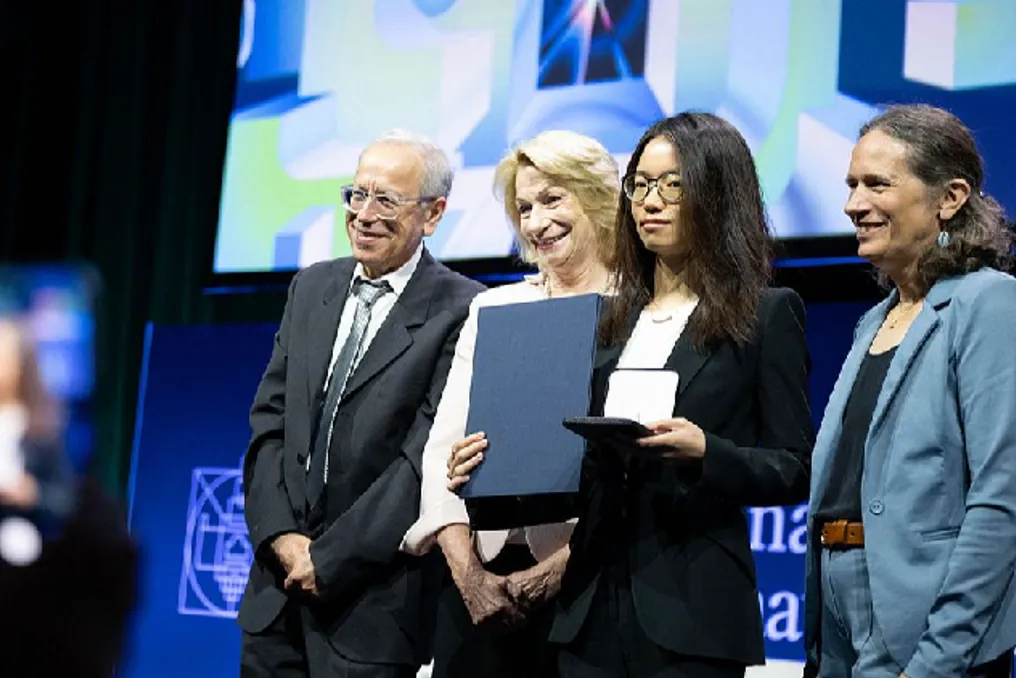
Chinese mathematicians Deng Yu and Wang Hong were awarded the Fields Medal at the International Congress of Mathematicians in 2026. This event marks the first time this prestigious award has been given to Chinese mathematicians. Furthermore, it is the first time two mathematicians with a background in mathematical education in China have received the highest mathematical honor in the same year.
Wang Hong's Achievements
Wang Hong, born in 1991 in Guilin, Guangxi Zhuang Autonomous Region in southern China, is currently a professor at the Institute for Advanced Studies in France and the Courant Institute of New York University. Her research focuses on harmonic analysis and the theory of geometric measure.
Wang Hong's path to mathematics was not easy. When she enrolled at Peking University at the age of sixteen, she was initially placed in the School of Earth and Space Sciences because the Department of Mathematics at Peking University in her province had only one vacancy, and her scores were insufficient. However, upon learning about the possibility of transferring to mathematics after passing an exam, she seized the opportunity.
Wang Hong noted her long-standing childhood passion for mathematics, which led her to solve some of the most complex problems in the field. When encountering a dead end in her research, she turns to physical exercise to clear her mind and starts over from scratch. She also emphasizes the importance of collaboration, stating that working together allows for different perspectives and mutual support when a problem seems blocked.
Interests Outside Mathematics
In addition to mathematics, Wang Hong has long been interested in drawing. She often makes sketches while contemplating a problem, believing that drawings help her visualize its structure. For her, the connection between drawing and mathematics represents an 'implicit common property.'
Deng Yu's Achievements
Deng Yu, born in 1989 in Shenzhen, Guangdong Province in southern China, holds a professorship at the University of Chicago. His research areas cover partial differential equations, hydrodynamics, harmonic analysis, and statistical physics.
His interest in science began with a simple problem from a school textbook. Deng recalls spending an entire day solving this problem. Although it might seem easy to him now, the delight of finding the solution became one of his earliest memories of joy in problem-solving.
Deng demonstrated exceptional talent in both mathematics and Go—a traditional board game he loved since childhood. As a high school student, he participated in the national qualifying tournament for Go in China and missed the chance to become a professional player by just one match. Later, he used the game as a way to relax when tired or stuck on a problem.
During three years of high school, Deng independently studied the complete high school mathematics curriculum. In ninth grade, he took a math test at the level of the Chinese university entrance examination and consistently scored no less than 130 out of 150 points. In 2006, Deng represented China at the 47th International Mathematical Olympiad and won a gold medal. After enrolling in the School of Mathematical Sciences at Peking University, he transferred to the Massachusetts Institute of Technology, and in 2015, he earned his Ph.D. from Princeton University.
Shared Interests and Historical Context
Deng is also interested in poetry. When asked what he would do if he hadn't become a mathematician, he replied that he might have written science fiction. For him, these two pursuits share a fundamental similarity: 'You put forward a fictional hypothesis and then conduct extremely rigorous logical deductions and develop a story.'
Since the establishment of the Fields Medal in 1936, only five times among four countries—the USA, France, the UK, and Russia—have two mathematicians from the same country received this award in the same year. Thanks to the victories of Wang and Deng, China has become the fifth country to achieve this milestone.