When a major crisis arises in a country's politics, events visible on television are often just part of a more complex behind-the-scenes political game. Following the NEET exam material leak scandal, what unfolded in the streets of Delhi and in the corridors of parliament became a vivid example of this hidden political drama. On one side, there was student anger in the streets, and on the other, the aggressive stance of India's main opposition party, the Congress, and its leader Rahul Gandhi. However, behind this visual confrontation lay a well-thought-out strategy that temporarily froze an ambitious government project it had been working on for three months to achieve a majority.
Rahul Gandhi's Activity in Response to the Scandal
As soon as the NEET scandal surfaced, Rahul Gandhi immediately took the initiative. His activity on social media and public appearances demonstrated a clear strategy. Numerous sharp messages were posted through Rahul Gandhi's official account on X. He presented NEET not merely as an exam failure but as proof that the entire country's education system was under control. Citing statistics, he criticized states governed by the Bharatiya Janata Party (BJP) and labeled the central government a 'leak factory'.
In parallel, Rahul Gandhi visited various cities across the country to personally meet with affected students and their parents. The main goal of these events was to directly link the anger of students and the middle class to the methods and reliability of the central government. Nevertheless, before Rahul pushed this issue further, he disappeared from public view, and the Congress remained in a vacuum for about a month.
'CJP' and the Shift in Protest Venues
During this time, amidst public outrage on social media and street movements, a new, unexpected forum called 'CJP' (Cockroach Janata Party) appeared on Instagram. Abhijit Dipke, who developed it in Boston, USA, returned to his homeland. Under this banner, based on satire and the sharp anger of students, demonstrations against the NEET exam rigging began at Janta Mantar in Delhi. Crowds started gathering.
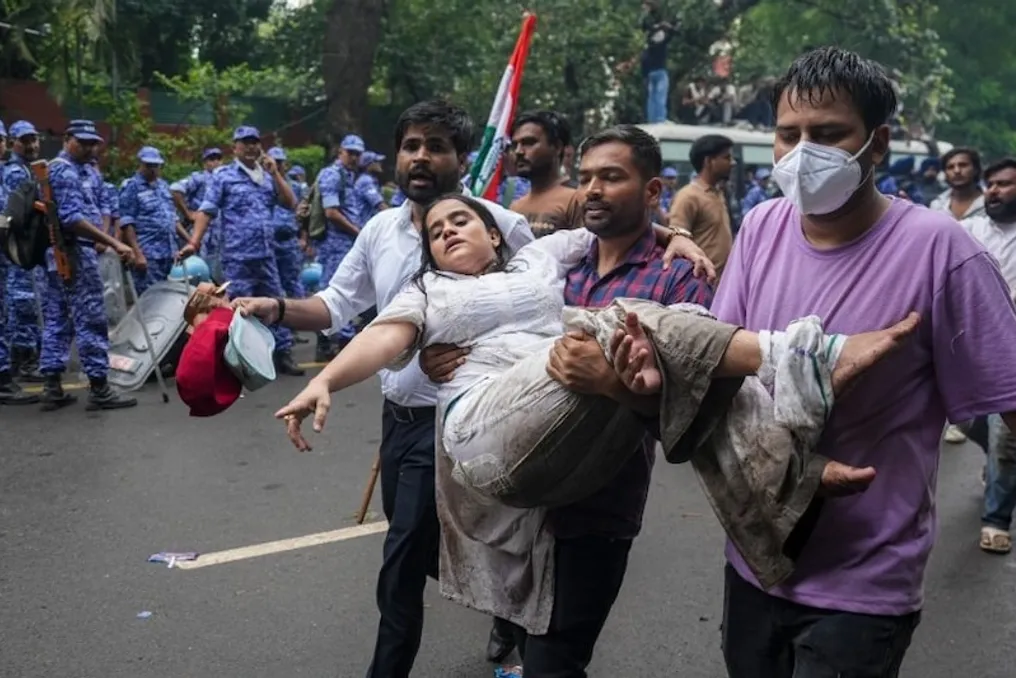
The CJP protests remained moderate until Sonam Wangchuk, who had previously faced NSA action for Ladakh protests, stepped onto the stage and began a hunger strike. This injected energy into the youth, and the protests intensified the day before the monsoon season. However, the Delhi police intervened. The next day, parliamentary sessions began, and unrest broke out on the streets of Delhi around Janta Mantar between demonstrators and police. Clashes occurred, stones were thrown, water cannons, tear gas, and baton beatings were used.
Videos of crying students, tears streaming in the streets, and scattered books went viral on social media, amplifying public indignation. This message reached the wider public and families: instead of listening to the legitimate demands of the students and ensuring a fair examination process, the government was using force against them.
Rahul Gandhi's Second Phase of Attack
As the summer session of parliament began, the Congress and Rahul Gandhi launched the second phase of their strategic attack. Here, the scenario prepared behind the scenes began to unfold. This strategy was devised at Mallikarjun Kharge's residence. The most dramatic and powerful visual image emerged when Rahul Gandhi suddenly headed to Lok Kalyan Marg, the Prime Minister's residence, along with Congress leaders, MPs, and members of the Indian Alliance for a sit-in protest.
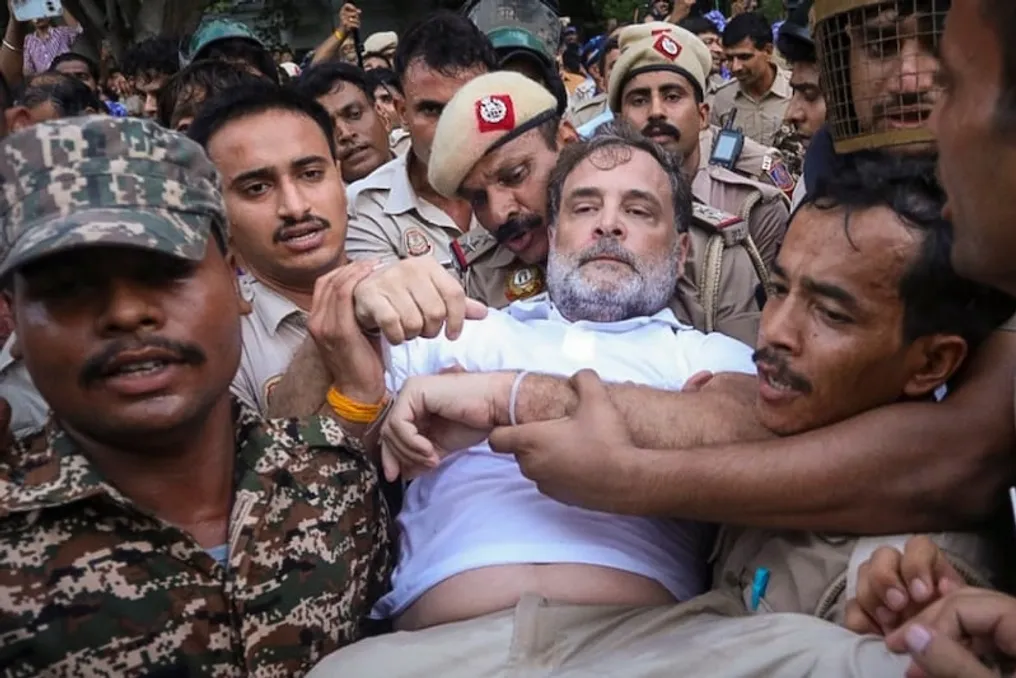
It is debatable whether they went there voluntarily or were allowed entry. This highly intense spontaneous act once again made Rahul Gandhi the central figure of the NEET protests. While his sit-in protest was being broadcast live on news channels, the Delhi police took decisive action and presented a powerful frame: more than half a dozen policemen lifted Rahul Gandhi off the street and detained him. This entire chaos visually shifted the narrative on the NEET issue in favor of Rahul Gandhi. Rahul Gandhi's white T-shirt, which always looked immaculate, was completely soiled from being dragged and the commotion, and one of his boots went missing.
This single frame conveyed a deep message to the people: the main opposition leader would not back down from fighting for the rights of children and youth, even in the face of police violence and chaos. This photograph put the government in a morally defensive position.
Congress's Stance on Demands
The opposition demanded the suspension of work and immediate debates on the matter. However, the Congress employed a very calculated move by making the resignation of Education Minister Dharmendra Pradhan its main and central demand, similar to other protesters. The message was crystal clear: no discussions or normal parliamentary work would take place until the Education Minister resigned. Thus, the entire strategy was built on the formula 'No resignation—no parliamentary work.'
Indeed, although the NEET issue is common to CJP, civil society, activists, celebrities, and political parties, the demands of each group differed. But the Congress clearly defined its position and demands within parliament. Until now, the party has been criticized for fragmented strategies in protests on various issues, but on the NEET issue, the Congress and Rahul Gandhi are absolutely clear, and the entire party stands behind them united.
The Main Stake: The Delimitation Bill
Now let us turn to the main point of this story, which is considered the true and invisible objective of the entire political event. Before the start of the summer session, hot information circulated in political circles that the central government was preparing to introduce the 'Delimitation Bill' (परिसीमन विधेयक). For this, enormous efforts had been made over the last three months to manipulate and unite various parties in different states to secure the support of two-thirds majority.
However, the aggressive strategy of the Congress on the NEET issue and the unwavering opposition stance on 'preventing parliamentary work' disrupted all the government's calculations. Since parliamentary sessions were constantly interrupted due to the opposition insisting on NEET and the resignation of the Education Minister, any work became impossible. In a situation where student anger rages in the streets and parliament is paralyzed, introducing or discussing such a highly controversial and sensitive law as delimitation poses a huge risk to the government.
Success of the Congress Strategy
It appears that this move by the Congress—shifting the NEET leak issue from the streets to parliament, using the resignation of the Education Minister as a shield, and creating obstacles for the delimitation bill—is currently completely successful. The government found itself entirely surrounded by the NEET issue and forced to constantly justify itself. At the same time, the ambitious delimitation bill, for which a chess game had been prepared for months, temporarily took a backseat during the summer session. The photograph of Rahul Gandhi with a soiled T-shirt and a lost boot on the street not only gave voice to student anger but also brought to fruition the political script developed behind the scenes.