Observations made with the James Webb Space Telescope have provided new data on how the first stars and galaxies emerged. Scientists investigated the dwarf galaxy Sextans A to understand how the Universe began to accumulate heavy element-rich dust in its early phases.
Limitations and focus of the research
This study was conducted due to the limitations of current instruments in deeply analyzing the oldest galaxies in the cosmos. As a solution, the team directed its investigation toward a system located approximately 4.6 million light-years from Earth, whose chemical composition resembles that of the first galaxies.
The findings point out which stars were most responsible for creating cosmic dust, material that later drove the birth of new stars and galactic evolution. The research was published on Monday, the 20th, in the journal The Astrophysical Journal.
Sextans A as a model of the ancient Universe
Despite the James Webb's ability to capture very distant galaxies, the detailed analysis of these objects remains a challenge. To overcome this difficulty, researchers opted to study Sextans A, a dwarf galaxy that shares chemical similarities with systems existing in the first billion years of the Universe.
According to the responsible group, this environment provides a unique opportunity to study the phenomena that occurred when the first stars began to alter the composition of the space between them. Claudio Gavetti, lead researcher at the National Institute of Astrophysics (INAF), stated that observing a nearby galaxy like Sextans A, with similar chemical conditions, is a valuable opportunity to understand the evolution of the first generations of stars and their role in transforming the interstellar medium.
Formation of elements and dust
At the beginning of the Universe's history, hydrogen and helium predominated, while heavier elements were rare. The first stars generated these elements in their cores and, upon exploding as supernovae at the end of their lives, dispersed this material into the interstellar medium. Later, this raw material was incorporated into new stellar generations.
Researchers noted that Sextans A has a concentration of heavy elements corresponding to only 1% to 7% of what is found in the Sun. This characteristic makes the galaxy a natural laboratory for simulating the conditions of the young Universe.
Stellar analysis and contribution to dust
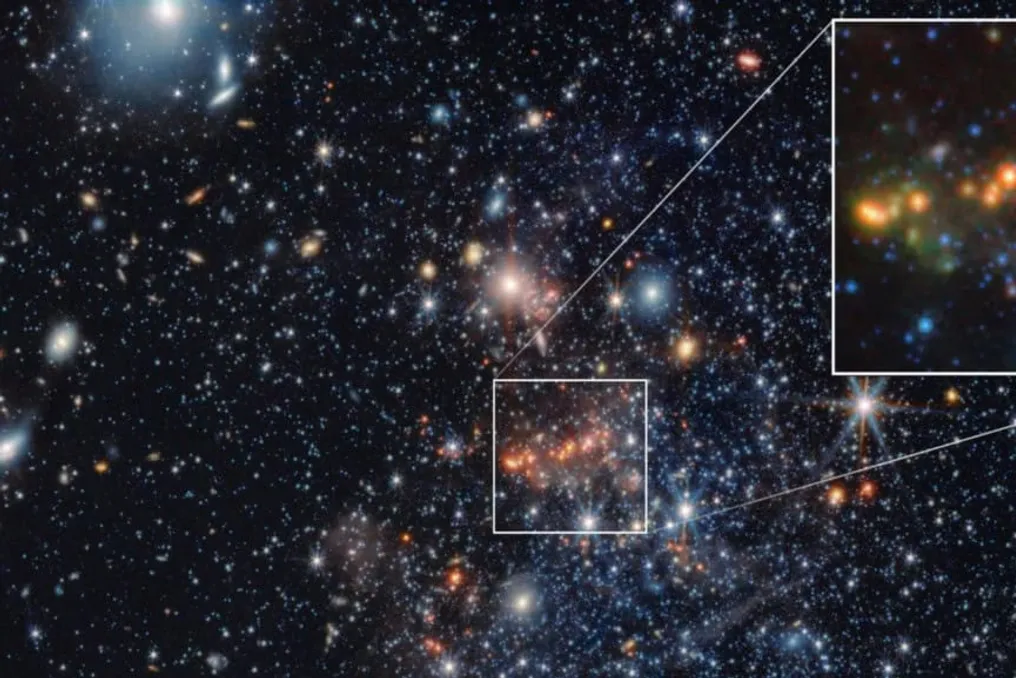
To conduct the work, the team employed the NIRCam and MIRI instruments, both present on the James Webb. The observations allowed mapping stars in the galaxy that transit through the phase known as the red giant branch, a period characterized by large increases in brightness and structural modifications.
The analysis revealed that about 90% of these stars were not enveloped in dust. In contrast, approximately twenty of them exhibited dense layers of this material, indicating that they functioned as important producers of cosmic dust. The study indicates that these stars formed between 2 and 3 billion years ago and had an initial mass equivalent to about one and a half times that of the Sun.
The authors concluded that identifying these objects deepens the understanding of which types of stars helped enrich the Universe with the essential elements for the emergence of new stars and the development of galaxies over time. Flavia Dell’Agli, a researcher at the National Institute of Astrophysics (INAF), emphasized that the JWST allows observation of environments with unprecedented detail, the value of which lies not only in the images but also in the comparison with theoretical models to validate the description of stellar evolution.