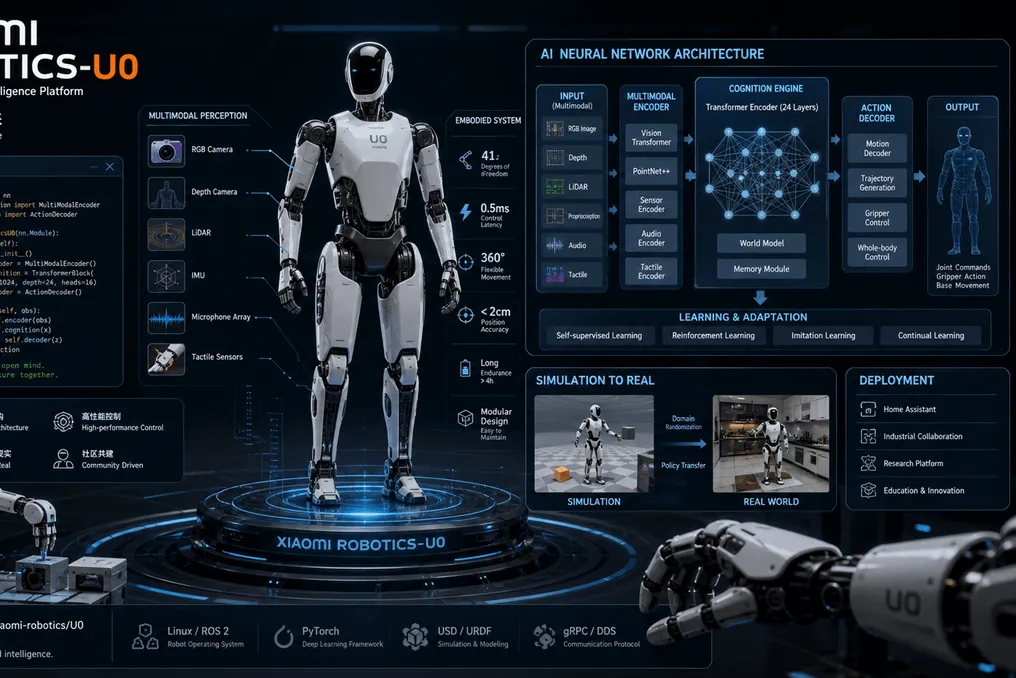
Xiaomi has introduced Robotics-U0, a multimodal autoregressive generative foundational model with 38 billion parameters. This model is the first in embodied artificial intelligence to be capable of simultaneously processing four different categories of tasks for robots within a single architecture.
Key Capabilities of the Model
The model covers four key functions. Firstly, embodied scene generation allows for the creation of multi-view initial scenes for specified robotic equipment based on text descriptions. These environments can range from kitchens and tables to warehouses and open spaces.
Secondly, the embodied transfer function enables the migration of existing robot trajectories into new environments. During this process, lighting, background, surface materials, target objects, or workspace style are changed while preserving the manipulator's original poses and the overall scene composition.
Video Generation and Image Editing
Thirdly, robot interaction video generation creates subsequent video frames based on initial observations and action instructions, maintaining movement coherence and physical consistency, as well as demonstrating generalization capability in previously unseen scenarios (zero-shot generalization).
The fourth capability involves retaining general text-to-image conversion and image editing functions, allowing knowledge from the visual internet to be applied to embodied AI tasks.
Performance and Efficiency
Robotics-U0 demonstrated high results on the WorldArena benchmark among 126 participating global models. In real-world tests with robots under out-of-distribution conditions, unknown lighting, and unfamiliar backgrounds, strategic task completion rates improved by an average of 26% after training on data augmented with Xiaomi-Robotics-U0.
The model is capable of improving existing data by maintaining geometric consistency—for example, by changing objects, lighting, backgrounds, or adding clutter—without the need to collect new data. Furthermore, it can generate entirely new scenes covering dangerous, extreme, or rare environments inaccessible to physical robots.
Architecture and Open Access
To enhance generation efficiency, the model utilizes the UNIS acceleration architecture, which increases performance by approximately 83 times compared to the base autoregressive paradigm, thereby significantly lowering the barrier for engineering implementation. This makes large-scale generation of training data for embodied AI a controlled and efficient solution, eliminating one of the main bottlenecks in embodied AI development where data scarcity limits the growth of model capabilities.
The open release includes a full project page, a code repository on GitHub, model weights on HuggingFace, and a collection on ModelScope. This represents one of the most comprehensive open contributions from a Chinese consumer electronics company in the field of embodied AI, following the deployment of Xiaomi's robotic factory and positioning the company as a fully functional player in embodied AI, encompassing hardware manufacturing, real-world deployment, and fundamental model research.