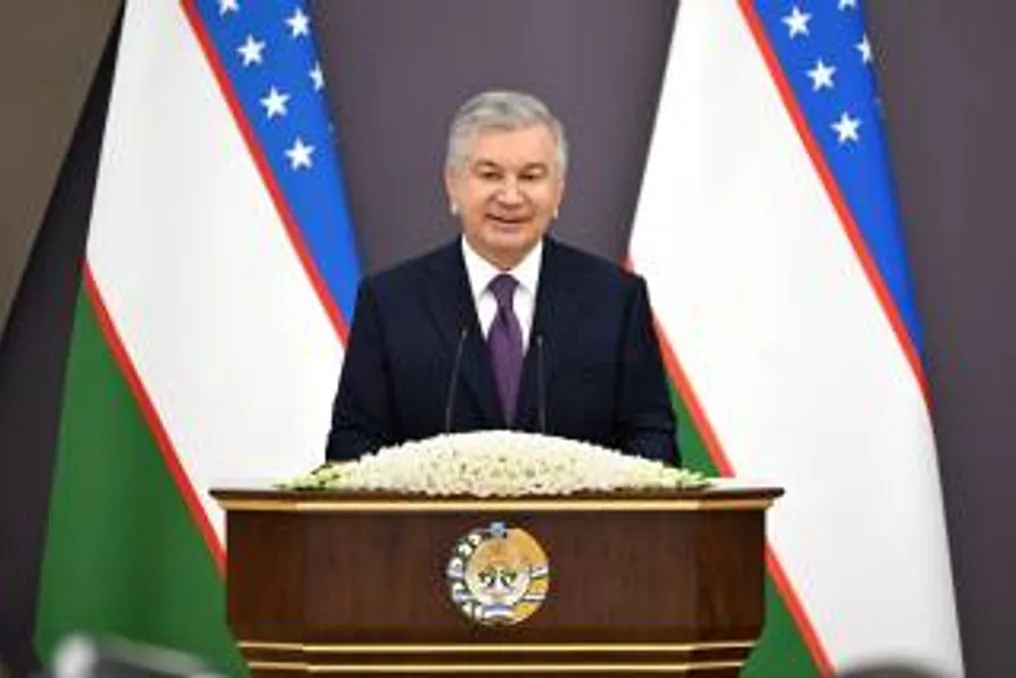
President Shavkat Mirziyoyev visited the Urta Chirchiq district in Tashkent region on July 22 and laid the cornerstone for the construction of a paid alternative highway along the Tashkent – Samarkand route.
Significance of the Project for the Economy
The head of state emphasized that this project is critically important for enhancing the economic potential and transport-logistical capabilities of New Uzbekistan. He stated that a completely new era is beginning in this sector, and the start of this major project will be a cause for joy for all citizens.
Economic Goals and Infrastructure
It was noted that the country's economy has grown threefold in recent years, and its volume is planned to reach $240 billion by 2030. This requires the development of road transport and logistics infrastructure in line with the pace of economic growth. Currently, an international transit road spanning 4,000 kilometers passes through Uzbekistan, of which 30% operate at full capacity, and another 25% function under overload.
International Transport Significance
Following the launch of the 'China – Kyrgyzstan – Uzbekistan' and Trans-Afghan railway routes, the country is becoming a key land corridor between the Pacific Ocean and Europe. New opportunities are also opening up for accessing Indian Ocean and South Asian markets through Pakistani ports. Estimates suggest that accepting an additional 15–20 million tons of transit cargo annually could generate revenue of $400–600 million, as well as create 50 thousand stable jobs and attract $3 billion in investments into logistics centers and terminals.
Strategic Development of the Road Network
Within these goals, it is planned to transform 4,000 kilometers of international roads connecting Andijan with Qungirot, and Termiz with Tashkent, into modern transit routes meeting high standards by 2030. The Tashkent – Samarkand highway is an integral part of this strategic program. Over the last ten years, road construction and repair totaling 78 trillion sums have been implemented, covering a total length of 128 thousand kilometers. Now, a modern, top-class highway is being created in the country for the first time.
Characteristics of the New Highway
The total length of the six-lane road, costing nearly $2.2 billion, reaches 282 kilometers. It passes through 13 districts in the Tashkent, Syrdarya, Jizzakh, and Samarkand regions, where more than 2 million people reside, opening up new prospects for these regions. The project will include the construction of 92 bridges, 28 overpasses, 60 tunnel crossings, as well as underground passages and drainage structures for agricultural needs.
Technical Features and Advantages
The road surface will be made of monolithic concrete, resistant to the loads of heavy transport and high speeds. It is planned that speeds on straight sections can reach 150 kilometers per hour. Modern safety solutions and digital innovations will contribute to a sharp reduction in traffic accidents. The head of state noted that after the project launches, every citizen will feel its benefits: the travel time from Tashkent to Samarkand will be reduced from the current 5 hours to 2.5 hours.
Economic Impact and Prospects
The new highway will be able to accommodate 60 to 80 thousand vehicles per day. Due to the absence of traffic jams and single-flow movement, energy, depreciation, and maintenance costs will decrease. Estimates suggest that cargo transportation costs will drop by 19–24 percent, which will expand the possibility of timely and quality delivery of perishable products such as fruits, vegetables, meat, and milk to markets. The new route will play an important role in connecting the Fergana Valley and the country's central regions with the southern and western regions, strengthening Uzbekistan's position as a transport and logistics hub in Central Asia.
Investment and Cooperation
According to World Bank analyses, every dollar invested in such infrastructure projects yields up to fivefold returns for the economy. The new road is expected to stimulate a 3 percent growth in the gross regional product of the Tashkent, Syrdarya, Jizzakh, and Samarkand regions. Logistics centers, warehouses, industrial-agricultural enterprises, trade and service facilities, as well as hotels and tourist attractions will be created along the route, providing new jobs and additional income sources for local budgets.
Project Implementation
Local services and construction materials are actively used during the construction, ensuring large orders, increasing production capacity, and creating additional jobs for local enterprises. Leaders of the four regions were tasked with allocating land plots based on the principle of 'Unified Corridor – Unified Standard,' as well as jointly planning logistical, engineering, and communication infrastructure. The highway design is based on the advanced experience of countries in Europe, Turkey, China, and other states. The first phase will be implemented with the participation of Chinese partners under the EPC model, after which modern management, maintenance, and operation mechanisms will be introduced. The project will be carried out in accordance with international environmental and safety standards and is scheduled to be commissioned by 2030.
President's Final Statements
The President emphasized that this project is part of a large-scale national road construction program. Construction of the Khiva – Urgench road continues, the international tender for the Tashkent – Andijan route is concluding, and work is underway to determine a private partner for the road connecting Tashkent with Bostonlik. The head of state stated that on the eve of the country's 35th anniversary of independence, they are laying another solid foundation for the future, economic stability, and the well-being of the people. The President specifically noted that for the first time in Uzbekistan's history, a 'green' and innovative route is being created with the participation of Chinese partners, local and foreign specialists, engineers, and builders.