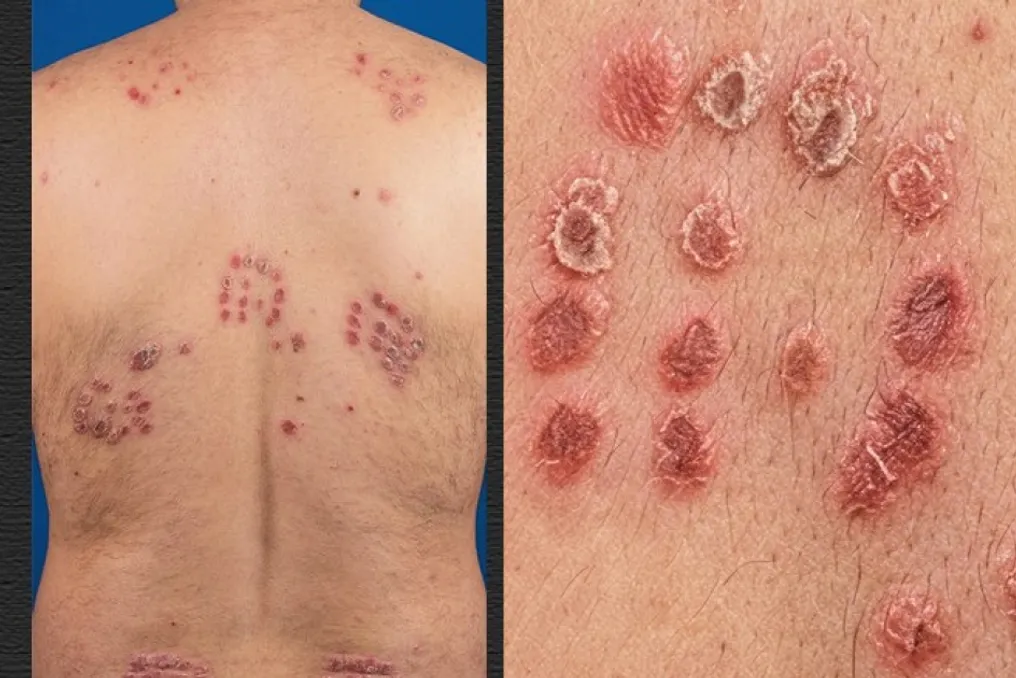
A 35-year-old man suffering from moderate to severe plaque psoriasis sought treatment at a Turkish dermatology clinic. He had previously been in remission for eighteen months thanks to treatment with monoclonal antibodies against interleukin-23A, specifically risankizumab.
Effect of Cupping and Diagnosis
Two weeks before his visit, the patient decided to self-treat back pain using cupping therapy. Specialists applied clusters of superficial incisions to the skin so that the vacuum could draw out a small amount of blood—this ancient procedure is called hijama or wet cupping. Examination revealed clearly demarcated erythematous scaly papules and plaques on his shoulders, as well as on the middle and lower parts of his back.
Doctors Yusuf Demir and Zekai Kutlubay presented this case in The New England Journal of Medicine. After gathering the medical history and conducting examinations, the man was diagnosed with Koebner phenomenon, also known as isomorphic response.
The Essence of Koebner Phenomenon
This phenomenon is characterized by the appearance of rashes typical of various dermatoses, such as psoriasis, vitiligo, or lichen planus, in areas of the skin where such manifestations were not previously observed. This occurs after mechanical irritation of the skin, caused by scratches, burns, sutures, or abrasions. It is important to note that this phenomenon can occur even in people whose condition is well-controlled.
The patient stopped using cupping and resumed his previous dose of risankizumab. Three months after a follow-up examination, all his rashes disappeared.
Additional Research Findings
The article also mentions the results of another study published in JAMA Neurology. It showed that prolonged exposure to traffic noise increases the likelihood of developing Parkinson's disease. The risk increased by three percent for every additional 11.5 decibels of noise; however, having a quiet facade not facing the road helped reduce this elevated risk.