Despite the common belief that the country's system and structure have declined, the article's author strongly disagrees with this assertion and provides evidence. He argues that over the past two weeks, every element of democracy has been operating at full capacity, with some even demonstrating 200% productivity.
Start of the Crisis and Government Reaction
The situation began with a leak of the NEET exam. Thousands of students, their parents, teachers, and the entire associated industry expressed disappointment, exclaiming: 'Oh, the same thing again!' The government reacted promptly: the CBI quickly arrested everyone involved in the leak, including intermediaries who were selling this sacred process as a commodity. A directive was then issued for a re-examination, which took place within a month, and the results were announced.
Judicial Proceedings and Public Reaction
During the same period, a term emerged from the courtroom that captured the attention of the entire nation. The Chief Justice was reviewing a petition from an advocate who was very actively pursuing Public Interest Litigation (PIL). During the hearing, the judge referred to an insect—a 'cockroach.' This word quickly and incorrectly spread across the country. An activist from the AAP party, located in Boston, picked up on this term and created the meme page 'Cockroach People's Party.' Soon, 2.2 million people joined the 'cockroach dance.' His advisors, being 'strategists' under 30, advised him to find a topic since 'the audience has been found.'
Escalation of Protests and Political Play
Since the law against disrespecting the court is in effect, protests against the Supreme Court were excluded. Therefore, they expanded the definition of 'cockroach,' defining it as unemployed. However, unemployment in India is not a hot topic; it has existed since 1951, like a piece of chicken before the leader of the Bharatiya Janata Party. Then NEET got it. The author believes that the NEET leak is the only 'national integration project' in the country that truly works. Leaks occur during both central and state examinations, whether it's recruitment for constables or Patwari vacancies, and no one sees the means to prevent this.
Millions of children experienced stress and had no outlet to express this pain. Pain without an address remains just noise. Dipika gave this suffering an address: 'One must appeal to Dharmendra Pradhan.' This became a demand, a hashtag, and the information spread like wildfire. They arrived in Delhi hoping for arrest but were instead met with flowers. They were even allowed to demonstrate at Jantar Mantar, even though they did not request permission, assuming refusal would be the next act of their movement. The Indian government understands the calculations of the 'pressure cooker' well.
Political Landscape and Party Confrontation
The AAP, which itself originated from a movement, was pleased to see its person starting a new movement. The BJP was also satisfied. They decided to let them tweet, shout, and tire themselves out, assuming that when the monsoon season arrived, their tarp would turn into a pool, and they would return home themselves. The author asserts that beneath the morality lies the map of politics. Elections will take place next year in Punjab, where the AAP rules, and the BJP is a secondary player, but possesses 64-bit level confidence because it managed to establish itself even in a difficult area like Bengal. This allowed the AAP to focus entirely on Dipika, as the anger of the youth, if provoked correctly, can lead in unpredictable directions, which benefited the AAP.
The BJP was glad that the Congress remained outside this situation, as the real threat to the AAP in Punjab is the Congress, not the BJP. On the other hand, Rahul Gandhi, who had been building a youth electorate for years by doing push-ups in university auditoriums, did not want to give his 'milk product' to this new guy, suspecting he was an AAP front.
Role of Activists and Media Space
At this moment, Sonam Wangchuk appeared. He had just been released from prison and keenly realized that NGOs receiving foreign funding are now doomed to starvation due to strict FCRA rules. He took the podium and refused food. He brought something that Dipika could never create—a voluminous 'biography.' Kejriwal managed NGOs and became a national player, whereas Wangchuk manages NGOs and remains a local leader, even in Ladakh. The hunger strike is a regular loan this activist takes against his own body, comparable to part of Anna Hazare's second phase.
Meanwhile, algorithms did their job. Instagram, which can shake the honesty of even a 45-year-old qualified accountant, was handed over to 17-year-old children. The echo chamber effect began. When the government became uncomfortable, it switched on the air conditioner of illusions, believing that times had changed and this would become a trend that would pass in a couple of days. But hope is not a strategy. Hope faded, but the movement remained. The burden of revolution rested on Wangchuk's fragile shoulders, while Dipika's team handled logistics, and Junayd monitored nutrition.
In the main media outlets, the crowd pushed them away for the first two days, subjecting them to trolling and abuse. After that, Dipika presented the absence of media as proof of a conspiracy. This is a brilliant trick: first you turn off the lights, and then you cry in the dark! In any case, why did they need the media? Their audience was already in their pockets (on Instagram).
Climax and Consequences of Clashes
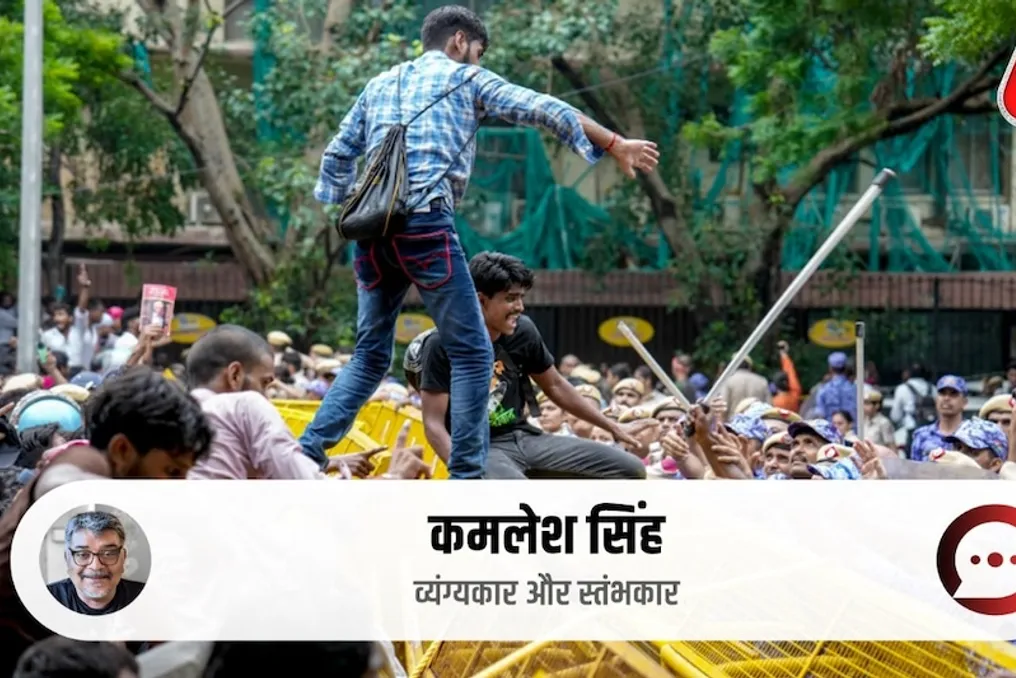
On the twentieth day, Wangchuk was taken from the podium to the hospital for observation. After all, 'being a victim' is a content format, and chief judges understand this language perfectly. They announced that the march to Parliament on July 20th would take place. Since the parliamentary session was ongoing, there was a restriction on large gatherings. And so, barriers were set up. 'Professionals' came out for the students: activists from the Socialist Party and people from the Azad Samaj Party led by Chandrashekhar Azad, arriving from all over Uttar Pradesh. These men had marks of batons on their backs, like lines on an astrologer's arm. Activists from Punjab came to protest against the BJP. NEET became the lowest part of this multi-tiered cake. A local leader from East Delhi brought his petty thugs to decorate the cake. Conflict brewed, ready to explode.
Thousands of innocent children, arriving from small towns in Uttar Pradesh and North India, found themselves entangled in this. They didn't know each other, didn't know the men beside them, and didn't know that every rally has a structure that must be understood to survive. They didn't know that a rally usually ends with baton chases, and if the situation worsens, with police rifle fire. Provocateurs did what they were brought for: barriers were destroyed, vehicles burned, stones thrown. The police, trained to consider any crowd a cadre, began beating with batons, measuring strength by the number of loyal political activists. This blow landed directly on the heads of 17-year-old children who came with water bottles and placards. They had only seen batons on TV screens since Monday morning. They were smart about questions and accountability, but when it came to saving their lives from batons, they froze.
Analysis of Events and Conclusion
Monday and Tuesday were not politics; they were hospital corridors. The author states that he will not pretend to be impartial. The anger of these children was one hundred percent justified. They took to the streets without asking who the leader was because their goal was clear, even if leadership was absent. A remarkable trait of this generation is that they take to the streets without looking at whose photo is on the placard. They were naive—yes. They were used—absolutely. But the deception was committed by those who exploited them, not by the innocent boys and girls who believed.
The author's heart remained in that hospital corridor, next to a girl with a broken wrist who would have to come up with excuses at home, and a boy whose glasses were smashed in the street. And also with a police constable who stood for 11 hours in the dry July heat, receiving a stone shard on his forehead, who would have to bear a scar, and who would simply be transferred for doing what he was ordered. No one wants to be on that street on Monday. Everyone who was there on Monday paid a price. The rest was done by algorithmic intervention. To those who needed to see injuries, only injuries were shown. To those who wanted to see a conspiracy, a conspiracy filled with a bucket was shown. Polarization was completed in 48 hours! Faster delivery than any Indian government service!
The country is angry: angry at the brutality of the police, angry at the deafness of the government. Yet, Dharmendra Pradhan still holds the post of minister. Rahul Gandhi, seeing that the new, cadre-less guy was undermining his entire plan, started his own protest. Tension is rising in Delhi. Requests for new provocateurs have been sent, and payment has been made in advance.
However, look at the positive side of this ugly, brilliant, and insignificant life! Everything worked perfectly. The government was strong. The state was strict. The protest was obvious. The protest was permitted. The march was allowed up to a certain point, and this point creates democracy. The police did their job, brilliantly realizing the state's monopoly on violence in a way that sociologists Weber would be happy about, and their mothers would be depressed. The opposition took to the streets to defend the right of people to be heard, but shouted at the people. Parliament worked, suspended. The opposition shouted to be heard, and the ruling party shouted to present its point of view. No one listened to anyone, but all of it was recorded in history.
The judiciary did its job, completely ignoring petitions for protests. The judge who called the 'insect' said nothing more. There was no suo motu action, no clarification. The strong government did its job by refusing to succumb to the blackmail of self-governing, unselected representatives of youth. Although this category produced most of the current ministers in 1974. The youth did their job by refusing to go home until accountability was presented in the way they expected—that is, the resignation of Dharmendra Pradhan. The leftists did their job by singing revolutionary songs. The far-leftists did their job by convincing young children that dying young is like building a career (without explaining whose career?). Professional protesters, as always, were present wherever the issue arose. First, they criticized the media on YouTube, and then crossed the street to give a nice byte-interview to the media machine. Despite being beaten by protesters who seemed to support the government, and by the police who beat them for standing near the stone throwers, they kept working.
Every element of our democracy works exactly as designed. Good night, fellow citizens. Nothing broke. Just the children broke. Absolutely perfect.
3