Residents of South Africa employ two different approaches to protect their food heritage. High-tech seed banks use deep-freeze storage to preserve rare varieties, while community seed libraries pass on heirloom seeds to local farmers.
Residents of South Africa employ two different approaches to protect their food heritage. High-tech seed banks use deep-freeze storage to preserve rare varieties, while community seed libraries pass on heirloom seeds to local farmers.
Despite external differences, both strategies pursue one urgent goal—maintaining the viability of local crops. One method provides a seed reserve for future emergencies, while the other supports their current growth in local soil. Together, they safeguard food security, helping to combat hunger in subsequent generations.
Zaiyan Khan, head of the seed library at SEED (Seed Biblioteek of Schools Environmental Education and Development), works to preserve the country's agricultural heritage. This volunteer-run initiative has permanent branches in Muizenberg and Mowbray, as well as a mobile point in Mitchells Plain. It operates solely on a unique barter system: instead of money, farmers contribute compost, worms, or collected seeds to support the library.
According to Khan, preserving traditional varieties in urban settings is a complex task. 'The main problem is access to land for growing seeds,' she notes. 'We connect with people who have space in gardens or on farms, creating such guardian gardens.'
Because they categorically reject commercial, pesticide-treated seeds, proper natural conservation is critical. Khan explains that they rely on traditional methods, such as wood ash and diatomaceous earth, to protect stocks from pests, such as weevils. She emphasizes that seeds must be thoroughly dried before storage. 'Drying means it is dry, with one molecule of water, so it doesn't die and can maintain that vitality much longer.'
Despite spatial difficulties, the growing interest in local seed preservation demonstrates that this movement resonates within communities. For Khan, every seed has value, even those that do not germinate. 'We do not discard a seed,' she adds. 'Seeds that are non-viable can be used to make musical instruments or works of art, so nothing is ever lost.'
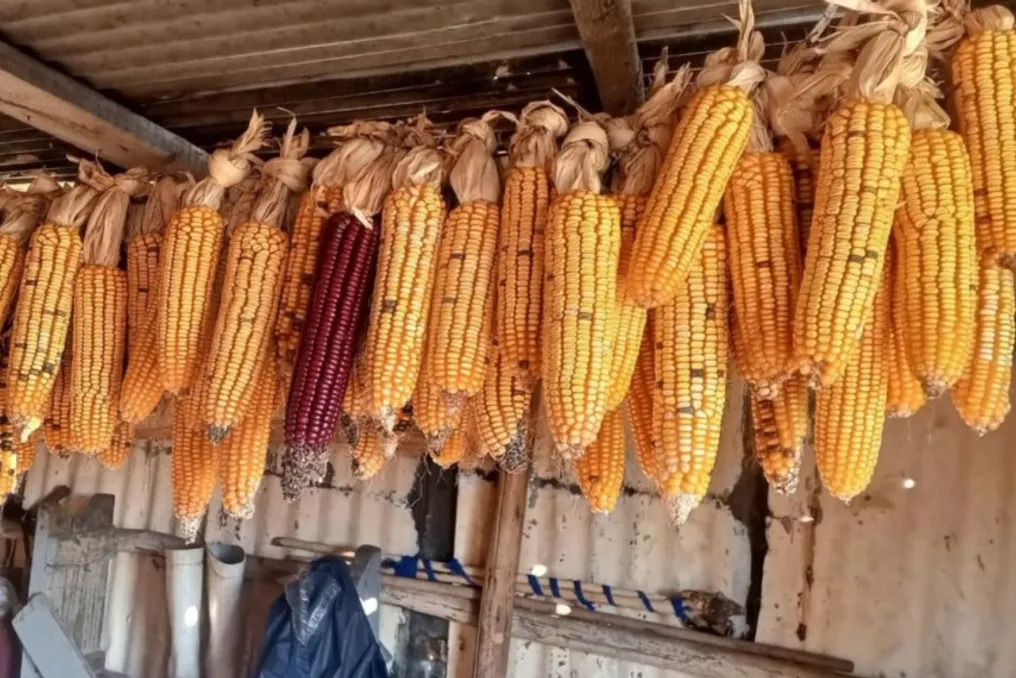
For Cholelwa Honkkoshe, an agroecology farmer in Nsera village in Gugongqo town (East London), the seed bank is as important as the financial one. She explains that the seed bank is a place to store seeds in dark, airtight containers. This ancient practice, passed down by ancestors who selected and dried the best harvest, ensures a constant food supply.
Today, she considers it a vital shield against climate change. During an extremely dry summer in the Eastern Cape, her maize died, but her local sorghum thrived. 'Sorghum is resilient, very nutritious, and for me, it is the best choice for planting instead of maize,' she says. She also notes that despite heavy bird damage, she managed to harvest a plentiful yield and save seeds for the next season.
However, Honkkoshe points out that commercial hybrid and patented GMO seeds threaten this independence because they cannot be saved. While the National Agroecological Framework of South Africa offers hope to community seed banks, she argues that true transformation must start at home to fix the complex healthcare system. 'Even if we restore sorghum as our staple crop instead of maize, malnutrition will stop being a problem,' she explains. She adds that poor nutrition directly affects school attendance rates and contributes to the rise of lifestyle diseases.
Experts emphasize the crucial interaction between different systems. Dr. Tsudufhadzo Chikhala, a gardener and postdoctoral researcher at Tshwane University of Technology, notes that while community initiatives and conservation institutions protect food systems, their functions are entirely different. 'Seed libraries focus exclusively on localized, short-term rotation,' Chikhala explains. 'They borrow seeds, grow them, and save the best seeds. They do not freeze seeds or store them for decades; it is strictly local.'
Meanwhile, Dr. Maanea Rampinhwa, a lecturer in the Department of Plant and Soil Sciences at the University of Venda, notes that these local collections directly contribute to community gardening development. 'You take seeds to plant, and you are expected to return them for future use,' says Rampinhwa.
Regarding seed banks, Chikhala indicates that they function as long-term repositories managed by governments, universities, and large organizations such as the South African National Biodiversity Institute (SANBI). 'They have a long-term preservation system; they preserve rare, heirloom, or endangered crop varieties,' says Chikhala. 'Some seeds are stored at temperatures of -18°C or below and can last over 100 years.'
Rampinhwa adds that this high-tech setup serves deeply scientific purposes. 'Seed banks store seeds under controlled conditions to preserve their genetic makeup, protect endangered species, and support research,' she concludes.
The Shoprite Group recently established its three hundredth community garden outside of Bredasdorp, located in the Western Cape. The 'Zero Organic Waste in Landfills' project is being implemented in collaboration with the local municipality and the South African Zero Waste Association.
In 2021, this site was focused solely on waste diversion. Today, it collects organic food waste from 800 households to produce compost and grow fresh vegetables. Experts note that farmers interested in regenerative agriculture in Mzansi are moving in the right direction.
Food For Mzansi interviewed Sandjiv Ragubir, Head of Sustainability at the Shoprite Group, to learn about the mechanism of this project and the importance of local food systems.
Reaching the 300th milestone has been a significant moment for the Shoprite Group. Sandjiv Ragubir states that such gardens play a vital role as they increase the availability of fresh and nutritious produce, especially in underserved areas. He refers to the 2025 South African Food Security Index, which highlighted the critical importance of diverse nutrition. Community gardens contribute to this diversity by providing immediate access to various fresh vegetables.
Over the last decade, the program has expanded to 300 gardens across the country. In addition to soil preparation, the program provides 18 months of practical agricultural training, irrigation systems, water harvesting infrastructure, and continuous mentorship. These gardens not only produce food but also create local economic opportunities, develop practical skills, and strengthen long-term community sustainability.
The Bredasdorp project utilizes a circular economy model. Such initiatives change communities' perception of waste, viewing it as a valuable resource rather than something to be discarded. Bredasdorp serves as a clear example of this process. Organic waste from approximately 800 households is collected, sorted, and composted on-site.
This results in nutrient-rich compost that is returned directly to the soil for vegetable cultivation, forming a closed loop system just meters away from the waste disposal site. By preventing organic waste from reaching landfills, greenhouse gas emissions are reduced, soil health is improved, and sustainable local food production is supported. This demonstrates successful collaboration between municipalities, NGOs, and the private sector.
Regenerative methods are absolutely capable of strengthening community resilience in the face of climate change. They help communities cope with climatic challenges by improving soil health, increasing water retention, and boosting biodiversity. Healthy soil absorbs and retains moisture much better, allowing crops to withstand periods of drought and extreme weather conditions.
In Bredasdorp, the garden uses compost derived from local organic waste for natural soil enrichment. This reduces the need for synthetic fertilizers and protects long-term land productivity.
As food prices rise, local production becomes increasingly important. Price increases place immense pressure on family budgets, making it difficult to afford nutritious food. Local production helps alleviate this pressure by eliminating high transportation costs for goods over long distances. It makes fresh vegetables accessible right within the community. In the Bredasdorp project, vegetables are grown and sold near where people live, meaning food travels a very short distance from the ground to the table.
While local production cannot replace large-scale agriculture, it perfectly complements it. It improves immediate access to fresh produce, strengthens local food systems, and helps communities become less vulnerable to supply disruptions. This is why community gardens are becoming an increasingly valuable part of broader efforts to enhance food security and community sustainability across South Africa.
When Vanessa Simelane started working with the family garden in her backyard in Mpumalanga, her goal was not to create a business, but to preserve part of her mother's legacy. Thanks to a vital investment from her neighbor, CM Mills, she transformed from a backyard gardener into a commercial force producing up to 1500 broilers per cycle.
Simelane grew up in Chrisismere, Mpumalanga, a region known as the Sunrise Place. Growing up among a family of small farmers shaped her connection to agriculture at an early age, awakening a curiosity that grew with her. Despite focusing on her studies, she completed primary school at Laerskool Chrisi and then graduated from Secondary School Nederland Park in 2017, but her deep love for the land never left her.
After graduating from school, Simelane faced a period of unemployment, unaware that daily quiet household chores were preparing her for a future career.
The true foundation of her entrepreneurial journey began in 2019 after the death of her mother, Babsi Simelane. Her mother always maintained a special backyard garden, growing spinach, carrots, potatoes, lettuce, and tomatoes for the family. After the loss, Simelane took full responsibility for maintaining this garden.
During her period of unemployment, the garden quickly became a vital source of financial support. Most of what she ate came directly from the garden, helping to save valuable family funds. Over time, this daily chore transformed into a commercial opportunity through a simple, firm decision. When neighbors came asking for free tomatoes or other vegetables, Simelane told them she was selling the harvest.
Simelane notes: 'The decision to grow vegetables not only for home use but also for sale became one of the best decisions I ever made. Since every meal requires at least one or two vegetables, there is always demand for fresh produce. Growing vegetables allowed me to support my household, generate income, and contribute to providing healthy food for my community.'
Alongside maintaining the home garden, a new opportunity arose shortly after the Covid-19 pandemic. In 2021, her growing passion for agriculture led her to participate in a development program that allowed her to attend the Bubble Farmers Academy, where she received specialized training in broiler production. This program gave her initial momentum, supplying the first 100 chicks and enough feed for a full production cycle. She recalls: 'It was during this training that I discovered my true calling and decided to pursue poultry farming as a career.'
Working in the same backyard where her garden grew, Simelane successfully raised poultry for six weeks and sold it directly to the local community. She continued this combined activity of raising poultry and vegetables in the backyard, gradually building her customer base until in 2024 she took a major step—registering the enterprise as Avesanda Poultry Farm.
By 2025, the backyard operation officially exceeded the available space. Simelane made a calculated business decision and leased a 4.4-hectare plot to expand both poultry and crop production. However, the new land lacked the necessary commercial infrastructure, threatening to halt her progress.
This obstacle was overcome thanks to an unusual relationship with her new neighbor, CM Mills, located directly opposite her farm. Recognizing her hard work and determination, the neighboring business provided significant capital investment to accelerate the growth of Avesanda Poultry Farm. Instead of a standard loan, the neighbor completely renovated the infrastructure on the plot. They installed perimeter fencing, equipped specialized curtains in the poultry houses, provided waterers and feeders, supplied professional slaughtering equipment, and ensured the farm had proper access to water and electricity.
To allow her to immediately utilize the new facilities, the neighbor also financed her initial production cycles. They purchased her first batch of 200 chicks and feed for the entire cycle, and later financed a second batch of 400 chicks with full feed cycle. Simelane says: 'This support allowed me to expand production, strengthen my operations, and lay the foundation for the growth that Avesanda Poultry Farm experiences today.' She adds: 'I am deeply grateful for their belief in my vision and their commitment to supporting emerging farmers.'
Thanks to solving infrastructure problems through the neighbor's intervention, Simelane's daily management has led to significant operational growth. Today, Avesanda Poultry Farm has scaled up from domestic 100 chicks to producing between 1200 and 1500 broilers per production cycle. More importantly, she has secured a stable commercial market for supplying 1200 slaughtered chickens every week.
The 4.4-hectare plot also allowed her to expand her vegetable business, which she inherited from her mother. In addition to the original crops, Simelane now grows green peppers, chili, and sweet potato for the market. The growing enterprise supports the local economy by employing two permanent staff members, including Simelane herself, and two part-time workers.
However, operating at this scale involves significant risks that Simelane must carefully manage to maintain business sustainability. Her biggest hurdle is the rising cost of feed, which accounts for 65% to 75% of poultry farming expenses. To protect her profit, she buys feed in bulk, collaborates with neighboring farmers to negotiate better prices, and vets suppliers to ensure consistent quality.
Biosecurity is another daily priority due to the threat of highly pathogenic avian influenza. Simelane maintains strict hygiene on the farm, using foot baths and disinfecting all vehicles and equipment entering the farm. This meticulous attention to detail pays off, as each milestone brings her closer to achieving her ultimate family goal.
For aspiring agricultural entrepreneurs, Simelane emphasizes that business discipline must always come first. She advises young producers to view farming as a business, not just a passion; to start small with what they have and gain practical experience on an established farm before starting their own venture. She concludes: 'Starting a farming business is rewarding, but it requires commitment, discipline, and sound business management.'