Google has implemented a new account access method called video selfie. This feature was developed to assist users who have difficulty accessing their accounts because they have lost access to the mobile device or computer they usually use.
Google has implemented a new account access method called video selfie. This feature was developed to assist users who have difficulty accessing their accounts because they have lost access to the mobile device or computer they usually use.
To activate this tool, the user must look at the camera and follow specific instructions, such as moving their head to capture various facial angles. If there are future problems accessing the account, a new video will need to be recorded. Google then compares this new recording with the previous one to validate whether the person is indeed the profile owner.
The company itself stated that the video selfie represents an additional way to access the account, providing more alternatives if the user is locked out or cannot use their usual phone or computer.
The company assures that the video selfie is kept encrypted and is only generated after explicit user permission. Furthermore, the file can be deleted at any time through the account settings.
During the verification process, the system integrates multiple layers of security to prevent forgery attempts. These measures include comparing the current video with the previously registered selfie, requiring simple head movements to prove that the recording is being made in real-time, protection against falsified content, including deepfakes, and identifying any suspicious activity during login.
Google emphasized that the video selfie belongs to the user and that they maintain control over it, being recorded and stored securely only with consent, and can be deleted at any time from the Google Account.
This feature aims to complement existing access options, such as passkeys and recovery contacts, serving as an alternative when other access methods fail. However, currently, the new feature is not available for Google Workspace accounts, children's accounts, or users participating in the Advanced Protection Program.
Users with compatible accounts can check availability and proceed with activation. It is important to note that this new entry method functions as just another login option, without replacing the authentication methods that are already in place.
Instagram had announced a feature that would allow any individual to use another person's face in images created by artificial intelligence. To do this, one only needed to enter the victim's username in the application, enabling photographic manipulation by AI and subsequent republication of the results.
This new feature would be automatically activated for all public accounts on the platform. To prevent the creation of deepfakes, users would have two options: look for a specific setting, which was not highly visible in the app menus, or make their account private.
Initially, the purpose of the implementation was to promote the use of Muse Image, a new image generation algorithm developed by Meta's AI sector. However, even considering company standards, the proposal was deemed excessive in terms of privacy. On Friday night (10th), Meta opted to reverse the launch of the feature.
In a statement, the company justified the change by saying: 'Our goal was to provide a useful creative tool, and give people control over deciding if their public content could be referenced [used] in this way. We heard feedback that this feature missed the mark, so it is no longer available.'
This episode is not the first case where Meta automatically activates invasive functionalities, either by forcing acceptance or hiding details in the terms of use of its products and applications. A previous scandal occurred in February when employees of Sama, located in Kenya, reported receiving videos captured by Meta Glasses. These recordings contained extremely private information, such as bank data, sex scenes, or moments in bathrooms.
Following the exposure of this incident, which caused significant international repercussions, Meta terminated its contract with Sama. The African company employed over a thousand people responsible for the task of 'data annotation'; they received content captured by Meta devices and applications for manual captioning, a process used in training Meta's image recognition AIs.
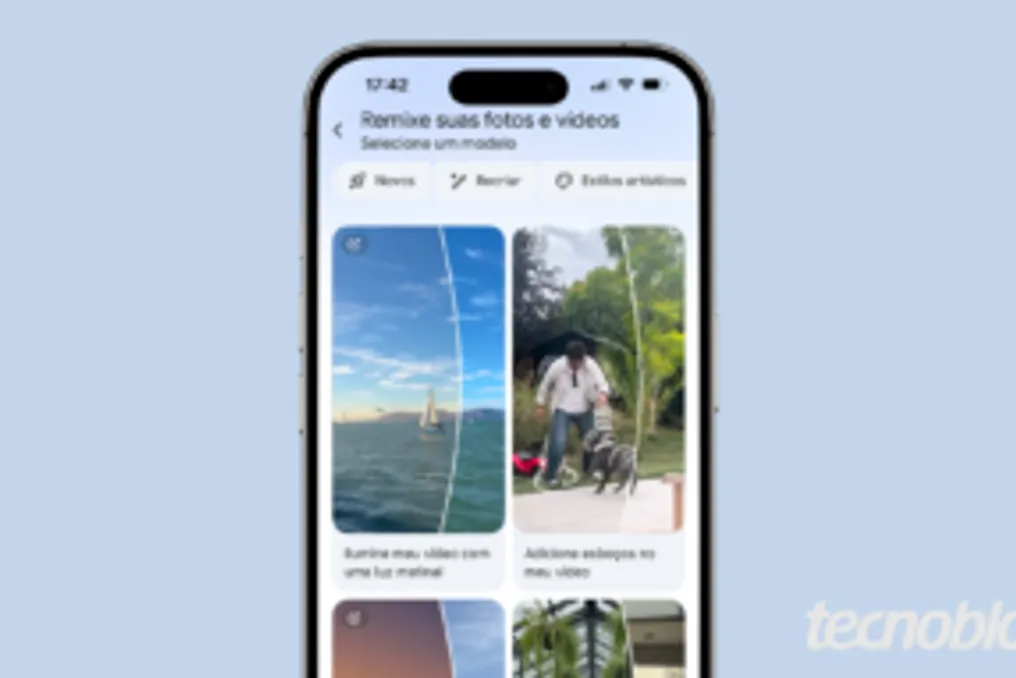
Google Photos has introduced a new Artificial Intelligence-based video editing capability called Video Remix. This tool allows for the transformation of short clips using various pre-configured effects, enabling changes to backgrounds and scene lighting.
The feature operates using the Gemini Omni model and is already being made available to subscribers of the Google AI Plus, Pro, and Ultra plans in specific regions, including Brazil. This addition is part of a broader Google Photos strategy focused on AI integration, incorporating video editing functionalities common in other applications, such as CapCut.
Video Remix offers adjustments to visual aspects such as light, background, or style, through ready-made definitions within the application. However, the functionality has certain restrictions: it only works with videos up to 60 seconds, requiring the user to select a segment of 1 to 10 seconds for editing. Furthermore, files must have their backup completed in Google Photos, and processing requires an internet connection, as it occurs in the cloud. Corporate and school accounts from Google Workspace are excluded from access to this tool.
The editing process is simplified and accessible through the Create tab in Google Photos, where the company concentrates its AI editing tools. To begin, the user must choose a template, select a video already backed up in Google Photos, and then specify the segment to be modified.
There are three main categories of editing available. The Reimagine option allows replacing the original scene of the video with AI-generated environments, such as a cafe or a beach at sunset. Filters are used to modify the scene lighting, simulating effects like soft glow or 'golden hour.' Additionally, there are artistic styles that drastically alter the clip's aesthetic, offering options inspired by watercolor, oil painting, anime, and sketchbook drawings. It is important to note that in this feature, it is not possible to insert custom commands (prompts); for that, the user must resort to the 'Create video' option directly in the Gemini app. The tool supports 9:16 or 16:9 aspect ratios, and recordings in other formats can be automatically centered and cropped by the application itself. All material generated or edited by Google carries a digital watermark known as SynthID.
Gemini Omni constitutes a set of generative AI models developed by Google, focusing on video creation and manipulation. This model was designed to integrate multiple types of input data—including audio, image, text, and video—to produce new clips based on these references. Its objective is to understand the context of the scene to enable more intuitive edits, such as changing the background, altering the visual style, or animating photographs.