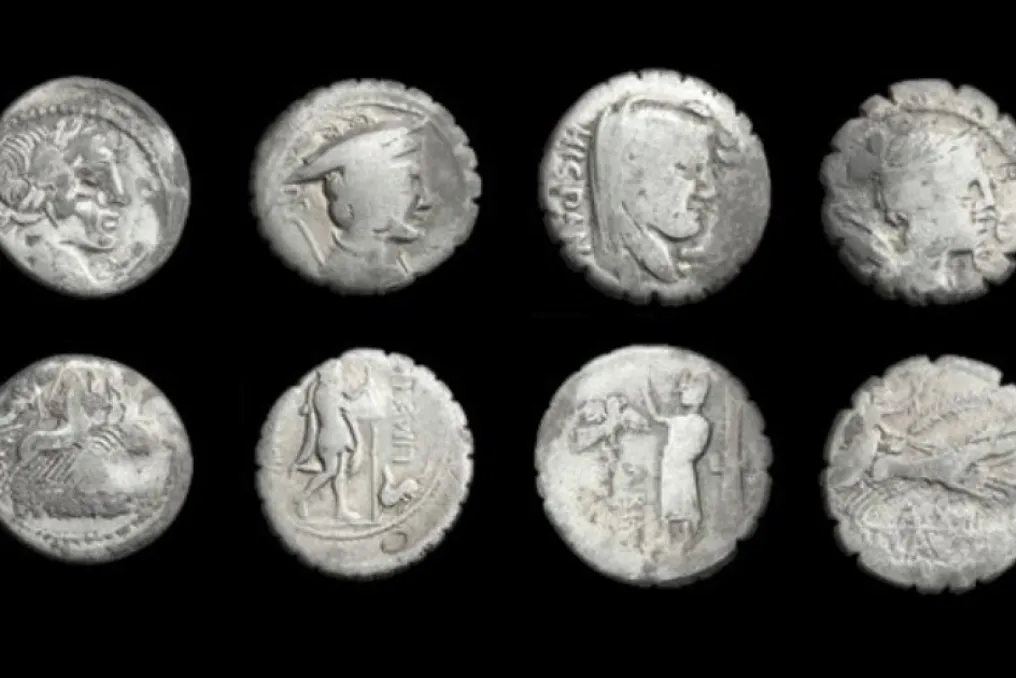
Archaeologists have discovered a Roman military camp in Slovakia located north of the Danube River. Specialists believe this unique monument dates back to the second half of the second century AD, coinciding with the period of the Marcomannic Wars.
Discovered artifacts and features of the camp
Various weaponry items and several hastily made burials were found at the excavation site. Furthermore, a trace left by Roman footwear was identified in the soil. This information was published on the website of MH Invest.
Historically, a significant part of the northern border of the Roman Empire ran along the Danube, affecting the territory of modern-day Slovakia. Germanic tribes such as the Quadi and Marcomanni lived north of the river. Although major clashes between these barbarian tribes and the Romans did not occur for a long time, the situation changed drastically in the second half of the 2nd century AD. During the reign of Emperor Marcus Aurelius, the Marcomannic Wars began (166–180 AD).
Course of the Marcomannic Wars and political decisions
During these military actions, Germanic and Sarmatian peoples fought against the Romans, achieving significant success in the initial stages. Only closer to the end of the conflict was the Roman army able to achieve victory, after which the Romans crossed the Danube. Marcus Aurelius intended to establish new provinces, securing lands north of the river for the empire. However, this plan was interrupted by the sudden death of the emperor from an infection, and his successor Commodus abandoned this idea, making peace with his northern neighbors and maintaining the previous border along the Danube.
Modern excavations in Nitra Region
Since 2025, researchers from the Archaeological Institute of the Slovak Academy of Sciences, led by Matej Ruttkai, have been conducting rescue and protective excavations across a large area in the Nitra Region, where an industrial park is planned. These lands are located north of the Danube, in the southwestern part of Slovakia. Among the archaeological and paleontological finds discovered is this Roman military camp, which most likely dates to the period of the Marcomannic Wars.
Architecture and findings of the camp
The camp is of particular interest not only because of its location north of the Danube Limes. It differs from standard Roman objects of this type due to the absence of a rectangular layout. Nevertheless, it featured classic defensive elements: a moat and rampart surrounding the perimeter, as well as entrance gates. Archaeologists determined that the entrance to the fort was protected by a structure known as a clavicula—a special passage where the fortress walls were arranged to overlap each other, forming a corridor with a sequence of gates. Such Roman fortification solutions have not previously been recorded in Slovakia.
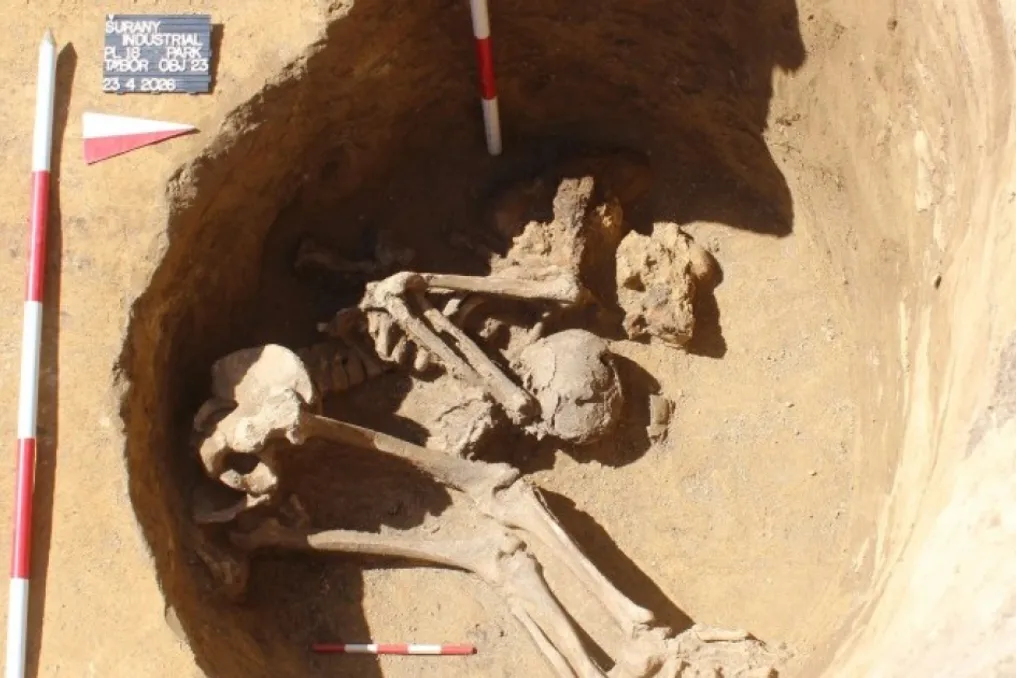
In addition to the remains of fortifications, scientists extracted a large number of human remains, including complete skeletons. These remains were found in ditches, former utility pits, or in shallow, hastily dug graves. They were likely Roman soldiers, evidenced by the large number of weaponry items found. Finds included arrow and spearheads, helmet fragments, armor elements, including lorica segmentata, as well as fibulae, coins, sandal nails, a dice, and household items.
Interpretation of findings and further research
Michal Heben, one of the archaeologists working at the site, suggested that the placement of skeletons in non-standard graves indicates that the people may have died violently, and their burial was conducted in haste. However, this requires further confirmation during future research when anthropologists thoroughly examine the skeletons for signs of combat injuries or diseases.
Researchers extracted blocks of soil from the monument in the form of monoliths for subsequent laboratory analysis. Using X-rays, they were able to observe a trace of Roman footwear inside one of these blocks. This imprint was preserved clearly enough to distinguish the sole details and estimate the foot size.
Context of the Marcomannic Wars
During the Marcomannic Wars, Marcus Aurelius concluded an agreement with local tribes under which eight thousand cavalrymen joined the service of the Roman Empire. Many of these cavalrymen were later sent to Britain as auxiliary troops. Several years ago, genetic analysis allowed scientists to possibly identify one of these individuals whose burial was found in the county of Cambridgeshire and dates back to the 5th century BC.