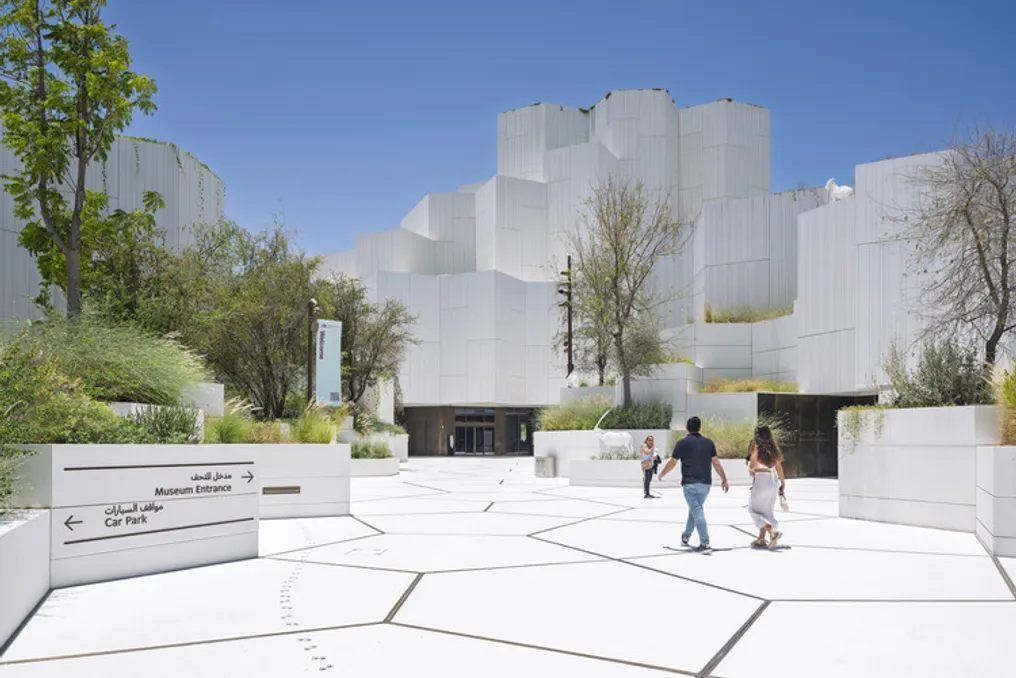
The concept developed for the Abu Dhabi Natural History Museum is based on the interaction between water and land. This dynamic dividing line is seen as a starting point for processes of movement and transformation.
The concept developed for the Abu Dhabi Natural History Museum is based on the interaction between water and land. This dynamic dividing line is seen as a starting point for processes of movement and transformation.
Instead of being planned as a single architectural structure, the museum was conceived as a landscape shaped by natural influences. In this project, architecture and the terrain itself merge, becoming inseparable elements.
The inspiration for the building comes from the geological formations and the characteristic wadis of the area. Thus, the construction emerges from the landscape as a collection of volumes that appear to have been sculpted over time, allowing the journey through natural history to begin even before visitors enter the museum.
In Tashkent, in a small courtyard located behind the blue gates of house No. 84 on Shokhjahon Street in the Yakkasaray district of the capital, the landscape exhibition by artist Bekzod Abdullaev titled 'Watercolor is Jazz' is being held.
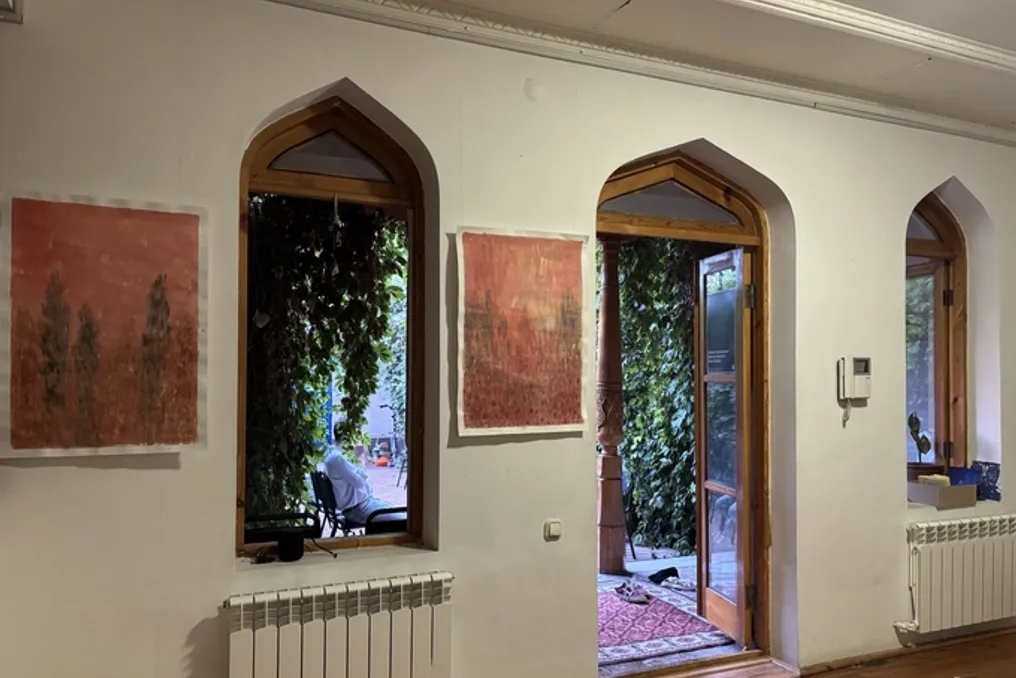
This courtyard is lush with greenery, and a narrow path leads to an old two-story mud-brick house whose walls and balcony are covered in ivy. The house, which has been rented by the 'Shams-i-Kamar' theater studio since last autumn, now functions as a co-working space for creative people, where film screenings, master classes, and various exhibitions are held. Within this intimate space, known as the 'Shokhjahon 84' House of Creativity, young artist Bekzod Abdullaev presented his exposition 'Landscapes. Watercolor Series' over the weekend.
Visitors are asked to remove their shoes before entering, creating the feeling of visiting a home rather than attending a traditional gallery. About twenty A3 watercolors without framing are hung on the plain white walls. The artist deliberately refrained from titles so that the viewer can interpret the works independently, without being constrained by the author's meanings.
Bekzod Abdullaev explains his approach by stating that it was important for him simply to paint and enjoy the process itself, allowing the viewer to see in the paintings what resonates with them personally.
At first glance, the watercolors may appear to be abstract landscapes, showing outlines of trees, a sunset sky, as well as circles imitating the sun or moon through the foliage. However, upon closer inspection, the image transforms into spots, strokes, swirls, and soft gradients, reminiscent of fading memories.
These works were created over the past six months and combine images from the author's memories of summer holidays at his grandmother's village, evening walks near the 'Cosmonauts' metro station, and quiet moments among trees in city parks. Abdullaev describes his watercolors as evocative and fleeting, emphasizing that they convey mood and atmosphere rather than striving for realism, leaving room for personal associations for each viewer.
The artist uses watercolor not only as a technique mastered during his studies in book graphics at the Kamoliddin Bekzod Institute of Arts and Design but also as a preferred tool for landscapes due to its unpredictability and freedom. He notes that unlike oil, where control over the process is high, watercolor always leaves room for chance. Although working with watercolor requires high precision due to the difficulty of corrections, it is precisely in this unpredictability, according to Abdullaev, that its charm lies. He compares oil to music recorded in a studio, and watercolor to jazz, which demands improvisation and trust in feeling.
This improvisational nature is evident in every work: part of the composition is determined by the author, while another part is shaped by the properties of the watercolor itself—its fluidity, transparency, and ability to suddenly change shape. The artist believes that the intimate setting enhances the personal connection between the viewer and the works, allowing them to immerse themselves in a state of silence contrasting with the city noise.
The series of watercolor landscapes by Bekzod Abdullaev can be viewed until August 18th. The 'Shokhjahon 84' Creative House is located at Shokhjahon Street (Shahjahkhan), 84, and welcomes visitors daily from 09:00 to 21:00. Entry to the exhibition is free.