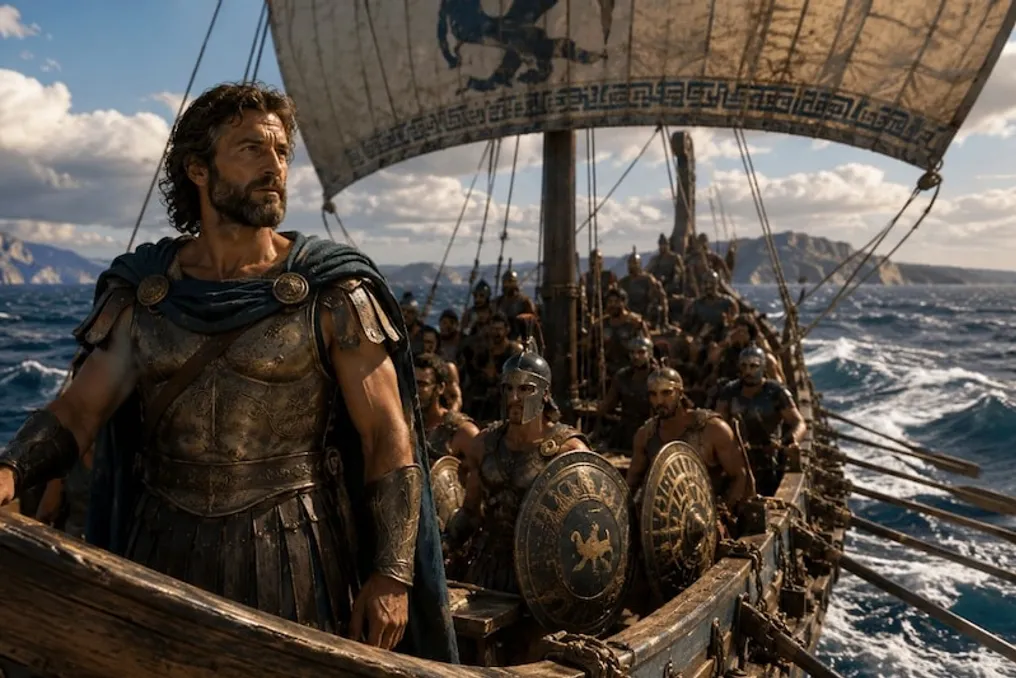
The 'Odyssey' remains one of the oldest literary works still read today. The ancient Greek poet Homer is considered the author of the 'Iliad' and the 'Odyssey'. However, scholars are uncertain about Homer's real existence; some believe he was a fictional character whose works were transmitted orally and later recorded in poetic form in the late 8th century BCE.
The Plot of the Epic 'Odyssey'
'The Odyssey' consists of 24 books and tells the story of the return of the king of Ithaca, Odysseus, home after the ten-year Trojan War, which lasted for ten years. During this journey, Odysseus's ships sink in storms, he is imprisoned for seven years, visits the underworld, and fights numerous monsters, demons, and gods.
The Historical Basis of Odysseus
There is no archaeological evidence that anyone named Odysseus ruled Ithaca. Nevertheless, some researchers hypothesize that Odysseus might symbolize the memory of one or more real Mycenaean rulers. In oral traditions, the names of important leaders often endure for a long time, even when historical details fade, and the stories of different people can merge into one mythological hero, making Odysseus a complex, blended personality.
Thus, Odysseus is likely not a historical figure whose life can be fully reconstructed, but as a character, he reflects real aspects of Mycenaean monarchy, sea voyages, wars, and diplomacy. Although the historical roots may be real, the surrounding story has turned into a legend.
Archaeological Parallels
Even if archaeology cannot confirm Odysseus's existence, it demonstrates the truthfulness of some parts of the world described by Homer. Important settlements from the Late Bronze Age Mycenaean period have been discovered on Ithaca. Although none of them can be called Odysseus's palace, they attest that the island was part of the political landscape of the Mycenaean period.
The political structure of Odysseus's state is also similar to the known system of Mycenaean Greece. Local rulers governed relatively small territories centered around fortified palaces but recognized the leadership of more powerful rulers—such as Agamemnon from the 'Odyssey'. This model corresponds to evidence obtained from various sites, including Mycenae, Pylos, and Tiryns.
Character and Deeds of Odysseus
Odysseus is the son of Laertes and Anticlea, the husband of Penelope, and has a son Telemachus. He is the ruler of the small island state of Ithaca and commands a fleet of twelve ships during the Trojan War. His story in the 'Odyssey' focuses on the ten years spent returning home after the end of the Trojan War. During this time, he confronts monsters and overcomes storms sent by the gods.
Homer portrays him under the guidance of the goddess Athena, presenting him not just as a brave warrior, but as a cunning, wise warrior. In the 'Iliad', he fights with the greatest Greek heroes and often acts as an advisor at councils. The Greek kings Agamemnon, Menelaus, and Nestor respect him. His main trait is metis, that is, practical wisdom, cunning, and the ability to solve problems strategically, not just through force.
Intellect Versus Brute Force
Odysseus blinded the Cyclops Polyphemus not through his immense strength, but through his cunning. He ordered his crew to tie the ships to the mast to avoid the seductive songs of the Sirens. When he and his companions pass by the Sirens—creatures half-bird, half-woman, whose music lures sailors to death—Odysseus cannot resist their singing.
Odysseus is very curious. When they pass by the nymphs, his companions ask him to come out, but he insists that they plug their ears with wax and wool while he remains tied to the mast to hear what it is like. His influence is felt even today, as, unlike other Greek heroes such as Achilles, Perseus, and Heracles, he is perceived more as a wise and far-sighted person than as a mighty warrior. It is constantly emphasized in the stories that he conceals his identity, takes on the guise of other people, and deceives people to achieve his goals.
Overcoming Dangers
During his ten-year journey back to Ithaca, Odysseus faces numerous dangers. The most famous of these is the Cyclops named Polyphemus, who captures Odysseus and his comrades captive. Polyphemus begins eating his companions and threatens to eat everyone, but Odysseus cleverly avoids this fate.
He treats Polyphemus to a large amount of wine, and then, when he loses consciousness, Odysseus blinds him by driving a sharp object into his eye. However, Odysseus's attack has consequences. Poseidon, associated with Polyphemus and being the god of the sea, prolongs Odysseus's journey back to Ithaca, causing storms and destroying his fleet.
Along his way, Odysseus also encounters the god of winds Aeolus, who gives him a bag containing all the winds except the west wind that would take him back to Ithaca. He also narrowly escapes the Scylla and Charybdis, and he encounters the sorceress Circe, who turned many of Odysseus's men into pigs. Odysseus persuaded Circe to restore his men to human form using a herb called Moly. After this, a romantic relationship developed between Circe and Odysseus for a year, resulting in her giving birth to two sons.
Furthermore, Odysseus faced a huge whirlpool named Charybdis, which sucks in ships, and the six-headed monster Scylla, which abducted six sailors when Odysseus's ship came too close. The entire story of the 'Odyssey' revolves around Odysseus's courage, intellect, strength, and hope of returning home. While the 'Iliad' focused more on Achilles, the 'Odyssey' is entirely dedicated to King Odysseus.