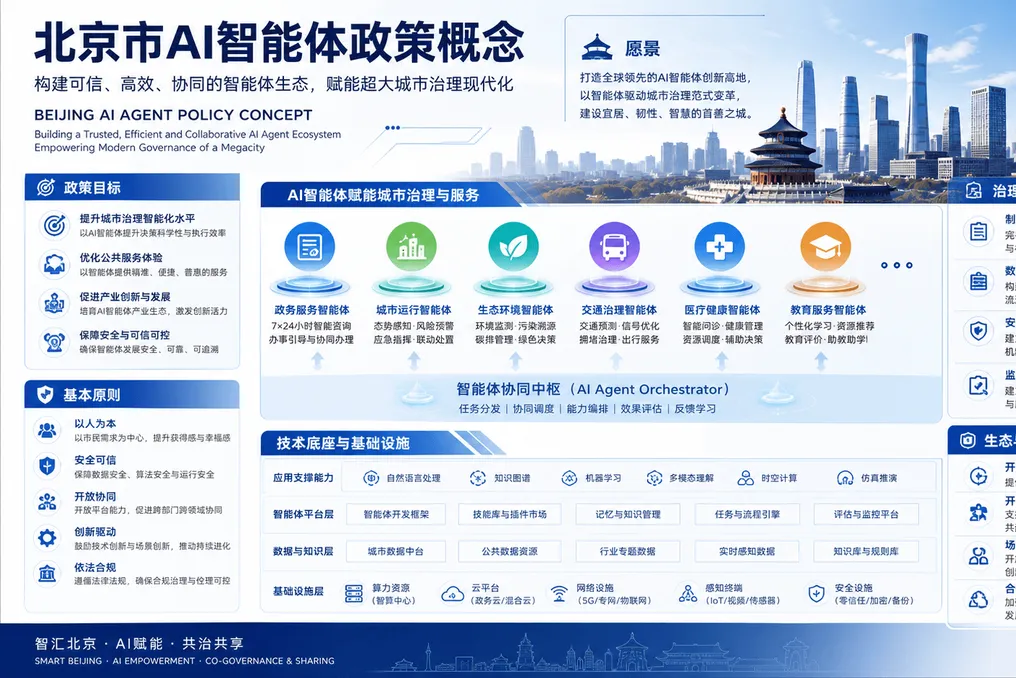
Beijing has unveiled a comprehensive policy comprising ten measures concerning artificial intelligence agents. This document marks one of the first global governmental frameworks specifically targeting the developing economy of AI agents.
Key Policy Provisions
The policy, titled 'Several Measures to Accelerate the Development of AI Agents in Beijing,' was published on July 23rd. It covers the entire stack of agent technologies—from the capabilities of foundational models to deployment infrastructure and economic standards. The document introduces terms such as Agentic AI, Harness Engineering, AI OS, Token Economy, and AIP into official state policy for the first time.
Requirements for Foundational Models
The first measure focuses on the capabilities of foundational models, emphasizing practical task execution over benchmark scores. The policy mandates that models possess functions such as online learning, continuous learning, autonomous evolution, ultra-long horizon task execution, complex analysis and planning, tool calling, long context understanding, multi-agent coordination, and memory. This represents a significant shift from evaluating models based on static criteria to measuring their reliable ability to act, i.e., the probability of successfully completing a multi-stage task in the real world.
Engineering Concepts and Markets
The second measure introduces the concept of Harness Engineering, which includes context optimization, task state preservation, inter-agent coordination, and observability. Furthermore, the policy provides for the creation of skill markets and agent compatibility protocols for a future where software is consumed by agents rather than humans.
Economic Ecosystem and Future
The remaining measures address the development of AI operating systems, tokenomics infrastructure, including token factories, 'task-as-a-service' and 'agent-as-a-service' models, aggregation of computing resources, vertical industry applications, talent development, international cooperation, and governance systems. The policy anticipates the formation of a complex economic environment where agent capabilities can be exchanged, combined, and measured in standardized ways across various industries. This reflects the reality that agents, functioning as one-person companies enhanced by agent systems, are becoming viable economic entities.
Significance for Global Industry
Beijing's policy is considered a turning point for the global AI industry, as it prompts governments to move from general AI support measures to the targeted construction of infrastructure for an agent economy. The sophisticated technical knowledge demonstrated in the document indicates close collaboration with leading AI companies and research institutions. For AI companies worldwide, this policy signals that the transition to agents is not merely a technological evolution but an economic transformation requiring new standards, business models, and infrastructure. Beijing has clearly signaled its intention to become the first jurisdiction to build such a comprehensive agent infrastructure, which could grant it a long-term competitive advantage in the nascent agent economy.