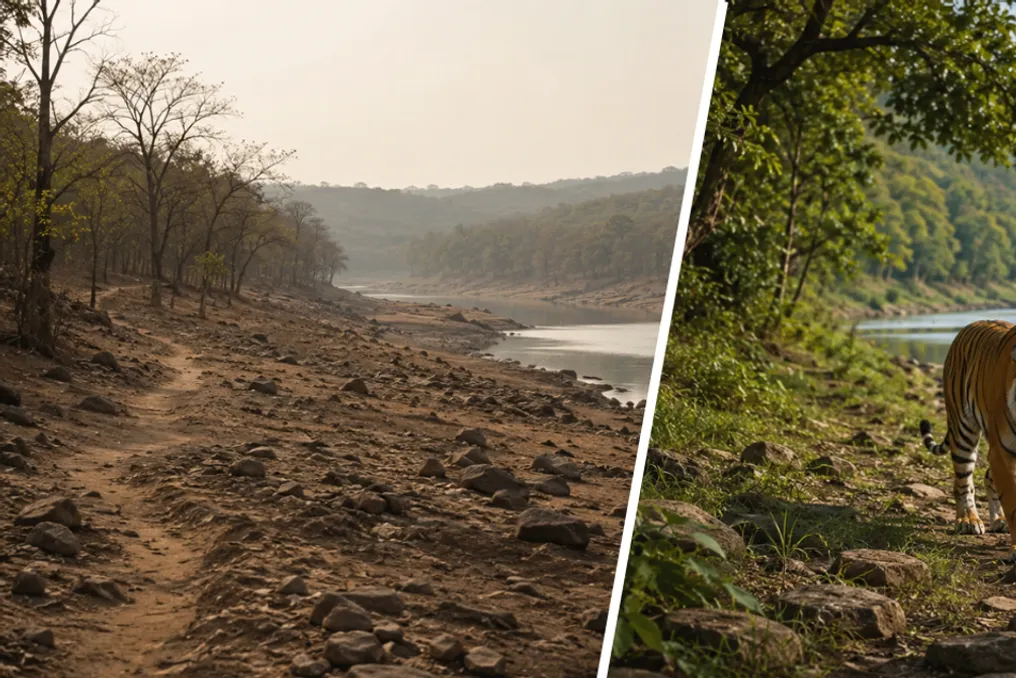
Recent publications have once again drawn attention to the Panna tiger sanctuary. This is due to the project connecting the Ken and Betwa rivers, which includes the planned construction of the Daudhan dam, expected to flood thousands of hectares of forest in one of India's most famous tiger landscapes.
Conservation Issues
The discussion goes beyond the fate of a single sanctuary, raising questions about the future of one of India's greatest wildlife restoration stories. More than fifteen years ago, Panna lost all its tigers. However, thanks to one of the country's largest conservation initiatives, the sanctuary managed to restore the population from scratch, and today there are about 80 tigers inhabiting it.
Currently, conservation specialists are asking a new question: what will happen to the landscape that was painstakingly restored over decades if it begins to change? Tiger recovery was only part of Panna's success; healthy forests, abundant prey, connected habitats, and reliable water sources played an equally important role.
Period of Tiger Extinction
Scientists note that any change in these ecological components can trigger a chain reaction throughout the entire ecosystem. For a long time, Panna was considered an ideal territory for tigers. The sanctuary, located in the forests of Madhya Pradesh, was once hunting grounds for the princely states of Panna, Chhatarpur, and Bijawar. It was recognized as a national park in 1981 and later declared a tiger reserve in 1994. Over time, adjacent forests and buffer zones expanded the protected landscape to nearly 1600 sq km.
On paper, everything looked well, but poaching subtly undermined years of conservation work. In the early 2000s, the presence of 24 to 40 tigers was estimated in Panna, but by 2009, only one solitary male remained. The sanctuary lost the species it was created to protect. For conservation specialists, this meant not just the disappearance of a predator, but the collapse of an entire ecological process.
Population Return
This was followed by one of the most closely monitored wildlife restoration programs in India. In June 2009, the Madhya Pradesh Forest Department, with support from WWF and the management of Panna sanctuary, launched an ambitious tiger reintroduction program. The first to arrive were two tigresses—T1 from Bandhavgarh and T2 from Kanha. Soon, a male T3 from Pench joined them.
Immediately after T3 was released, he began moving back into Pench, passing through villages and other areas dominated by human settlements, without conflict. Forest officials tracked him continuously for over a month before returning him to Panna in December 2009. This time, he stayed. He claimed territory, found mates, and became one of the founders of Panna's recovering population.
In April 2010, T1 gave birth to four cubs, and a few months later, T2 also gave birth to four cubs. In 2011, two more tigresses, T4 and T5, were introduced. Although T4 later died from an infection caused by her radio collar, the program was already gaining momentum. Over the years, seven translocated tigers—five females and two males—gave birth to over 80 cubs. What seemed impossible turned into one of the greatest successes in nature conservation in India. If there was no breeding population in 2009, by 2019 the tiger population in Panna had grown to 54 individuals. In 2020, UNESCO included the sanctuary in the World Network of Biosphere Reserves. Today, estimates suggest Panna supports about 80 tigers.
Importance of Ecosystem and Science
This remarkable success is documented in the film 'Return of the King: How Panna National Park Got Its Tigers Back', directed by Mandakini Mall and produced by Roundglass Sustain. The documentary shows that the movement of tigers was just the beginning. Every breeding tiger was fitted with a radio collar, allowing forest teams to monitor their movements around the clock. Rangers tracked dispersal, reproduction, and territorial behavior, helping the animals safely adapt to their new home.
However, the film also highlights a broader lesson. Conservation biologist Dr. Raghu Chundawat, who has studied tigers in Panna for decades, argues that the sanctuary reflects the challenges facing India's dry forests. These landscapes constitute almost half of the tiger habitat in the country, yet they are where tiger populations are declining fastest. According to him, the reason lies in what he calls a 'scale mismatch.' Unlike tigers living in dense forests, those in dry forests require territories three to four times larger because prey is distributed over more extensive areas. As roads, settlements, and infrastructure fragment these forests, maintaining healthy tiger populations becomes increasingly difficult.
In Chundawat's view, Panna and Sariska serve as important reminders that protecting the habitat is as crucial as protecting the animals themselves. The film also features wildlife cinematographer Joanne Van Gruisen, who believes that long-term conservation depends on local communities. Families living around Panna depend on agriculture and forest resources for their survival. When conservation also supports their well-being, wildlife protection becomes a shared goal, not a competing interest.
Role of the Ken River
The restoration of Panna was never solely about bringing back tigers; it was about restoring an entire ecosystem. Researchers from the Wildlife Institute of India (WII) and the Zoological Survey of India (ZSI) found in their study 'Interspecific interactions among mammals in Panna Tiger Reserve, Central India: Predator-Prey Dynamics' that water plays a central role in shaping the sanctuary's fauna. Their research showed that the probability of detecting mammals decreases with increasing distance from water. As reported by WII researcher Supratim Dutta to Mongabay: 'The Ken River functions as the ecological backbone of the entire mammalian community.'
The study suggests that Panna's recovery was achieved through a combination of several ecological factors: healthy prey populations, connected forests, meticulous management, and reliable water resources. In other words, it is not enough just to restore predators; the environment that supports them must remain healthy.
Impact of Future Development
Even before the current disputes, scientists studied how future development could affect the sanctuary. A 2021 article published in Current Science titled 'River Interconnectivity and Biodiversity Conservation: A Study of Panna Tiger Reserve' calculated that the Ken-Betwa project could directly flood about 58.03 sq km, which accounts for approximately 10% of the sanctuary's critical tiger habitat. The study also predicted an indirect loss of over 105 sq km due to fragmentation and reduced habitat connectivity.
These studies underscore an important lesson from Panna's impressive comeback. The sanctuary's revival did not happen merely because several tigers were relocated. It happened because the forests remained connected, prey populations recovered, water continued to sustain the landscape during harsh summer months, and the tigers had enough space to establish territories and raise cubs. In Panna, the future of the tiger has always been closely linked to the future of the landscape it calls home.