Ashim PK, a Dubai resident who grew up in the village of Erpona, Kerala state, shares his thoughts on how public opinion around Argentina is forming after the recent World Cup. He notes that his perception of Argentine football was shaped since childhood while watching matches in the southern state of India, colored by the flags of Brazil and Argentina.
Shifting Public Opinion
Previously, friends' mockery over Argentina's losses was relatively harmless. However, after Argentina managed to beat Egypt in the concluded tournament, the situation changed. Conspiracy theories emerged suggesting the team received improper assistance from FIFA and referees during victories over Egypt and Switzerland, leading Argentine support to become a subject of insults.
According to Ashim, many fans do not view Argentina's loss to Spain in the final as an admission that Spain played better. There is a feeling that Spain had a moral right to defeat a team that many considered unworthy of the final.
Comments on Refereeing and Bias
Ashim emphasizes that controversial decisions are part of football, pointing out that teams complaining about refereeing in Argentina's matches themselves benefited from decisions in their favor at other times. He argues that people tend to complain when a decision goes against them but ignore it when it benefits them. He also finds it unfair to create conspiracy theories about FIFA wanting any team to win the World Cup.
Furthermore, Ashim was puzzled by the narrative on social media labeling Argentina as a racist country. He objects to such categoricity, stating that every country has both good and bad people, and one cannot label an entire nation based on the actions of a few individuals.
Questions Regarding Lionel Messi's Image
Another troubling point for Ashim was that trolls attacked Argentina's mascot, Lionel Messi, not because of his performance in the final, but due to non-football related issues. Some social media users tried to inject politics into football, questioning support for Messi's humanitarian initiatives, particularly concerning Palestine. They pointed to Messi's participation in UNICEF campaigns in Israel but deliberately ignored the fact that the same campaign included Messi's visit to Palestine.
Hodge Ferrari, an Argentine sports photographer from Sharjah, agrees that even mainstream media engages in slander. He expresses disappointment with British media, noting that their criticism often seems driven by prejudice rather than objective analysis. Ferrari criticizes the selectivity and dishonesty of the criticism, insisting that fair game analysis differs from promoting a specific narrative.
Sportsmanship in South America
Brazilian football expert Tim Wiki explains that demonstrating fighting spirit against a stronger opponent is acceptable in South America. He believes that Argentine football possesses both beauty and a wild side. When they play well, their technique is incredible, but when they fear losing greatly, the national team becomes a symbol of the nation, and defeat feels like an invasion that must be repelled by any means, whether fair or unfair.
Wiki notes that this behavior looks bad on the world stage but raises an interesting question about what constitutes shame: giving up easily or fighting until the end using all available means. He believes this distinguishes the South American approach and provokes a strong reaction on the other side of the Atlantic, especially in England.
Comparison of Aggressive Styles in Football
Ferrari reminds that football history is full of teams that fought hard against stronger opponents. He cites examples of aggressive play in club football, such as José Mourinho's teams, where players like Sergio Ramos and Pepe regularly broke rules. He also recalls the 1984 incident where Diego Maradona was injured by Andoni Goikoetxea, and later Maradona himself struck an opponent.
Ferrari asserts that there has always been a dark side to football in all major countries. He counters that critics focus only on Argentina's physical play, ignoring how often Messi was fouled throughout the tournament, including the final. He points to the obvious foul by Rodri on Messi near the penalty area that was ignored.
Unacceptable Player Behavior
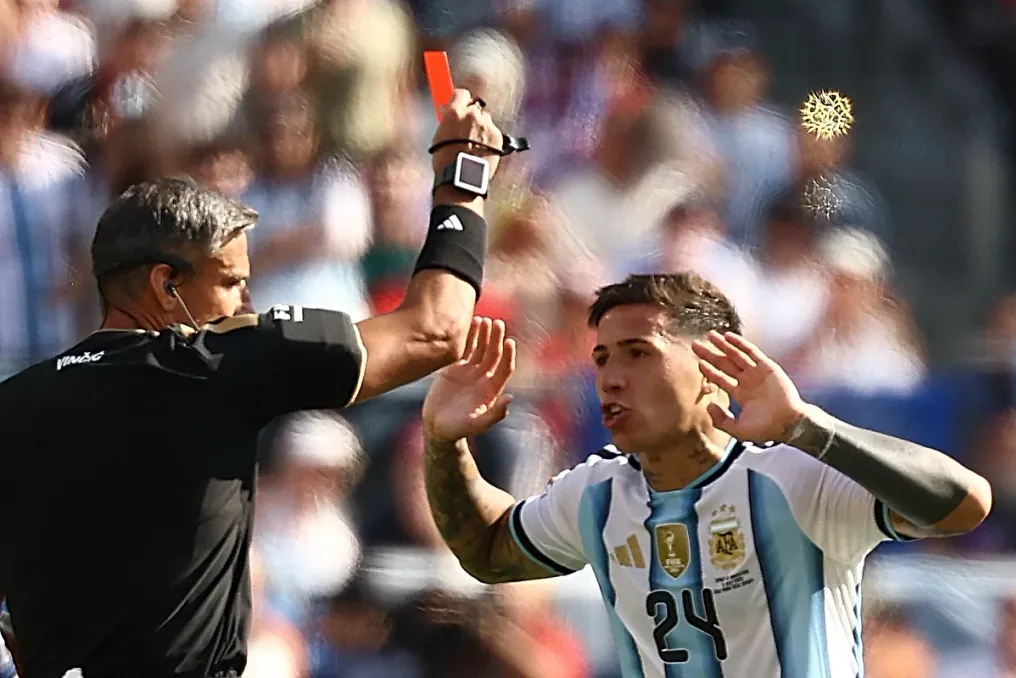
As an Argentine, Ferrari feels shame over Leandro Paredes' actions, who attacked Spanish player Gavi after the final, calling such behavior unacceptable. He believes some of his fouls were so rough it seemed he came to fight rather than play. Ferrari also rejects the notion of many European media outlets that the Paredes incident reflects the mentality of all of South America, calling it lazy journalism.
He compares this to the incident where Jude Bellingham hit an Argentine player after the semi-final, arguing that one incident cannot be used to generalize an entire team or country. Despite mediocre performance in the final, Ferrari states that his compatriots will always be proud of the Argentine team, accepting defeat to deserving champions, but demanding the same fairness in evaluation.