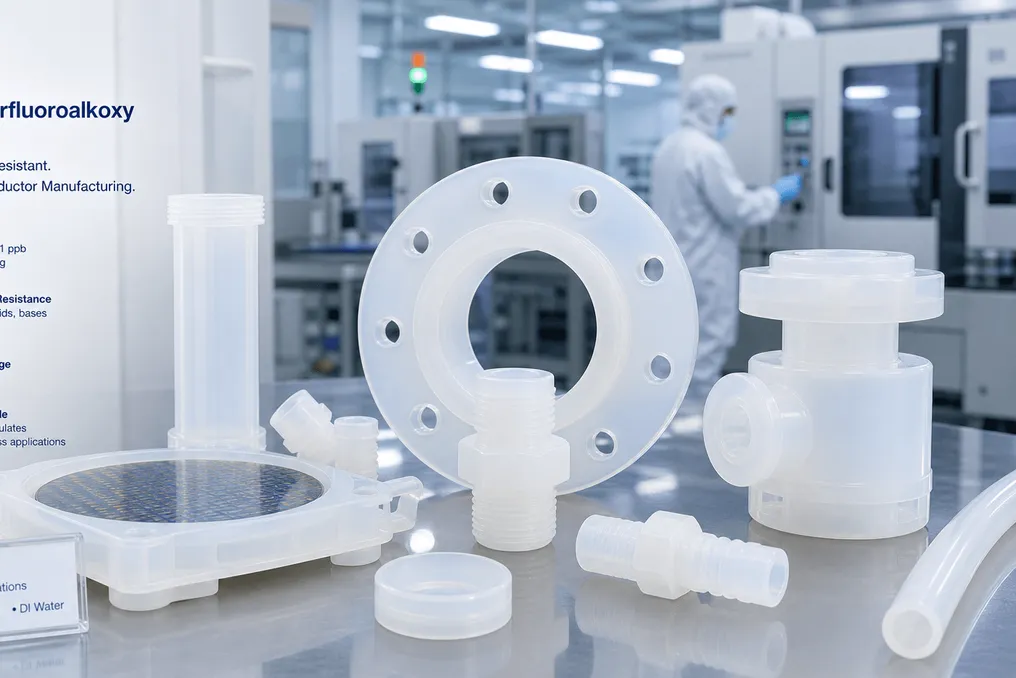
High-purity PFA, a fluoropolymer essential for modern wet process equipment in the semiconductor industry, is gaining attention amid China's increasing drive to localize its semiconductor supply chain. This material is critical for manufacturing chemically resistant tubing, fittings, valves, and containers used in wafer cleaning, etching, and chemical-mechanical polishing processes.
Material Significance for Chip Manufacturing
The material's ability to resist contamination at an extreme purity level directly impacts the yield of functional chips on advanced technological nodes. The localization of PFA production within the country is occurring against the backdrop of expanding capacity by global memory chip manufacturers and accelerated investment in advanced logic processing.
Traditional Dominance and Technical Requirements
Historically, the high-purity PFA market was controlled by several major global chemical companies with years of experience in producing ultra-pure fluoropolymers. The material must meet very stringent standards, including extremely low metal ion extraction, particle count control, and mechanical property stability in every batch. These requirements have proven technically challenging for new market entrants.
Verification Process and Dependency Reduction
Several Chinese chemical companies have reached the batch verification stage. Their products undergo qualification testing by semiconductor equipment manufacturers and fab operators. The verification process typically takes several quarters and includes accelerated aging tests, chemical compatibility analyses, particle shedding measurements, and performance checks directly on the customer's equipment. Successful verification will allow Chinese equipment makers to procure this critical material domestically, thereby reducing reliance on foreign suppliers and shortening lead times, which can reach 12–24 months due to global equipment constraints.
Market Prospects and Technological Barriers
The market potential is considerable, as every advanced semiconductor fab requires large volumes of high-purity PFA for chemical delivery systems, wet benches, and wastewater treatment infrastructure. As China builds numerous new wafer fabs under government-backed initiatives to achieve semiconductor self-sufficiency, the domestic PFA market volume is growing proportionally. Industry estimates suggest that demand for semiconductor-grade fluoropolymers in China could exceed several billion yuan annually over the next five years.
Path to Mass Production
The technological complexity of this production cannot be underestimated. Producing high-purity PFA requires specialized polymerization processes, ultra-high purity raw materials, dedicated cross-contamination-free production lines, and sophisticated quality control systems capable of detecting impurities at parts-per-trillion levels. The verification stage is a crucial milestone, but achieving mass production with consistent quality at competitive prices may require additional investment in specialized manufacturing infrastructure. If local suppliers can successfully pass the verification and scaling phases, high-purity PFA could become another example in China's broader strategy of material localization in the semiconductor industry, which has already made significant progress in photoresists, etching gases, and CMP slurries.