OpenAI has unveiled Presence, a new platform aimed at enterprise clients. This solution is designed to allow artificial intelligence agents to be implemented in internal processes and services intended for external audiences.
OpenAI has unveiled Presence, a new platform aimed at enterprise clients. This solution is designed to allow artificial intelligence agents to be implemented in internal processes and services intended for external audiences.
The product was conceived to execute various specific tasks, such as answering queries, solving problems, accessing duly authorized systems, performing pre-approved actions, and, when necessary, transferring cases to human teams. The main objective is to ensure a higher level of trust for applications of great relevance.
According to the company, Presence integrates AI models, operational guidelines, control mechanisms, rigorous evaluations, and a constant improvement cycle. This enables agents to adapt to changes in products, internal regulations, and user behavior.
OpenAI clarifies that each Presence installation begins with the definition of a specific workflow. In this initial stage, the agent receives only the knowledge and permissions strictly necessary to fulfill its designated function.
It is the responsibility of the client company to determine which activities can be automated, which require prior approval, and under what circumstances a human attendant must take over the service. Once operational, real interactions and cases passed to people serve as a basis for identifying any system limitations.
OpenAI mentions that Codex offers suggestions for adjustments that can be analyzed by teams before final approval, allowing agents to keep up with changes in corporate policies and user habits without compromising the company's control over the process.
The company also assures that it supports clients throughout the entire implementation process, from identifying the most important processes to integration with knowledge bases, internal systems, permission definition, testing, and operation commencement. For larger projects, this support can be provided by OpenAI itself or by partner integrators.
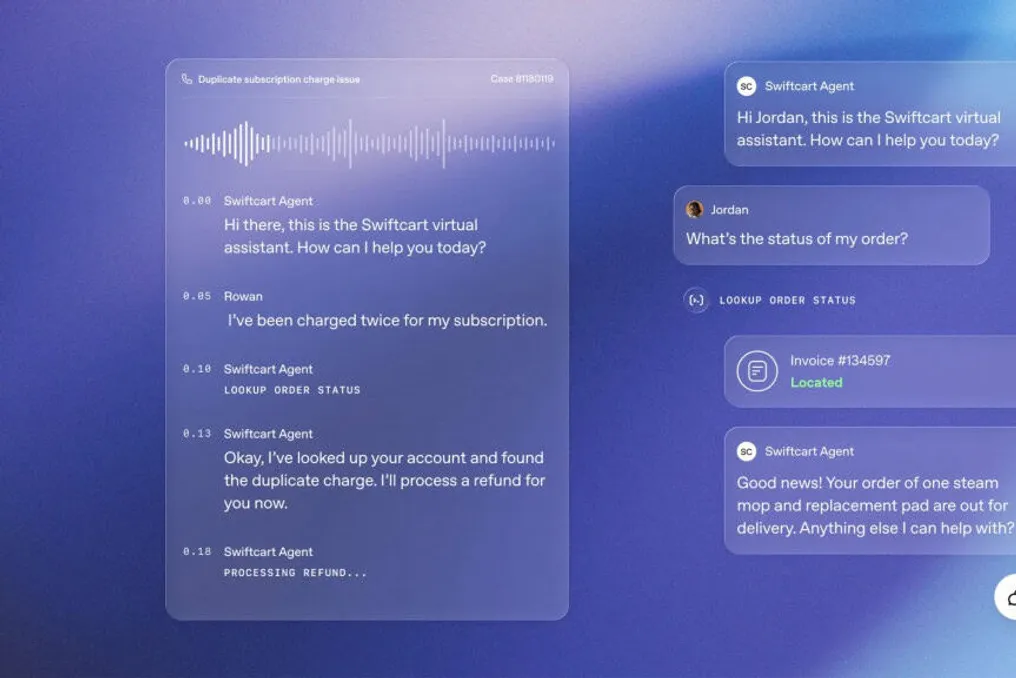
Currently, Presence operates in voice and chat modes. Usage examples include customer service, active sales, and internal flows classified as high risk. In a case illustrated by the company, the agent can understand a billing request, verify the user's identity, consult account data, apply defined organizational rules, and execute an authorized action.
OpenAI emphasizes that some elements remain uniform across all implementations, such as escalation criteria, evaluations, and policies. However, other components can be customized according to the service channel or chosen process, which expands the platform's potential without requiring a complete structural rebuild.
The company claims that the product has been refined through projects conducted with large corporations. One example cited is the use of Presence on OpenAI's own English telephone line, where it performs identity verification, consults account information, and executes authorized actions.
According to the company, this system managed to resolve 75% of incoming demands without the need for human intervention and reduced referrals to attendants by 15 percentage points after ten days of improvements implemented with the help of Codex.
Among the organizations involved in the initial phases are BBVA, which is evaluating the use of voice service for banking operations in Mexico; SoftBank, which is testing Japanese conversations; and IAG, which is investigating the application of the technology to provide support during peak demand, such as severe weather events.
Daniel Ordaz, responsible for BBVA's AI transformation in Mexico, commented on the partnership, stating that the institution collaborates with OpenAI to explore how reliable service agents can influence the future of financial services. He detailed that, as a design partner of Presence, they work to develop and refine finance-focused voice experiences, aiming for more agile, fluid, and personalized interactions.
Before being released to users, Presence undergoes simulations covering common requests, exceptional situations, and high-risk scenarios. These evaluations confirm whether the agent achieved the expected result, respected established policies, used the correct tools, and referred cases to people when appropriate.
After deployment, conversation logs, quality indicators, and escalation incidents continue to feed the review process. Codex analyzes this data, proposes modifications, and allows each update to be compared with the production version before its final approval.
OpenAI informs that access to Presence is restricted to eligible corporate clients through a limited general availability program. Implementations are conducted by the company's own engineers and selected global integrators. Currently, the platform does not offer an autonomous subscription model.