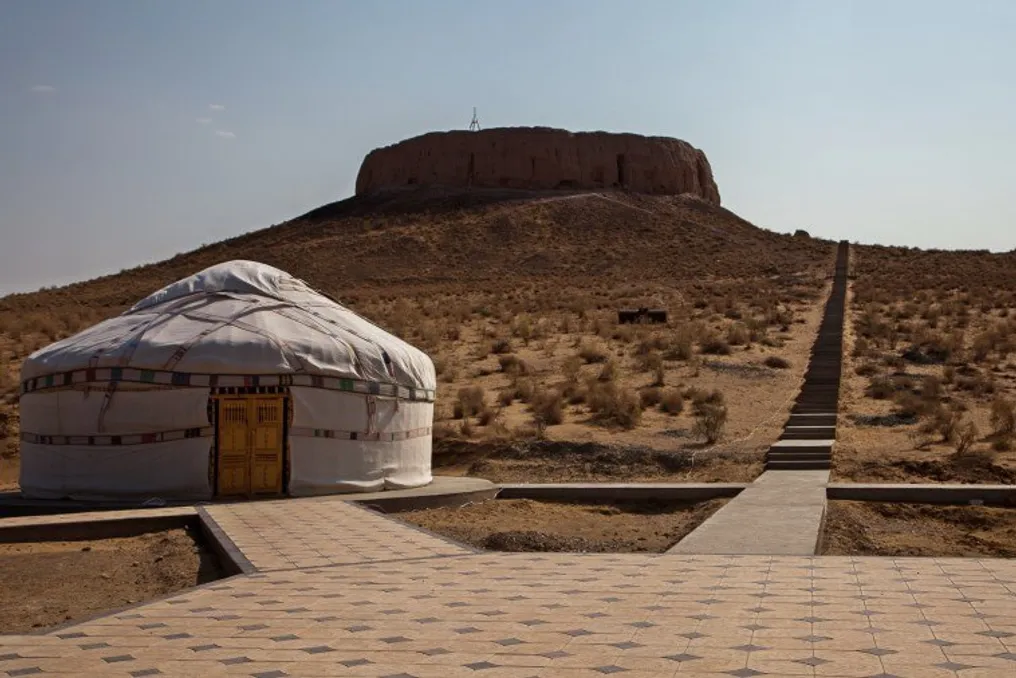
The Karakalpakstan region, despite its significant tourism potential, including the famous avant-garde museum in Nukus and proximity to the Aral Sea, traditionally remains outside the main tourist routes of Uzbekistan, where Samarkand, Bukhara, and Khiva dominate.
The Beginning of Hospitality
Popular
Local entrepreneurs are striving to change this situation by developing hotel infrastructure. Dilfuza Janibekova is one such innovator: 12 years ago, she opened a small eight-room guesthouse in her family home, and now she manages a complex with 80 rooms that continues to expand.
In an interview with Podrobno.uz, Janibekova spoke about the start of her journey. Her activities began near the Igor Savitsky Museum of Arts in Nukus, often called the 'Louvre in the Desert.' The first impetus for development was a recommendation from a Dutch tourist in 2014, who noted the potential of the house for accommodating travelers.
Professional Experience and Early Challenges
Before opening her own project, Janibekova had experience in the tourism sector: after graduating from the Faculty of English Language in 2005, she worked as a guide, then became a manager at the 'Zhibek Zoli' hotel, and from 2008 to 2013, headed the 'Kyzylkum' hotel. Starting with a small family home, she quickly discovered high demand for accommodation.
However, early development faced a serious problem—a lack of funding. The process of obtaining the first loan was delayed by eight months due to bureaucracy. While waiting for documents, Janibekova prepared the territory for a new wing: she bought an adjacent house and obtained two hundred square meters of land from city authorities almost free of charge, although this area initially contained an abandoned landfill that she had to clean up herself.
Financial Transformation and Growth
The situation in the industry improved after the launch of state tourism support programs, which simplified access to funds. For the next stage of expansion, she received a preferential loan of 3.5 billion soums over seven years with a two-year grace period. Bringing the room fund to 80 rooms required building a fourth floor, and this time the banking procedures took only a few days, unlike the month-long wait at the start.
The Impact of the 'Stikhiya' Festival on the Market
The Karakalpakstan market received a powerful boost thanks to the electronic music, art, and science festival 'Stikhiya.' Janibekova links the sharp growth in hotels in Nukus to this event. If there were previously only five or six hotels in the city, their number has now reached 30-40.
The success of the festival demonstrated growing interest: in 2019, out of 5,000 participants, there were about 500 foreigners. In 2023, when the event was held in Navoiy Region, it attracted three thousand visitors, half of whom came from CIS, European, and Asian countries. Returning to the historical site in Muynak allowed for the gathering of over 8,000 guests from various countries, including Germany, Japan, and the USA. This success also stimulated the development of Muynak, where the number of hotels increased from one to approximately ten.
Challenges: Geography and Personnel
Despite the successes, event tourism has a structural drawback—seasonality. Most guests use Nukus only as a transit point, staying for one or two days, which creates an imbalance because the infrastructure operates at its limit only during the 'Stikhiya' festival.
Another problem was the staff shortage. Previously, training personnel required sending employees to Tashkent, which was difficult. Janibekova managed to organize off-site courses in Nukus, leading to the opening of a branch of the International University of Tourism and Cultural Heritage 'Silk Road' in the region. Digital accounting 'E-mehmon' was also introduced, automating registration and reporting.
The main external obstacle remains geography: Karakalpakstan finds it difficult to compete with well-known centers like Samarkand, Bukhara, or Khiva, and the distance to Muynak and the Aral Sea exceeds two hundred kilometers. Due to logistics, tour operators rarely include the region in standard tours.
Development Prospects and Advice
Janibekova believes that the region should be integrated into classic tours, for example, by allocating one or two days in Nukus before traveling along the Khiva – Bukhara – Samarkand – Tashkent route. She emphasizes that the attractive feature for tourists is the atmosphere of tranquility and absence of urban hustle.
The entrepreneur plans to open a Karakalpak cuisine restaurant on the complex grounds to provide tourists with authentic local dishes. The launch will require a new loan, which, thanks to reforms, will be processed quickly. Summarizing ten years of experience, Janibekova notes that the secret to success was not in chasing quick profits but in a sincere commitment to service quality and working with people, advising beginners to focus on what they want to do rather than the amount of starting capital.