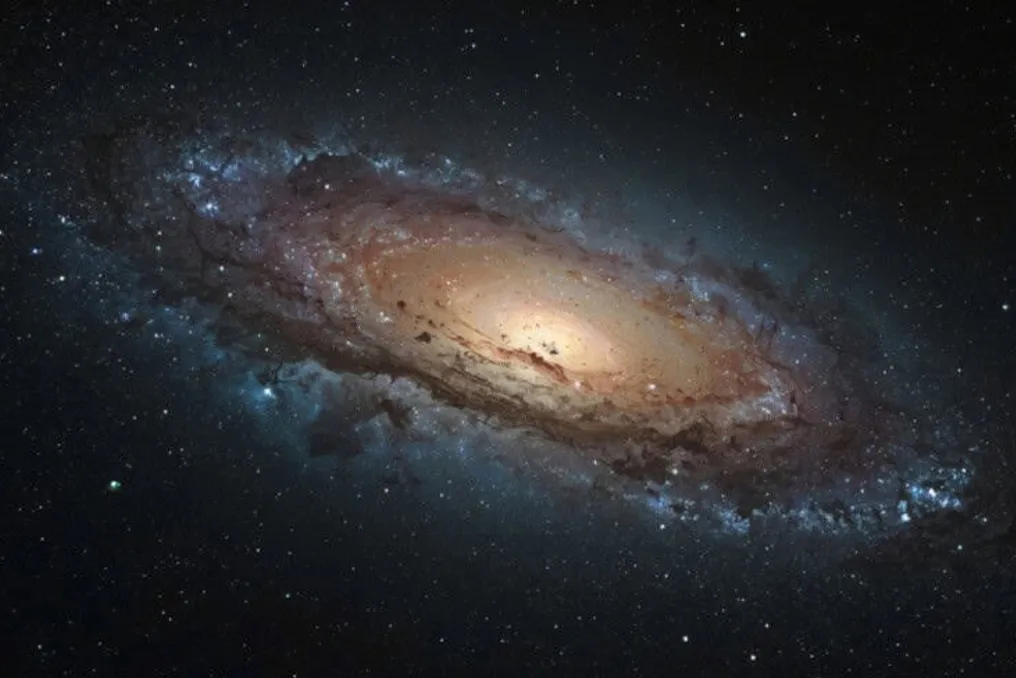
Researchers suggest that the Milky Way may have undergone a drastic transformation in its history, specifically an alteration in the inclination of its galactic disk within the surrounding dark matter halo.
Origin of the Scientific Hypothesis
This theory was proposed based on new cosmological simulations presented at the National Astronomy Meeting of the Royal Astronomical Society, held in the United Kingdom in 2026. The study establishes a link between the atypical movement of the farthest stars in the galaxy and past mergers with smaller galaxies.
Structural Analysis of the Galaxy
The investigation was conducted by a group led by astronomer Kirill Batrakov from the University of Durham, also in the United Kingdom. He analyzed models of galaxies analogous to the Milky Way to understand how major shocks could modify their structure over time.
The most recognized image of the Milky Way is its vast disk composed of stars, gas, dust, and other elements orbiting the galactic center. However, this structure is contained within a much larger area: a spherical halo of old stars and an extensive layer of dark matter.
Unexpected Data from the Gaia Mission
Recent data collected by the Gaia mission, which aims to map the positions and movements of the galaxy's stars, revealed an unexpected pattern. Stars located on the outer edges of the Milky Way show a slower rotation rate than scientists predicted, considering the estimated mass of the galaxy.
Initially, one possible explanation was that the mass of the Milky Way might have been overestimated. However, Batrakov's team explored an alternative: the possibility that the galaxy's formation trajectory itself influenced the dynamics of its components.
Simulations and Merger Evidence
To validate this idea, researchers employed simulations called Auriga, which replicate the evolution of galaxies similar to the Milky Way from remote epochs of the Universe. These models demonstrated that galactic systems that underwent major mergers tend to exhibit stellar halos with slower rotation.
The findings were correlated with evidence already observed of interactions between the Milky Way and other galaxies. Among these signs are stellar streams with chemical compositions distinct from those expected for objects formed internally in the galaxy, as well as visible deformations in the galactic disk.
The Gaia Sausage Event
One crucial moment is believed to have occurred approximately ten billion years ago, when the Milky Way merged with a smaller galaxy called Gaia Sausage. This name was given to the collision because astronomers believe the absorbed galaxy had a sausage-like shape.
According to the simulations analyzed by the team, an interaction of this type could generate a gravitational effect capable of gradually changing the orientation of the Milky Way's disk relative to its dark matter halo. In this scenario, what is known as the galaxy's 'sideways spin' would not be a sudden event, but rather a gradual inclination that could exceed 90 degrees over billions of years.
Support from Other Studies
The hypothesis is also supported by another study cited by the scientists. A study led by the Chinese Academy of Sciences indicated signs that the Milky Way's dark matter halo is aligned almost perpendicularly to the stellar disk. The authors of this work also suggested a possible progressive reorientation of the galactic disk as a cause.
Conclusion and Next Steps
Despite the promising results, researchers emphasize that there is still no definitive confirmation that the Milky Way underwent this process. Although the low movement detected in the stellar halo is consistent with the theory, new markers of this phenomenon are needed to reach a more certain conclusion.