Two astronomical images that garnered significant attention last week, representing considerable scientific value, are featured weekly in the program Olhar Espacial.
Asteroid Torifun
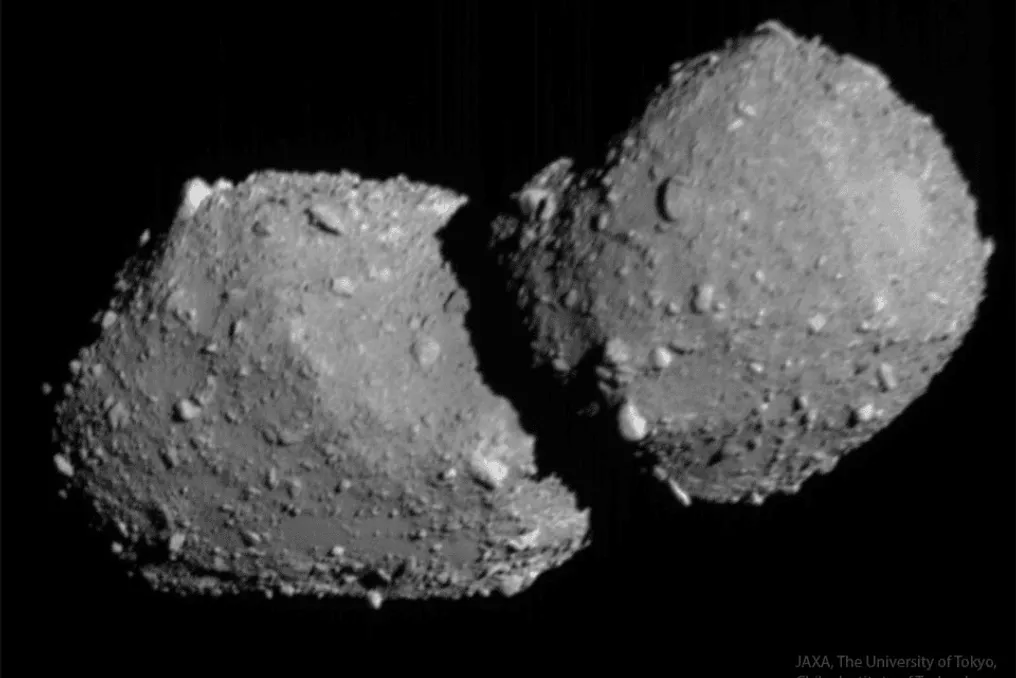
The first image is an unprecedented record of the asteroid Torifun. At the beginning of the month, this object was flown by the Japanese robotic probe Hayabusa2. This probe previously visited and collected samples from another asteroid, Ryugu, in 2018.
For ground-based telescopes, Torifun appeared as an elongated asteroid; however, the passage of Hayabusa2 revealed that it is actually a contact binary object formed by the gentle collision of two separate asteroids. In addition to the two lobes, Torifun has numerous large rock blocks and shows no distinct craters, suggesting its surface is a collection of debris.
Hayabusa2 is currently continuing its journey through the Solar System and is scheduled to encounter another asteroid, 1998 KY26, only in 2031.
Exoplanet in Beta Pictoris
The second image is a series of recordings showing the exoplanet Beta Pictoris b over more than ten years. This planet was discovered through direct imaging taken with the VLT – Very Large Telescope – in Chile, as well as with the James Webb Space Telescope.
Beta Pictoris b is the third planet discovered orbiting Beta Pictoris, which is the second brightest star in the constellation of the Painter, located 63.4 light-years away. Although the star should be at the center of the images, it was masked or removed during digital processing.
In early images, the exoplanet was obscured by the glare of another object, Beta Pictoris d. Identifying Beta Pictoris b, which is one of the faintest exoplanets discovered via direct observation, required additional digital processing to remove the brighter planet.