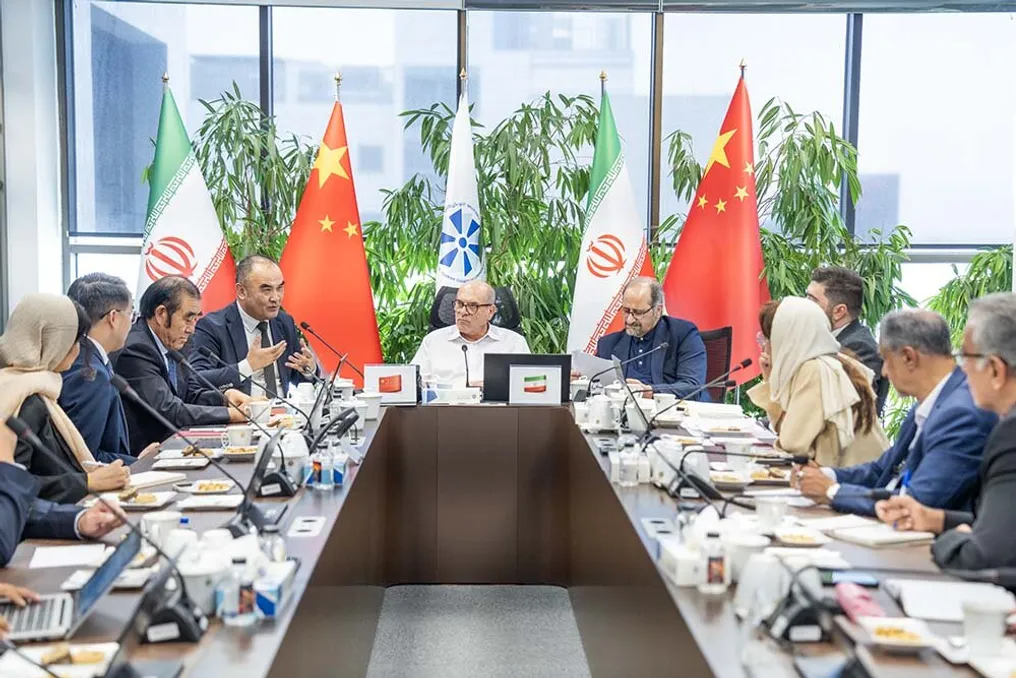
As part of the significant development of bilateral economic relations, leaders from the Tehran Chamber of Commerce and the International Chamber of Commerce of Khorgos met in the Iranian capital to outline a detailed executive roadmap for expanding trade.
Institutionalizing Cooperation
These high-level negotiations concluded with the official opening of the Khorgos representation at the Tehran Chamber of Commerce, marking an important transition toward institutionalized interaction. These efforts aim to utilize the strategic land port of Khorgos, located on the border of China and Kazakhstan and functioning as a key Eurasian hub, to diversify Iran's trade routes and reduce dependence on traditional southern sea routes, especially against the backdrop of recent geopolitical tensions.
Key Proposals and Mechanisms
During the joint meeting, Mahmoud Najafi-Arab, head of the Tehran Chamber, and Ma Fumin, head of the International Chamber of Commerce of Khorgos, emphasized the urgent need for common mechanisms for logistics, export development, and market intelligence gathering. Najafi-Arab stressed the necessity of revising trade corridors, specifically shifting focus to the North-South corridor and the Khorgos land port to counteract disruptions in regular maritime access. He insisted that cooperation must go beyond general agreements, requiring actionable plans with clear division of responsibilities and strict deadlines.
Key operational proposals included establishing a joint export management company, setting up a permanent Iranian exhibition center in Khorgos to showcase domestic products, and launching a shared digital platform for exchanging accurate and up-to-date market data. Najafi-Arab also noted substantial opportunities for Iranian businesses in the post-war recovery phase, particularly in infrastructure, modern warehousing, renewable energy, and export-oriented agriculture. Addressing concerns from private sector stakeholders, he assured that the Chamber is actively working to eliminate logistical bottlenecks, reduce transit costs, and simplify administrative barriers.
Mutual Presence and Committees
Furthermore, both sides agreed on the exchange of permanent representations. Following the immediate launch of the Khorgos office within the Tehran Chamber premises, a representative from the Tehran Chamber will soon be dispatched to Khorgos. This mutual presence is intended to ensure rapid coordination, real-time tracking of market trends, and direct resolution of trade disputes, transforming sporadic trade contacts into continuous, organized economic partnership. During discussions, the creation of a joint committee to prioritize and implement these agreements was also officially proposed.
Logistics and Transport Preferences
A special session organized by the Federation of Iranian Transport and Logistics thoroughly examined the operational difficulties associated with cargo transit through Khorgos. Members of the Federation described current problems: rail transport suffers from severe capacity limitations, prolonged container delays at border points, and complex customs bureaucracy for mixed cargo. In the road transport sector, difficulties include an acute shortage of trucks, the absence of a unified coordinating structure for Iranian companies, sharp increases in freight rates, and systemic delays in issuing visas for drivers crossing the border. Participants strongly called for the formation of a joint working group involving customs authorities, road service organizations, and private logistics firms to systematically address these obstacles.
In response, Ma Fumin presented a pragmatic assessment of the transport situation. Acknowledging the growth of rail transport through Khorgos in recent years, he stated directly that road transport currently offers higher speed and efficiency for Iranian traders, making it a more suitable option under current conditions. He expressed confidence that the logistics system would improve through the implementation of recently signed memorandums of understanding, and that railway capacity could be expanded once infrastructure constraints are resolved.
Strategic Goals and Finance
Ma Fumin's parallel meeting with Farial Mostofi, Vice President of the Tehran Chamber, focused on overarching strategic goals. Mostofi emphasized that sustainable trade requires a balance between imports and exports, calling for Iranian industrial and agricultural products—especially pistachios and other dried fruits—to have a more prominent presence in the Chinese market. The Chinese delegation, which included investors in machinery, auto parts, and renewable energy, expressed readiness for direct engagement. Discussions also covered the use of modern financial technologies, including correspondent banking mechanisms and the potential application of digital currencies to facilitate international settlements.
Concluding the high-level meetings, both chambers reaffirmed their commitment to maintaining expert-level dialogue, conducting trade missions, and identifying joint investment projects. The establishment of the representation and the development of the executive roadmap are viewed as the definitive first steps toward transforming the vast economic potential between Iran and China into tangible, mutually beneficial results for the private sectors of both countries.