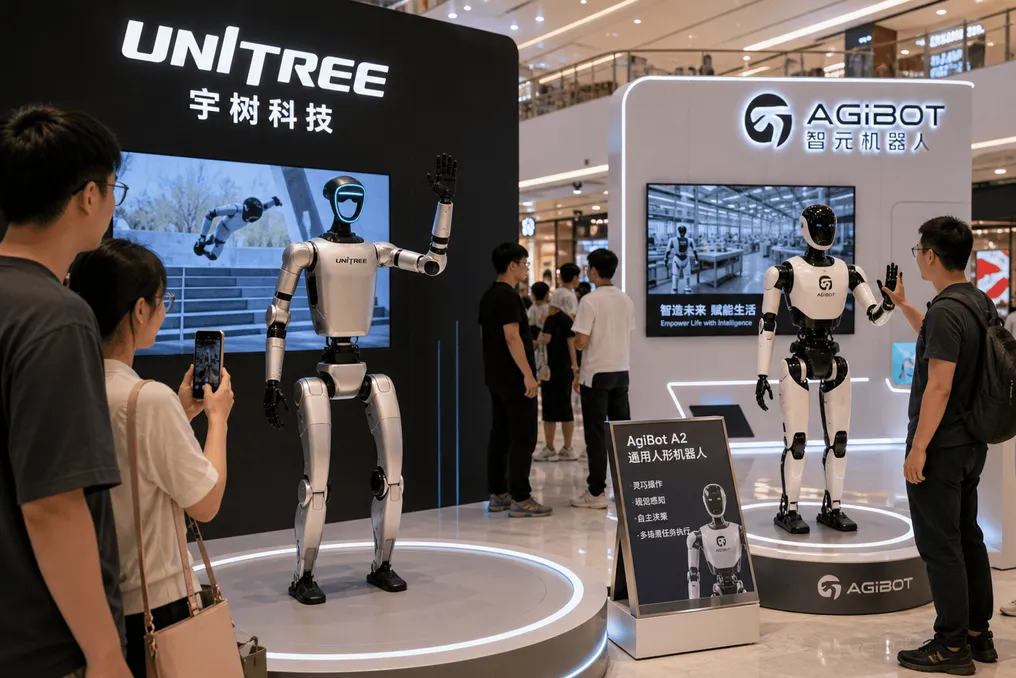
Unitree Robotics and AgiBot have opened flagship stores in prestigious commercial districts. These stores are designed to test the full cycle of commerce for humanoid robots—from customer interaction to purchase and subsequent servicing.
Unitree Robotics and AgiBot have opened flagship stores in prestigious commercial districts. These stores are designed to test the full cycle of commerce for humanoid robots—from customer interaction to purchase and subsequent servicing.
Competition in the field of humanoid robotics has expanded: instead of laboratory ratings, companies like Unitree Robotics, AgiBot, and other leaders in embodied AI are opening physical retail points in major commercial zones across China. Unitree has placed its own stores in the Wangfujing district of Beijing and Jiuguan on Nanjing Road in Shanghai. AgiBot introduced its first global store at JD MALL in Minhang, Shanghai.
Other players are also expanding their presence: Vbot has entered Changning Raffles City and Beijing Solana, while Qiyuan World is preparing to open locations in Shenzhen and Shanghai. Furthermore, a collectible store format has emerged: Taozhu New Maker manages five locations in Beijing, and Wuhan Optics Valley has opened the country's first 7S robot store.
This expansion of the retail network indicates a fundamental shift in competitive dynamics. Since basic skills such as walking, running, and motion control have become standard requirements for most manufacturers, the decisive battleground has moved to consumer perception, trust, and user experience. Robots require physical contact so that buyers can assess their practical utility, interaction quality, and durability, which cannot be conveyed solely through video or technical specifications.
The stores serve a triple function: they act as customer acquisition channels, laboratories for testing business models, and venues for the full cycle of trade—from consultation and experience to purchase and after-sales service.
Although the retail economy is in its early stages, it shows significant potential. Unitree Marketing Director, Wang Qishen, confirmed that the Wangfujing store has achieved profitability. The Wuhan 7S store generated cumulative revenue of 615,000 yuan in two months. Nevertheless, the vast majority of revenue from humanoid robots still comes from B-end clients; Unitree reported that 73.6% of humanoid robot revenue in 2025 comes from scientific research and education.
These stores help answer key questions: what functions are consumers willing to pay for, what is the acceptable price range, do leasing or installment models work, and how do maintenance and after-sales service systems function at a retail scale.
Two main retail models have emerged. The first is direct brand stores, operated by Unitree. They are located in elite shopping malls, ensuring complete control over sales and experience. Prices range from 8,000 yuan for quadruped robots to 170,000 yuan for humanoid robots. The second model is collectible stores, such as Taozhu New Maker, which aggregate products from dozens of manufacturers, serving as an entry point for consumers into the robotics field, and providing full 7S service support.
Robot retail draws lessons from both smartphone distribution efficiency and the conversion of high-value goods in the automotive industry. Unitree aims to open 50 stores within a year, Vbot plans to enter more than 10 cities, and Taozhu New Maker intends to open 20 national outlets. The main challenge remains transitioning from random visitor traffic to stable revenue from purchases and services.