India is home to 59.3 million small and medium enterprises (SMEs), which contribute to 30% of the country's GDP, 45% of its exports, and provide employment for over 25 million people. These businesses act as the unsung engines of India's growth.
India is home to 59.3 million small and medium enterprises (SMEs), which contribute to 30% of the country's GDP, 45% of its exports, and provide employment for over 25 million people. These businesses act as the unsung engines of India's growth.
Recognizing the significance of SMEs, YourStory organized the MSME Sparks 2026 event. This five-day virtual celebration took place from June 22 to 25 and concluded with a grand ceremony on June 26 at ITC Gardenia, Bengaluru. The initiative was built around the concept of 'Bharat, nourishing the world' and gathered founders, policymakers, and ecosystem participants to highlight the sustainability and ambition driving the Indian business economy.
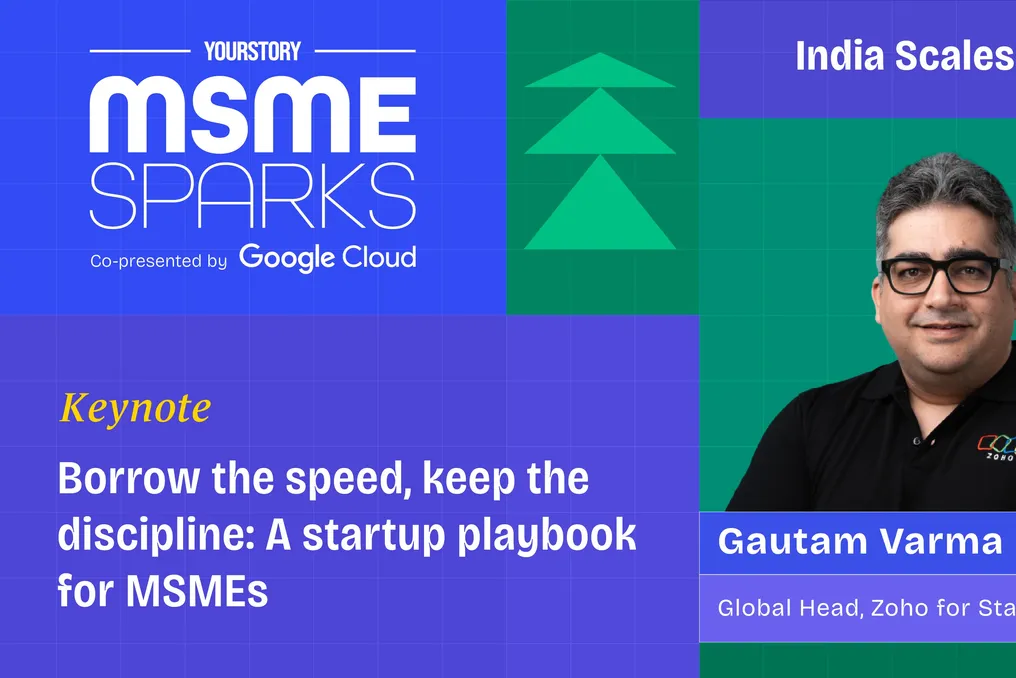
The event covered six key themes: digital transformation, access to capital, sustainable development, global market entry, policy and compliance, and the future of artificial intelligence and data-driven innovation. During the first day of the virtual event, a key session titled 'Borrow Speed, Maintain Discipline: A Guide for SMEs' took place. Gautam Varma, Global Head of Zoho for Startups, participated in this session, exploring how SMEs can adopt startup agility without losing the financial discipline that has allowed them to survive for decades.
Varma refuted the common narrative of startup success. He pointed to data from Startup Genome and Carta indicating that 74% of fast-growing startups attribute their failure to premature scaling. He noted that in 2024, one startup closed after a year of operation, and by 2025, this number increased to seven.
His main message was that SMEs do not have to completely copy the startup model. They should take the 'engine' of a startup while retaining their own 'chassis.' Varma explained that it is enough to 'borrow the engine, make data-driven decisions, conduct quick experiments, scale using technology, launch it through a very fast feedback loop, and then overlay AI to ensure speed, while maintaining their core chassis, which includes financial discipline, profitability, long-term thinking, and deep customer trust.'
Varma argued that much of this tension manifests in family businesses, where friction between old and new ways of working often arises not in boardrooms, but at the dinner table. He cited data showing that 40% of the next generation entering family businesses feel frustrated when trying to implement digitalization, while nearly 45% of current owners do not expect their children to simply continue running the business as before. In his view, the solution lies in finding common ground around specific numbers, as margins and pricing are facts that both generations already agree upon.
He believes that the role of technology is to organize and reveal common data, allowing decisions to be made faster and with less resistance.
To illustrate his points, Varma shared the journey of Tulsi Weigh Solutions. This company, based in Kolkata with a 70-year history, serves over 6,200 clients in 15 countries without ever seeking external funding. In 2022, the business migrated its operations to Zoho One, consolidating CRM, finance, HR, and collaboration tools into a single ecosystem.
Although individual teams gained better control, the founder still lacked a unified overview of the entire business. The next step was connecting this consolidated data to an AI layer, which allowed the founder to ask simple questions in English, such as about renewal rates by region or conversion rates for recent leads, and receive instant, contextual answers across the entire business.
Concluding the session, Varma offered three practical steps for SMEs: transform one intuitive decision into a data-driven one; run a small experiment based on it; and allow AI to work with existing business data while adhering to proper constraints. He left the audience with a strong phrase: 'Speed without discipline is just a faster way to spend money.' He added that the true strength of SMEs lies not in size or adaptability, but in longevity itself. 'It's not that you are small and therefore adaptable. It's that you are still here.'
The session set the tone for the entire first day of MSME Sparks 2026, constantly reminding attendees that technology, and especially AI, is no longer a distinguishing feature available only to a few, but a growth lever becoming increasingly accessible to every SME ready to utilize it.
Most business leaders recognize the importance of artificial intelligence, but only a smaller portion of them has managed to make it truly useful. The gap between these groups is not related to ambition or budget, but most often to understanding which problem should be assigned to an AI agent first, and which solutions should remain under human control.
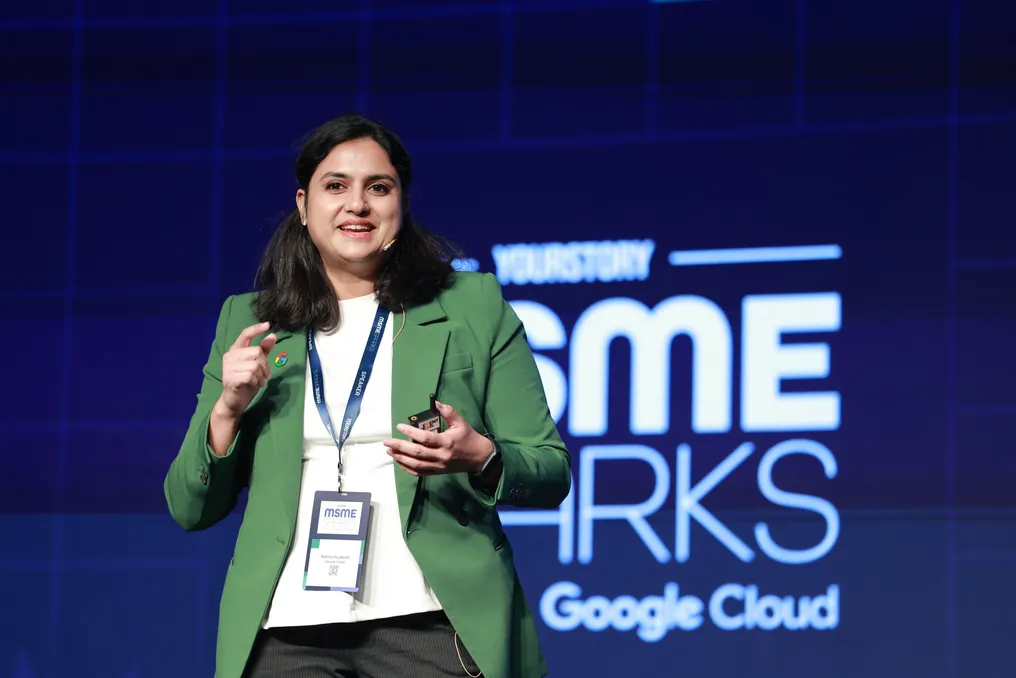
This question became the central theme of Nikila Gudipati's presentation, Head of Client Engineering at Google Cloud, at the closing event of MSME Sparks 2026. The event itself was significant because MSME Sparks 2026, YourStory's flagship event dedicated to Indian SMEs, spent four virtual days analyzing factors transforming the growth of these enterprises, including digital transformation, access to capital, and the role of AI in daily operations. The final event took place on June 26th at ITC Gardenia in Bengaluru and was the only in-person meeting of the week, gathering founders, industry leaders, and ecosystem participants to conclude discussions started during the virtual sessions.
In her presentation titled 'Smarter Solutions with AI,' Nikila Gudipati focused on the week's technological topic. She began with a statistic that clearly defined the problem: 'On average, a typical company works with 254 business applications.' Since the data is distributed across dozens of isolated tools, the problem is not just inefficiency, but also the so-called 'switching tax'—the constant mental and operational burden associated with switching between applications to gain a single holistic view of the business. Gudipati argued that Gemini Enterprise is designed to eliminate this tax by acting as a central hub for creating, publishing, and managing AI agents across all organizational workflows.
Two live demonstration examples vividly illustrated the practical application of this technology. In the first example, a contract lifecycle management agent was asked to identify expiring client agreements. Within a single dialogue, it extracted data from CRM and compliance systems, identified accounts with the highest revenue risk, and drafted a renewal letter, allowing for the scheduling or complete automation of subsequent actions. Gudipati emphasized: 'It's not just about asking questions based on prompts; it's actually the ability to act on your behalf so you can focus on more strategic and important things for your business.'
In the second demo, an agent tracked the situation of a retail operations director who was trying to understand the reason for low efficiency in one store. Using point-of-sale records, inventory data, and employee information, the agent diagnosed three main causes, including low customer satisfaction and high staff turnover, and then suggested scheduling a meeting with the store manager after pre-loading the relevant data. Examples of this scale demonstrate investment firms using multi-agent systems to help analysts research five times more companies, or large manufacturers reducing HR query resolution almost to automation while halving defect resolution time.
For SMEs attending the event and looking for an entry point, Gudipati advised starting with reversible and low-stakes solutions. She asked: 'Which of these reversible solutions can you delegate to an agent so you can refocus on the critical and strategic aspects of your role?'
Regarding security, which often remains an unspoken concern in any AI discussion, her answer was direct: 'The key difference with Gemini Enterprise is security. It's the most boring thing. It's the least fantastical thing companies worry about, but it is actually our biggest advantage.' Gemini Enterprise offers a 30-day free trial, available directly through Google Search, which is a low-risk, reversible starting point that accurately reflects the logic Gudipati advocated throughout the session.
As more and more small and medium enterprises (SMEs) from India aim to enter international markets, logistics is becoming as important as the product itself. Despite technology making global supply chains more accessible, many small companies face difficulties related to customs clearance, fragmented logistics networks, and regulatory compliance.
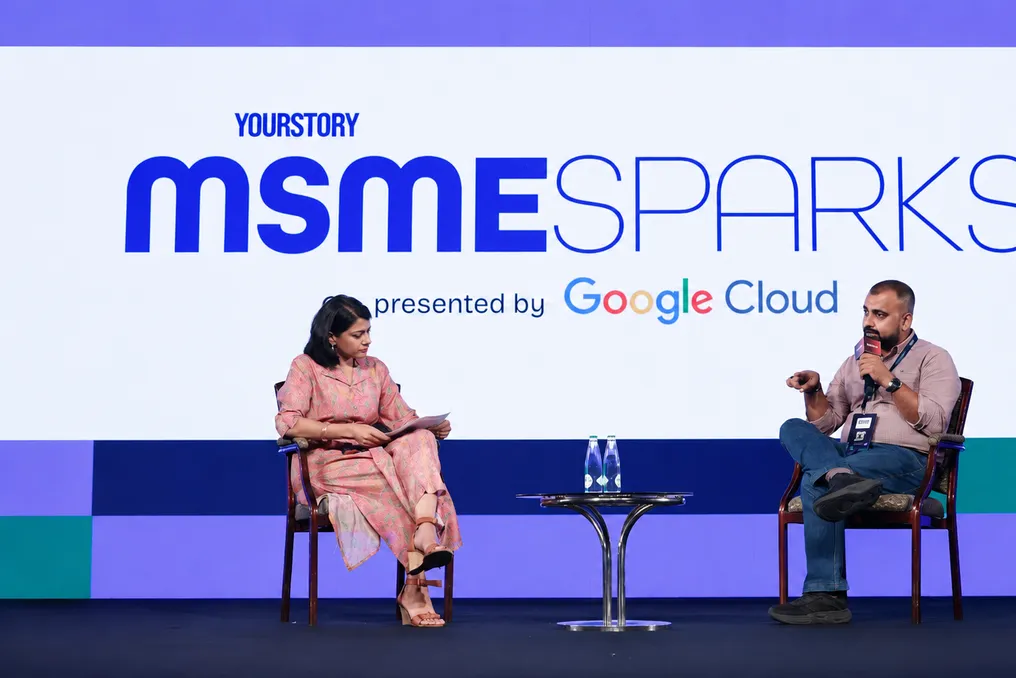
At the MSME Sparks 2026 event, held on June 26th at ITC Gardenia in Bengaluru, Dibyanshu Tripathi, CEO and co-founder of Hexalog, participated in a session with Shivani Mutanna, Senior Director of Content Partnerships at YourStory. The discussion focused on the topic 'Logistics Advantage: Scaling SMEs Beyond Borders' and examined how technology and more streamlined supply chains can help SMEs compete globally amid growing trade uncertainty.
Indian SMEs account for nearly 45% of the country's exports, but many encounter structural problems when entering international markets. According to Tripathi, creating a quality product is only part of the success. He emphasized that the first order depends on the company's capabilities, while the fiftieth order depends on the reliability of the supply chain. Long-term success, in his opinion, is determined by the ability to deliver goods stably and without obstacles. He noted that a German buyer does not look at the factory's ISO certification, but if every third shipment is delayed due to customs complexity, it negatively affects reliability.
Traditionally, logistics has been viewed as a supporting function. However, as businesses increasingly sell goods across borders, it has become a central element of customer experience and repeat sales. Tripathi argued that the main problem today is not digitalization. Although freight companies, warehouses, and customs brokers have automated many of their processes, exporters still have to coordinate the work of multiple stakeholders through messengers, email, and phone calls.
Instead of implementing more digital tools, the industry needs systems that connect these various players, simplify compliance, and help businesses make more informed logistical decisions. He cited the example of a small exporter from Moradabad, Uttar Pradesh, who supplies products to 28 countries but lacks the trade expertise available to large companies. The entrepreneur needed assistance with HSN classifications, duties, export incentives, and shipping solutions.
Tripathi explained that this is precisely the problem Hexalog is trying to solve by aggregating freight volumes among SMEs, simplifying compliance, and providing small businesses access to corporate-level logistics capabilities without the corresponding costs.
Technology, according to Tripathi, can also help businesses use existing operational data more effectively. Shipment records, invoices, customs documents, and delivery times allow for identifying patterns that help exporters forecast delays, optimize routes, and improve planning.
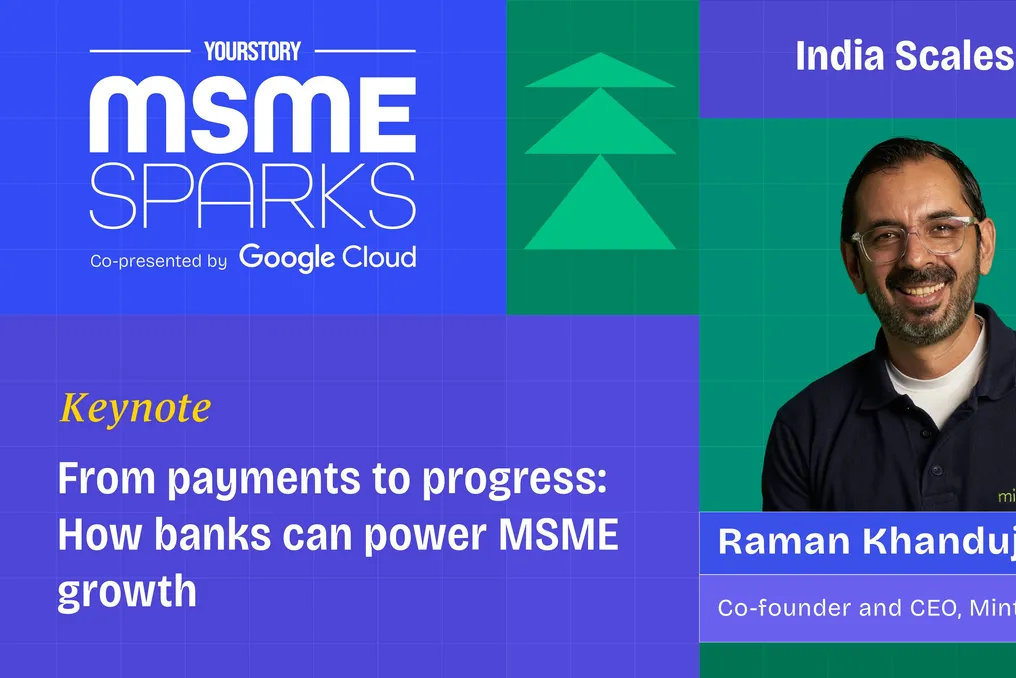
According to Raman Khanduja, co-founder and CEO of Mintoak, the digital transformation in India based on QR codes is only an initial stage for small and medium enterprises (SMEs).
Over the last decade, India has become a global benchmark in digital payments due to the widespread adoption of UPI, data accessibility, and ubiquitous smartphone usage. However, Khanduja believes that QR codes are merely the first step. Speaking at the MSME Sparks 2026 event, which was held virtually from June 22 to 25 and concluded on June 26 at ITC Gardenia in Bengaluru, he stated that the next phase of digital transactions must focus on transforming transactions into visibility, creditworthiness, and long-term growth for SMEs.
Drawing on nearly two decades of experience working with banks, American Express, and Visa, Khanduja noted that India has progressed from one of the largest markets with cash replacement potential to a place other countries look to for lessons. He expressed concern that celebrating the start of this journey is being perceived as its conclusion.
For a long time, SMEs faced difficulties obtaining formal credit because banks relied on traditional financial documents such as salary slips, Income Tax Returns (ITR), and Form 16. Khanduja emphasized that while SMEs needed capital, banks did not always understand their needs, and most small businesses lacked the required documentation, leading to their classification as underbanked.
Digital payments began to change this situation. When SMEs started using point-of-sale terminals and QR codes, every payment began to record business activity. According to Khanduja, a bank can now see, for example, a restaurant's peak demand, a pharmacy's repeat customers, or a wholesaler's inventory cycle. This data represents not just transactions but economic signals, allowing millions of SMEs to generate information reflecting real cash flow for the first time.
The current task, according to the speaker, is no longer about counting transactions but about using this data to support business growth. Khanduja is convinced that the bank of the future will be integrated into the daily operations of SMEs, rather than being confined to physical branches. Small business owners are more concerned with cash flow, inventory, salaries, and receivables than with banking products, and often work with small teams, making even an hour away from the business costly.
He explained that this is where embedded finance and contextual lending concepts come into play. Financial services should be provided where business decisions are made, not just inside branches. As an example, he cited the story of Priya, a clothing seller in Surat. Initially, her relationship with the bank was limited to a current account, but after implementing QR payments and a merchant app, the bank gained insight into her daily cash flows, seasonal demand, and large orders. Using these signals, the bank pre-approved a credit line of 10 lakh rupees, which appeared in the same app she used to collect payments. When a large order came in, she accepted the offer through the app and received the funds in just a few clicks.
Khanduja added that the same application allows her to automatically generate invoices, send payment links, and reconcile payments. Mintoak provides platforms for HDFC Bank, Axis Bank, SBI Payments, as well as for banks in Africa, the Middle East, and Southeast Asia. Its platform processes around 400 million transactions monthly. The founder believes that these 400 million are 'economic signals' that can be transformed into higher-quality products, smarter lending, and real support for SMEs. He urged banks to focus not on the number of QR codes, but on the businesses behind them, asserting that India needs more successful SMEs, not just more QR codes for counting. The biggest opportunity for banks is not processing transactions, but helping small businesses secure timely working capital, manage cash flow, and utilize future opportunities.