The deployment of over one million satellites intended for space data centers, along with tens of thousands of orbital mirrors, has the potential to permanently alter the night sky landscape of Earth.
Creation of an Artificial Ring
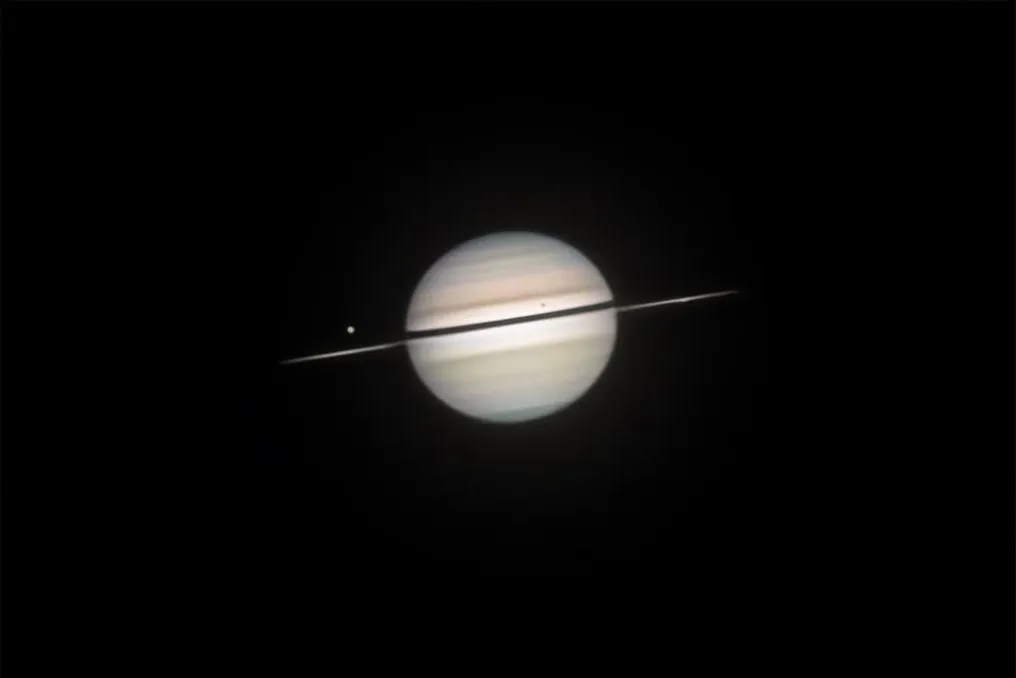
Researchers, cited by Space.com, indicate that if these endeavors advance, the planet could acquire a vivid artificial 'Saturn ring.' This ring would be perceptible from any location on the globe for hours after sunset and before sunrise.
This structure would be composed of satellites arranged in a common orbit, manifesting as a luminous band crossing the firmament. Experts warn that the brightness of this ring would exceed that of any known celestial body or planet, potentially even surpassing the brightness of a full moon.
Need for Specific Orbit
Hugh Lewis, an astronautics professor at the University of Birmingham (UK), explained that the only viable way to house the vast number of proposed data center constellations is to group them into a defined orbit situated at the transition between day and night.
Lewis commented that when observing the night sky, these satellites would be concentrated in a single plane, very close to each other and moving in the same direction, classifying the impact on the night sky as 'absolutely catastrophic.'
Expansion of the Space Race
The notion of a fabricated 'Saturn ring' seemed like science fiction recently, but with the increase in competition for orbital data centers last year, this scenario has become a real possibility.
Several corporations have already applied for permits from the U.S. Federal Communications Commission (FCC) to launch large groups of satellites. Among these companies are SpaceX, Starcloud, Cowboy Space, Orbital, and Blue Origin, whose combined projects exceed the one-million satellite mark for space data center operation.
China has also entered this dispute, planning to develop its own network of orbital data centers in the next five years. Additionally, the Californian company Reflect Orbital aims to launch 50,000 space mirrors to redirect sunlight to terrestrial power plants at night.
On July 10, Reflect Orbital obtained authorization from the FCC to operate its first orbital mirror, an 18 by 18 meter demonstrator satellite called Eärendil-1, whose launch is scheduled for this year.
Dependence on Solar Illumination
Lewis detailed that both orbital data centers and space mirrors require constant solar exposure to function. Therefore, the equipment must remain in an orbit that follows the terminator line—the boundary between the illuminated and dark areas of Earth—passing over the North and South poles.
He emphasized that 'orbital data centers and Reflect Orbital depend on what these operators call 24 hours of sunlight in space,' adding that this requires a specific orbit following the twilight line, unlike the Starlink mega-constellation, which is distributed across the entire planet.
Visual Impact in Simulations
Samantha Lawler, an astronomer at the University of Regina (Canada), agreed with Lewis's analysis. She and other scientists used computational modeling to simulate the visual effect of several proposed constellations, including SpaceX's Starmind, Blue Origin's Project Sunrise, and Cowboy Space's Stampede constellation.
According to Lawler, the simulations show that the visible satellites from the Earth's surface would not only obscure part of the stars but would also surpass them in number. As the Earth rotates under this trajectory, the ring would cross the sky twice daily: once between the end and beginning of the night, and another just before dawn. The researcher observed that 'the ring would pass overhead at the same time every night,' implying that the effect would be more severe in winter than in summer.
Harm to Scientific Astronomy
Lawler pointed out that the simulations were based on public data and that the study has not yet been submitted for peer review. However, she stated that the light scattered by the ring would continue to illuminate the sky for up to two hours after the satellites disappear below the horizon, similar to the residual glow of the Sun after sunset.
She warned that this would make the time of taxpayer-funded telescopes 'much less effective,' resulting in lower scientific output for the same cost, and would seriously compromise scientific investigations, such as the search for near-Earth dangerous asteroids. According to the expert, there would be no areas of the planet immune to this phenomenon.
The simulations also suggest that certain constellations, notably Blue Origin's Project Sunrise, would employ a distinct orbital inclination, creating a pattern resembling the letter X over the main ring. Lawler explained that near the equator, this X shape of satellites would be visible gliding across the sky at dawn and after sunset; further north, two distinct bands would be seen.
Luminosity Intensity and Observatories
Researchers point out that the luminosity intensity of the ring will depend on the actual number of satellites placed in orbit. However, they highlight that each Reflect Orbital space mirror should emit a brightness comparable to Venus, considered the brightest object in the night sky after the Moon.
A previous study by the European Southern Observatory concluded that a constellation with 50,000 space mirrors from that company could increase the brightness of the night sky by up to 300%, rendering some of the world's most advanced telescopes unusable.
John Barentine, an astronomer and advocate for dark skies, told Space.com that humanity has already drastically altered the space environment around the Earth. He stated: 'Humanity has fundamentally changed the cosmos to the point where Earth is now an artificial 'ringed planet,' suffocated by satellites and space debris.'
Barentine added that projects like Reflect Orbital's will transform these rings, currently almost invisible, into intense reflective bands, transcending a mere dispersed field of bright points.
For Barentine, the outcome would be a permanent effect capable of profoundly changing astronomical observation conditions, constituting a 'permanent and artificial 'Saturn ring' effect cutting right through the most critical twilight observation windows for global astronomy.'