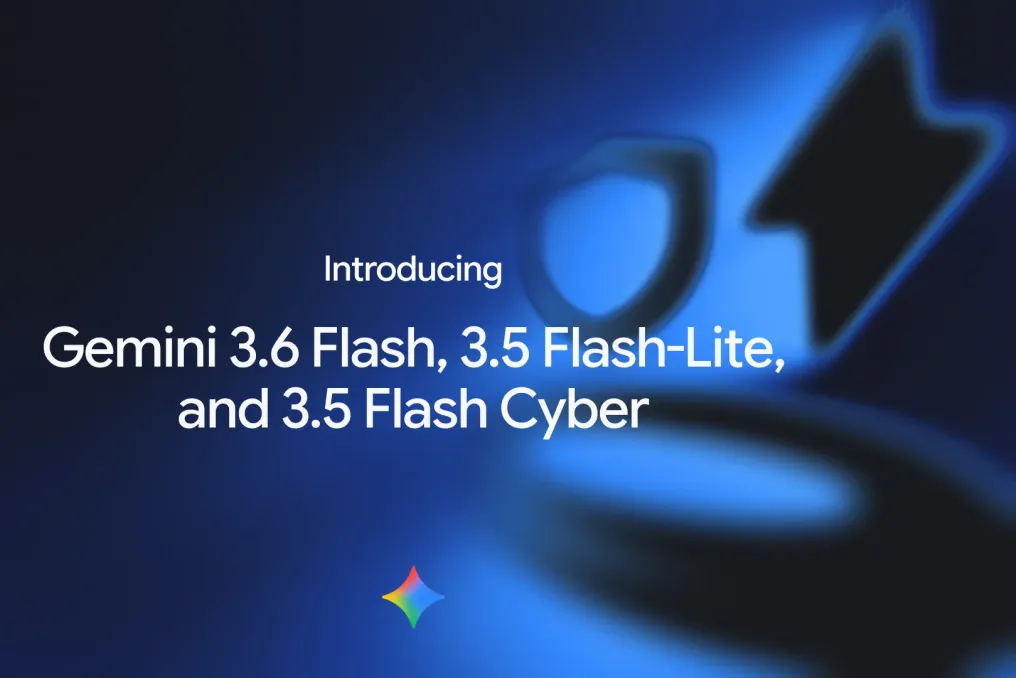
Google announced the launch of Gemini 3.5 Flash Cyber, a new artificial intelligence model focused on cybersecurity. This model was developed to identify and correct security flaws in programming code.
Google announced the launch of Gemini 3.5 Flash Cyber, a new artificial intelligence model focused on cybersecurity. This model was developed to identify and correct security flaws in programming code.
Published on the Google DeepMind blog, the company's AI laboratory, Gemini 3.5 Flash Cyber is positioned as an 'economical and highly competent' option compared to existing large and expensive cybersecurity models. The main competitors cited are Anthropic's Claude Mythos 5 and OpenAI's GPT-5.5-Cyber.
Gemini 3.5 Flash Cyber will be integrated into CodeMender, Google's AI agent responsible for fixing software security issues. In tests conducted on the CyberGym AI platform, the model demonstrated scores comparable to more robust models, such as Mythos 5.5 and GPT-5.5-Cyber.
Additionally, Gemini 3.5 Flash Cyber identified 55 security issues in the V8 JavaScript interpreter. This number surpasses the 47 findings by standard Gemini 3.5 Flash and the 36 found by Claude Opus 4.6. Among the vulnerabilities detected by 3.5 Flash Cyber, ten were not located by any other tested model.
Initially, access to Gemini 3.5 Flash Cyber will be restricted to governments and trusted partners, following a model similar to the one adopted by Anthropic with Mythos and its Project Glasswing. Google justifies this approach by stating that it will provide frontline defenders with a crucial advantage in detecting and correcting critical flaws before they are exploited, in addition to helping to reduce malicious uses.
Google emphasizes that the tool allows for multiple executions at high speed and low cost, enabling the scanning of more code execution paths to find vulnerabilities. Although the prices for 3.5 Flash Cyber have not yet been disclosed, expectations are that they will be more accessible. For comparison, Anthropic charges $10 per million input tokens and $50 per million output tokens, which is double the cost of Claude Opus 4.8. In contrast, Google's Gemini 3.1 Pro costs up to $4 per million input tokens and $18 per million output tokens.
The issue of AI costs has recently raised concerns among developers and companies. The competitive landscape also includes low-cost Chinese models, which has spurred discussions about bans on the use of Asian AIs by American companies.
Google released three new versions of its artificial intelligence models: Gemini 3.6 Flash, Gemini 3.5 Flash Cyber, and Gemini 3.5 Flash-Lite.
These updates were developed with a specific focus on areas such as autonomous agent creation, programming support, and cybersecurity. Among the releases, Gemini 3.6 Flash was presented as the most sophisticated model in the series due to its ability to offer greater efficiency.
Roberto «Pena» Spinelli, who holds a degree in physics from the University of São Paulo and a specialization in Machine Learning from Stanford University, in addition to being a columnist for Olhar Digital, commented on these developments.