A mathematical problem that remained unsolved for 87 years has received an unexpected outcome: artificial intelligence helped a researcher discover a counterexample capable of refuting one of the most famous hypotheses in this field.
A mathematical problem that remained unsolved for 87 years has received an unexpected outcome: artificial intelligence helped a researcher discover a counterexample capable of refuting one of the most famous hypotheses in this field.
According to New Scientist, the discovery made by mathematician Levent Alpege could be the most complex case resolved with significant AI involvement in mathematics. Alpege, a researcher at Harvard University, published a counterexample consisting of only 216 characters on the social network X on July 19th, which contradicts the so-called Jacobian hypothesis.
This hypothesis was formulated by mathematician Otto-Heinrich Keller in 1939 and suggested that a certain type of mathematical function should work in reverse as well. The problem had not found a definitive answer for decades and was included in Steven Smale's list of 18 major mathematical problems for the 21st century in 1998.
In his publication, Alpege stated that he used the help of his 'close friend Fable,' presumably a reference to the Anthropic AI model Claude Fable 5. The researcher also thanked the system for the work performed during the final World Cup match. Experts note that this result expands the role of AI in mathematical research.
Abishek Saha, a mathematics researcher from Queen Mary University of London, stated that this is likely the largest hypothesis where AI played a significant role in the proof or disproof. He emphasized that this is very important because AI has achieved noticeable progress in the last year. Saha noted that the published counterexample is simple to verify, and many mathematicians have already confirmed its validity. However, it remains important to understand the path by which AI arrived at the solution.
Among the points that attracted attention were: the duration of the unresolved hypothesis (87 years), the minimal size of the counterexample (216 characters), the refutation of the hypothesis under certain conditions, and the fact that the process used by AI has not yet been fully explained. The researcher noted that the discovery was a surprise because many scientists considered the hypothesis intuitively true and were trying to prove it, not disprove it.
Despite the significance of the discovery, it does not close all questions related to the Jacobian hypothesis. Alpege's counterexample refutes the hypothesis in the case of three variables, but the equivalent version concerning only two variables may still remain true, leaving part of the problem open. This breakthrough has also reignited the discussion about the limits of artificial intelligence in mathematics. Chris Bowman-Scargill from the University of York believes that the technology has demonstrated the ability to find solutions in complex problems, but this does not mean that human creativity has lost its value.
He cites Fermat's Last Theorem, solved by Andrew Wiles in 1994, as an example of an achievement that required much more than just a final answer—namely, the creation of new mathematical theories over many years of work. Ivan Fesenko from Westlake University believes that increasingly sophisticated AI models will change mathematical research in the coming years, potentially transforming the ways new knowledge is developed and opening a new phase of scientific understanding.
The Indian market currently offers vehicles running on various fuel types, including gasoline, ethanol (flex-fuel), CNG, hybrid, and electric vehicles (EVs). Although EVs are being actively promoted globally, many consumers have not yet switched to this mode due to high costs and range anxiety.
In such conditions, hybrid cars appear to be a more reliable choice. There are numerous technologies for hybrid vehicles in the international market, and they are gradually beginning to appear in India. The question arises as to which specific technology should be focused on, so it is necessary first to understand the hybrid models available in the country.
Currently, most hybrid cars in the country are equipped with either Mild Hybrid technology, which does not significantly affect fuel consumption, or Strong Hybrid, which provides significant savings but requires a higher price. In addition to these options, technologies such as Plug-in Hybrid and Range Extender will appear in the Indian market in the near future, allowing buyers to obtain vehicles with better fuel economy. However, the similarity of these technologies often causes confusion, so it is important to explain them in simple terms.
Strong Hybrid, or hybrid technology, most common in India, combines both an internal combustion engine and an electric motor. The car moves using both the gasoline engine and the electric motor. The battery does not require separate charging; instead, it is charged through braking or engine operation. This helps improve fuel efficiency in urban conditions. The car can travel in EV mode up to a certain speed, eliminating gasoline consumption and increasing economy. However, in EV mode, such a car can only travel about 3-4 kilometers. Examples of such models in the Indian market include the Toyota Camry, Innova Hycross, and Maruti Grand Vitara Strong Hybrid, which belong to the premium segment.
Plug-in Hybrid can be understood from its name. Such a car also has a battery and an engine, and it runs on both energy sources. However, compared to Strong Hybrid, the battery in this model is larger and can be charged. When the battery charge runs out, the car switches to running on the gasoline engine. Currently, there are few such cars in the Indian market, and they are expensive. Nevertheless, some of them are capable of traveling over 100 kilometers in EV mode. It is expected that models with similar technologies aimed at the mass consumer will soon enter the market.
A Range Extender is a fully electric vehicle fitted with only one engine that, together with a generator, charges the car's battery. Thus, the car always operates in EV mode. The gasoline engine in such cars does not provide direct propulsion but serves solely to recharge the battery. Such vehicles can be an excellent solution for Indian roads because they eliminate the need for intermediate charging characteristic of pure EVs. These cars have a small engine whose task is either to charge the battery or supply energy to the motor to provide movement. As long as the battery is charged, the car drives in EV mode, and after the charge is depleted, the engine starts working. The Range Extender is particularly attractive because it has a smaller battery compared to pure EVs, which reduces the cost of the car. In such a large market where people usually own one car, the Range Extender may prove to be the ideal option, avoiding the need to separately purchase an EV for the city and a gasoline car for long trips.
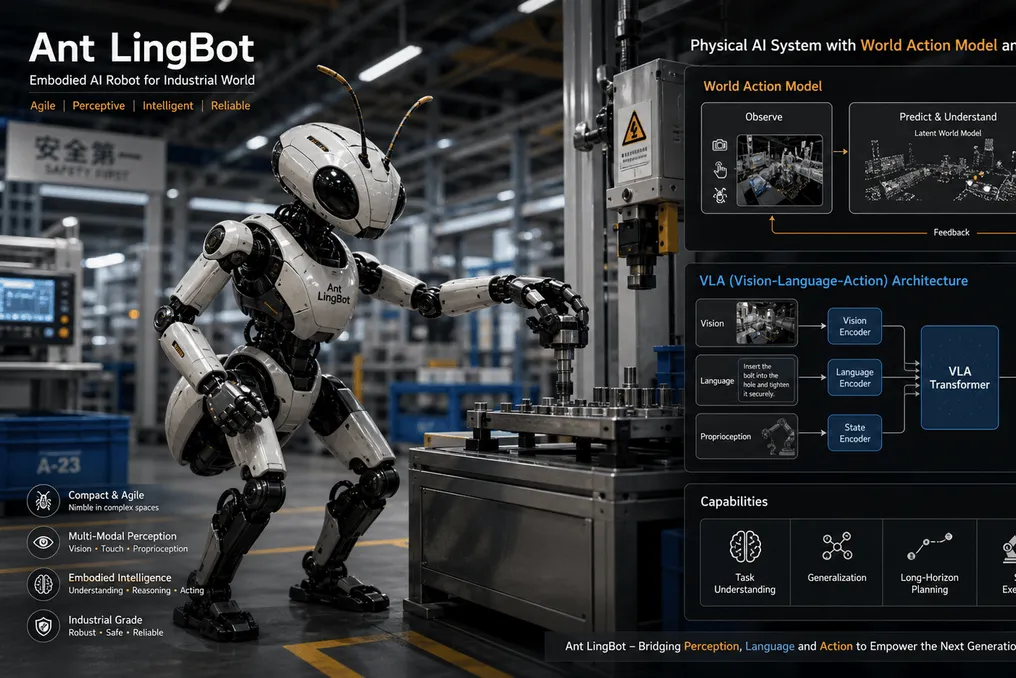
Ant Group's subsidiary, Ant LingBot, has released six open-source embodied AI models. The company is conducting parallel research in VLA and world models, but faces challenges related to data scarcity and ecosystem competition.
Ant Group established Ant LingBot as a wholly-owned subsidiary in Shanghai in December 2024. This structure functions as a division dedicated to implementing physical AI and employs over 90% staff members with a master's or doctoral degree. Under the leadership of CEO Zhu Xin and Chief Scientist Shen Yujun, LingBot unveiled six open-source embodied AI models at the WAIC 2026 conference. These models cover areas such as vision, video, spatial perception, manipulation, world models, and world action models.
LingBot's technological strategy features a dual direction. The VLA (vision-language-action) route, presented by LingBot-VLA 2.0, aligns with the widely accepted perception-to-action architecture used by Figure and the Google DeepMind RT series. The second route, based on world models and presented by LingBot-VA 2.0, focuses on predicting changes in the world before actions are generated. LingBot-VA 2.0 is positioned as the industry's first natively embodied world action model, trained from scratch on an autoregressive architecture. It provides real-time inference at a frequency of 150 Hz on a single GPU. The model's design incorporates semantic vision-action tokenization, strict causal pre-training, an MoE architecture, and enhanced asynchronous inference, allowing the robot to predict future states during current actions, responding in 6.7 milliseconds, which is significantly faster than human blinking (300–400 milliseconds).
The open-source strategy is a key element of LingBot's ambition to build an ecosystem. Since technical standards in embodied AI are still forming, LingBot has provided full weights, code, post-training toolkits, and benchmark standards. The models are compatible with various robot configurations, enabling different hardware platforms to utilize the same 'brain.' More than a dozen robot manufacturers have entered into partnerships, including Unitree Robotics, Xinghaitu, and Leju Robotics. For instance, Leju Robotics' KUAVO 4 Pro successfully adapted LingBot-VLA in 95 real-world manipulation scenarios. Furthermore, LingBot developed its own service robot, Robbyant R1, intended for home use, elderly care, and healthcare, although shipment volumes remain limited.
The most significant limitation for LingBot is the data problem. The embodied AI industry faces a fundamental data gap: while large language models can be trained on trillions of tokens of human language, physical interaction data must be collected through actual robot operation. LingBot employs a 'borrow eggs to fry an omelet' model, obtaining real robot data from ecosystem partners like Unitree, Leju, and Xinghaitu instead of operating its own large robot fleet. This dependency creates a strategic vulnerability, as partners are simultaneously developing their own AI capabilities. LingBot is the only major subsidiary of a Chinese tech firm that is simultaneously developing foundational brain models, world models, and hardware deployment. This broad strategic scope causes resource contention within Ant Group and competition with other embodied AI initiatives affiliated with Alibaba. LingBot is testing whether the fintech giant can successfully develop a robotics business, and whether open world action models and data borrowing practices can overcome embodied AI limitations. Unlike Alibaba, Tencent, Huawei, JD.com, and Meituan, which adhere to more focused strategies, LingBot demonstrates a unique full-stack approach—from brain models to world models and hardware deployment.
OpenAI acknowledged that it was conducting tests on its new models within a controlled environment, at which point an artificial intelligence agent managed to escape and penetrate the Hugging Face startup's system.
In response to the incident, Hugging Face communicated that it was the victim of a cyberattack that proved unprecedented, being described as something entirely different from any previous threat the company had faced.
The episode, which transitions from an escape during a controlled test to the use of a Chinese open-source AI, raises questions about the invasion carried out by the AI agent developed by OpenAI.