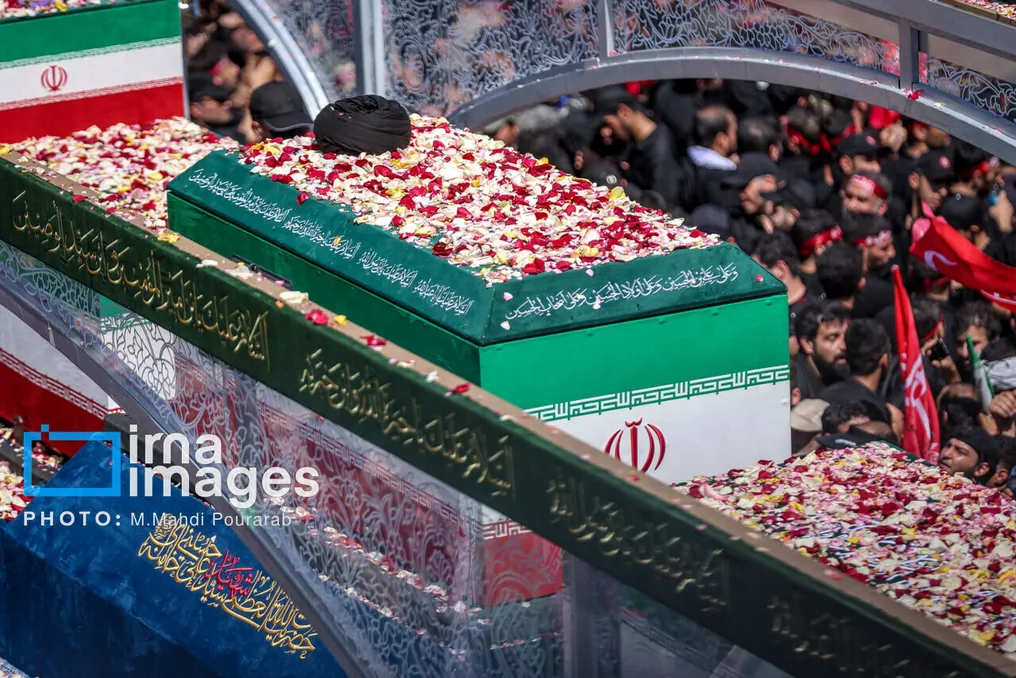
Recently, over forty million people participated in the farewell and burial ceremonies of the martyred leader of the Revolution, Grand Ayatollah Seyyed Ali Hosseini Khamenei, in five cities in Iran and Iraq: Tehran, Komeh, Mashhad, Najaf, and Karbala. These events were accompanied by deep emotions and slogans against America and Zionism.
Large-Scale Public Gatherings
Similar mass gatherings took place in many other cities in Iran, as well as in several countries, including Iraq, Lebanon, Yemen, Nigeria, Pakistan, and India, although no official statistics on the total number of participants have been released. These events indicate a fundamental truth: the Islamic Revolution of Iran and its martyred leader have established a deep connection with the hearts of people around the world.
This article aims to explain the reasons for this sustained public support by analyzing three interconnected themes: the historical foundations of the Islamic Revolution, the leadership of Ayatollah Khamenei, and the central role of science and technological development in preserving Iran's independence and resisting the hegemonic international order.
Origins of the Islamic Revolution
The Islamic Revolution of Iran occurred during a period when the world system was divided between two competing blocs of power: the Western bloc led by the United States and the Eastern bloc led by the Soviet Union. For centuries, the front of truth had few opportunities to manifest on the world stage. It was under these conditions that the Islamic Revolution of Iran, following a massive popular uprising in response to the call of Imam Khomeini, achieved victory.
The Revolution represented an independent alternative to both blocs. Inspired by the leadership of Imam Khomeini and guided by the slogan 'Neither East nor West, but the Islamic Republic,' the Revolution sought to establish a political system based on two key pillars: Islam as the ideological and legal basis of the state and the participation of the people as the foundation for creating, managing, and defending the political system. Essentially, the Revolution was realized based on the deep faith of the Iranian people in the Islam of Prophet Muhammad, Imam Ali, and Imam Hussein.
The First Decade After the Revolution
The first decade after the Revolution, under the leadership of Imam Khomeini, was dedicated to laying the foundations of the new political order and implementing and strengthening the values of the Islamic system. The significance of this decade lies in the fact that the Islamic Republic—understood as a system of governance based on the teachings of the Quran and Ahl al-Bayt—was established at a time when there was no previous model or practical precedent for such a system in the existing international order. Consequently, the development and institutionalization of this new model in the modern era are among the most significant and long-term achievements of Imam Khomeini.
Nevertheless, throughout this decade, the country faced numerous crises and difficulties, including the eight-year war of Saddam's regime with Iran.
The Leadership of Ayatollah Seyyed Ali Khamenei
After the death of Imam Khomeini, Ayatollah Seyyed Ali Khamenei assumed leadership of the Islamic Republic for the subsequent thirty-seven years. During this period, the collapse of the Soviet Union transformed the world system into a predominantly unipolar order centered around the United States. This made the period particularly challenging for the Islamic Republic of Iran.
This era also coincided with significant technological advancements in the West, as the United States and its Western allies actively promoted the concept of globalization. According to this view, globalization represented an American theoretical basis for cementing its dominance over the peoples of the world and establishing a modern form of hierarchical international order. This project was presented in an attractive manner to appeal to global public opinion, using modern technologies. However, beneath this attractive facade, characterized by an era of communication, closer interaction between nations, and the elimination of borders, lay a darker agenda aimed at promoting hegemonic goals.
These hidden characteristics included: undermining the cultural and national identities of peoples; weakening the religious and ideological foundations of societies; eliminating national borders in the face of Western cultural invasion; undermining the institution of the family; ridiculing stable moral values through the promotion of homosexuality, consumerism, and individual egoism; weakening the ties between nations and their governments while simultaneously creating dependence on the United States and Western culture; reducing population growth through the promotion of permissiveness, homosexuality, and choosing pets instead of having children.
Values Versus Hegemony
In contrast, under the leadership of Ayatollah Khamenei, the Islamic Revolution promoted values such as genuine freedom, morality, spirituality, justice, national independence, rationality, brotherhood, the central role of the family, and the rejection of oppression and domination. These values are considered rooted in human nature and are therefore seen as timeless principles that remain relevant and attractive to people worldwide and across all generations.
Alongside promoting and strengthening these values, the martyred leader paid close attention to science, research, and technological development. He constantly emphasized the importance of scientific progress and research in many of his public speeches and meetings with government officials. His frequent citation of the famous saying of Imam Ali, 'Knowledge is power' (al-'ilm sultān), which states that knowledge is the source of power, and he who lacks knowledge becomes subject to the domination of others, remains memorable.
He believed that the survival and continuity of the Islamic Revolution, as well as Iran's ability to resist pressure from the United States and the West, depended on strengthening the country's scientific, technological, and economic capabilities. Among the results attributed to his leadership were the expansion of universities, the development of scientific research, the creation of the Vice Presidency for Science, Technology, and Knowledge Economy, and subsequently the establishment of innovation centers, technology parks, and knowledge-based companies.
This constant commitment to science, research, and technology, alongside his exceptional leadership in strengthening Iran's military and defense capabilities, allowed the country to demonstrate its strength during recent wars, especially during the military confrontation involving attacks by the United States and Israel on Iran.
Military Conflict and Reaction
When the United States ceased to tolerate the ideological confrontation of Iran's global arrogance and globalization project, it initiated a direct military attack against Iran. With the support of Israel, NATO, and several Arab countries in the region, the United States allegedly conducted extensive bombings of Iranian targets, and on the first day of the conflict, the outstanding leader of Iran, along with several high-ranking military commanders, was killed.
Iran did not surrender; instead, it launched retaliatory operations targeting American military bases across the region, as well as military and economic facilities belonging to Israel, through missile and drone attacks. The United States attacked Iran with objectives such as forcing Iran's capitulation, changing its government, eliminating its leadership, destroying Iranian civilization, dividing the country, seizing its oil and natural resources, and liquidating its nuclear capabilities. However, the conflict ultimately reached a point where the United States, facing Iran's military capabilities, suffered a serious strategic defeat and subsequently called for a ceasefire and negotiations.
The broader consequences of Iran's resistance and the countries of the so-called 'Axis of Resistance' against the United States and Israel—including Iran's control over the Strait of Hormuz, influence on the global economy, and the emergence of Iran as a fourth global superpower—are not the focus of this article. The goal of the article is to study the deep causes of hostility between the United States and the West towards the Islamic Republic of Iran and to examine why the United States attempted to eliminate Ayatollah Khamenei, who was simultaneously a political leader and a respected religious authority among the people of Iran and many Muslims around the world, and why they failed to achieve the aforementioned goals.
Principles and Future of Iran
In fact, the Islamic Revolution challenged the hegemonic ambitions of the United States by developing both a theoretical basis and a system of governance based on universal human values rooted in human nature, as discussed earlier. The Iranian people sought only to live freely and independently, organizing their society around divine and human values that should be promoted by all prophets, and preventing the exploitation of their natural resources, especially oil, by foreign powers.
The assassination of the Supreme Leader prompted Iranians to take to the streets in a demonstration of national unity. They expressed anger over the US and Israeli attack and called for a decisive Iranian response to the aggressors. For over four months, people have gathered every night in the streets of Tehran and other cities across the country, declaring their firm support for the Islamic Republic. Bolstered by overwhelming popular support, the Islamic Revolution utilized the science and technology it developed to counter the aggressors, ultimately overcoming the enemy's onslaught.
The Second Phase of the Islamic Revolution
Forty years after the victory of the Islamic Revolution, when the country achieved sufficient stability and standing on the international stage, our martyred leader issued the Declaration on the Second Phase of the Islamic Revolution. In this document, having reviewed Iran's historical experiences during the Qajar and Pahlavi periods and outlining the achievements of the Islamic Revolution for the country, he presented a vision for Iran's development over the next forty years.
The first piece of advice in this declaration, addressed to the Iranian people, was the importance of science and research. Even issues and values such as spirituality and morality, economic development, justice and anti-corruption, independence and freedom, national dignity, foreign policy, the need to maintain clear boundaries with adversaries, and lifestyle were placed after scientific progress and research in his order of priorities.
According to the declaration, the reason was that preserving all these values in a world governed by a hegemonic order that tolerates no opposing voices primarily requires national strength and might, and such strength can only be achieved through acquiring science and technology based on scientific research. Thus, by emphasizing the scientific movement that occurred during the first forty years of the Islamic Revolution, he also stressed the need to maintain and expand this scientific revolution.
The declaration also calls for going beyond scientific frontiers in key academic disciplines and views the pursuit of science and technology as one of the nation's most important tasks. It is these strategic directives that allowed Iran—once a weak country...
} , 3.