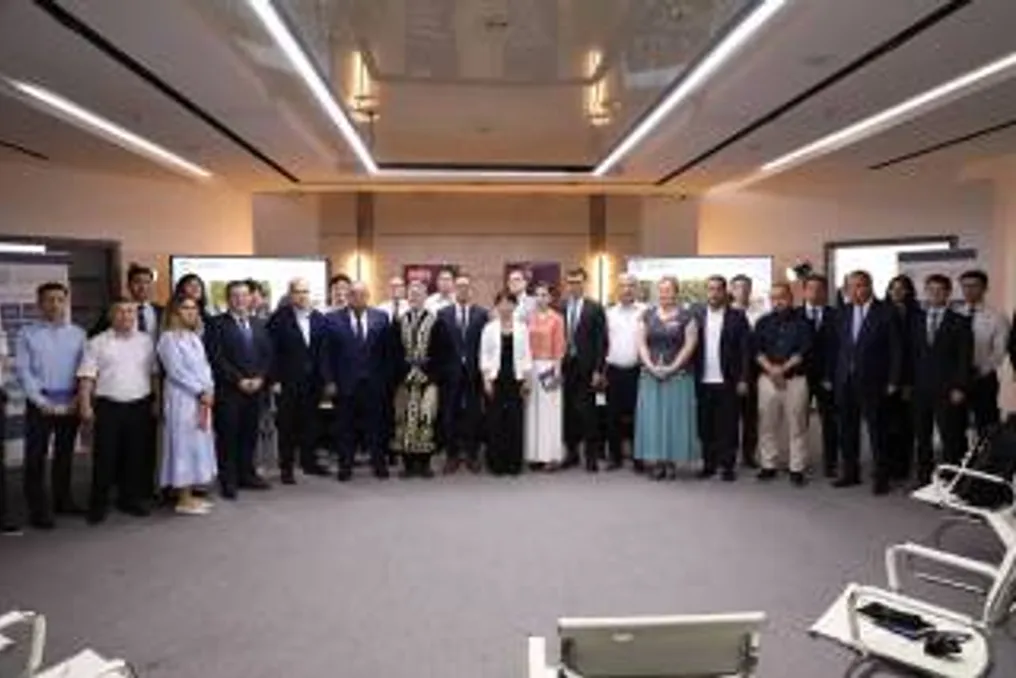
During an expert meeting held on July 11 at the Institute of Macroeconomic and Regional Studies, employees of the Institute of Strategic and Interregional Studies under the President of the Republic of Uzbekistan, Umarbek Nuriddinov and Kairat Akhmedov, participated. The meeting was held with Professor Jeffrey Sachs of Columbia University.
Jeffrey Sachs' Expert Status
Jeffrey Sachs is recognized as one of the most prominent specialists in modern economics and global development. He serves as the Director of the Columbia University's Center for Sustainable Development and has also worked as a special advisor to three UN Secretaries-General, having been president of the UN Sustainable Development Solutions Network.
International Project and Its Goals
Jeffrey Sachs' visit to Uzbekistan is part of the international initiative 'The Marco Polo Drive of Peace, Culture and Sustainable Development.' This initiative is a 43-day expedition along the Great Silk Road route from Rome to Hong Kong, aimed at promoting ideas of international cooperation, sustainable development, and Eurasian interconnectedness.
Key Theses on the World Economy
Speaking to experts, the professor outlined his views on the transformative processes in the world economy, the role of Central Asia in the emerging architecture of Eurasia, and the reforms being implemented in Uzbekistan. Sachs emphasized that the world is undergoing a period of profound economic change. He noted that the center of the world economy is gradually shifting towards Eurasia, restoring Central Asia's historical role as a space connecting East and West. If just a few decades ago the global economic center was located in the Atlantic region, today it is forming 'in a region very close to Uzbekistan.'
Uzbekistan's Potential in Eurasia
According to the professor, the active development of Asia is 'one of the most important economic processes of our time,' as this factor determines new directions for trade, investment, and transport connectivity. Sachs stated that under current conditions, Uzbekistan possesses a unique historical opportunity to become one of the leading centers for transport, logistics, investment, and tourism in Eurasia. He called this a 'great historical mission'—to be at the center of the world economy.
Cultural Heritage and Investment Climate
The professor also noted that the country's historic cities made a particular impression on him. He described Khiva, Bukhara, and Samarkand as 'absolutely unique and magical settlements,' emphasizing that the unique cultural landscape of Eurasia has been formed in these regions for centuries. Sachs acknowledged the effectiveness of the reforms being carried out in the country and noted the growing interest of international business circles in Uzbekistan. According to him, Tashkent is gradually turning into a hub for regional headquarters of international companies interested in operating along Eurasian transport corridors. As confirmation of this, he mentioned the high investor interest in the National Investment Fund and the significant subscription volume for shares during the Initial Public Offering (IPO) process.
Future Development Strategies
Discussing future vectors of national development, the professor proposed promoting a long-term industrial strategy of 'Made in Uzbekistan,' similar to China's 'Made in China 2025' program. He believes it is necessary to identify sustainable sectors that will ensure the country's competitiveness over the next 10–15 years. Sachs highlighted modern industries such as manufacturing, logistics, financial services, innovation, and electric vehicles, naming them priority areas. He stressed that Uzbekistan possesses all the necessary conditions and potential to become the largest industrial center of Central Asia in these fields.
Infrastructure and Regional Cooperation
In the professor's assessment, the Middle Corridor is becoming one of the most important transport routes connecting Europe and Asia. The implementation of infrastructure projects, including the construction of bridges across the Caspian Sea, provides the opportunity to turn this route into the fastest and most efficient transport path. Discussing the current state and prospects of Central Asia with CMTI experts, he highly praised the achievements of the region's countries in strengthening mutual partnership. Sachs noted that Central Asia is transforming into an independent regional community based not only on political negotiations but also on common institutions and cooperation mechanisms.
Proposals for Strengthening Regional Integration
Professor Sachs supported Central Asia's course toward openness and a multi-vector foreign policy, as well as the diversification of external ties. He believes that the region should forge its own development trajectory without becoming an arena for geopolitical competition. As a practical initiative to strengthen regional cooperation, he proposed considering the creation of a Central Asian Development Bank, which would function as a regional financial institution to support joint projects in infrastructure, energy, science, and technology. Furthermore, he advocates for developing transport connectivity in Central Asia, expanding partnerships in renewable energy, forming a unified energy space for the region, and uniting efforts in scientific research and innovation. In his opinion, joint investments by the five states in science and innovation could significantly increase technological progress and its scale.
Interaction with Neighboring Regions
Among the priority areas, the professor noted the need to strengthen Central Asia's ties with neighboring regions, including the South Caucasus and Afghanistan. He particularly emphasized the importance of the 'region-with-region' principle as the basis for stable diplomacy and economic integration. In conclusion, J. Sachs stressed that alignment on regional unity, openness, mutually beneficial cooperation, and leveraging Eurasian interconnectedness gives Central Asia a chance to occupy one of the leading positions in the world economy of the 21st century.